Jaw clenching · TMJ · Teeth grinding · Neck & shoulders
If you wake up with your teeth already clenched,
your jaw is not the problem. Here is what is, and how to switch it off in 4 weeks.
Why a night guard saves your teeth but never stops the clench, and the gentle release an acupuncturist who clenches her own jaw does before she sleeps, starting nowhere near your jaw.
"By week three my neck pain was surprisingly almost gone completely." Matina, Greece, in a Trustpilot review of a Neurotoned program.
See everything that comes with it
You wake up with your teeth already together.
Not sore. Just set. Like you have been holding something all night and nobody told you what.
You open your mouth slowly, testing it. Sometimes there is a click. Sometimes the hinge in front of your ear aches before you have said a word.

Then the inventory. Temples. Neck. The tops of your shoulders. The lower back, which will have its say the first time you stand up.
By eleven your shoulders are back up near your ears. By three there is a dull ache along your jaw and into your temple. By six you notice your tongue has been pressed hard against your teeth for an hour. You did not decide to. Somewhere you have read that it ends in cracked teeth, or a jaw that locks.
In the meeting you catch your teeth together and pull them apart. Four minutes later they are back.
At dinner you order the softer thing and say you are not that hungry. A crusty roll, an apple, a steak: each of them has a cost now, and you have been quietly paying it.
Your dentist has seen the wear. The flattened edges. The ridge on the inside of your cheek where you bite down. They made you a guard. You wear it, and you still wake up clenched. The Cochrane review of night guards found the same thing: a guard can save the teeth, and was never shown to stop the grinding.
You yawn carefully now, behind your hand, in two halves.
On Saturday there was something you would have said yes to. You did the arithmetic first. You know what the next day costs. You said no.
So you tried things. Properly.
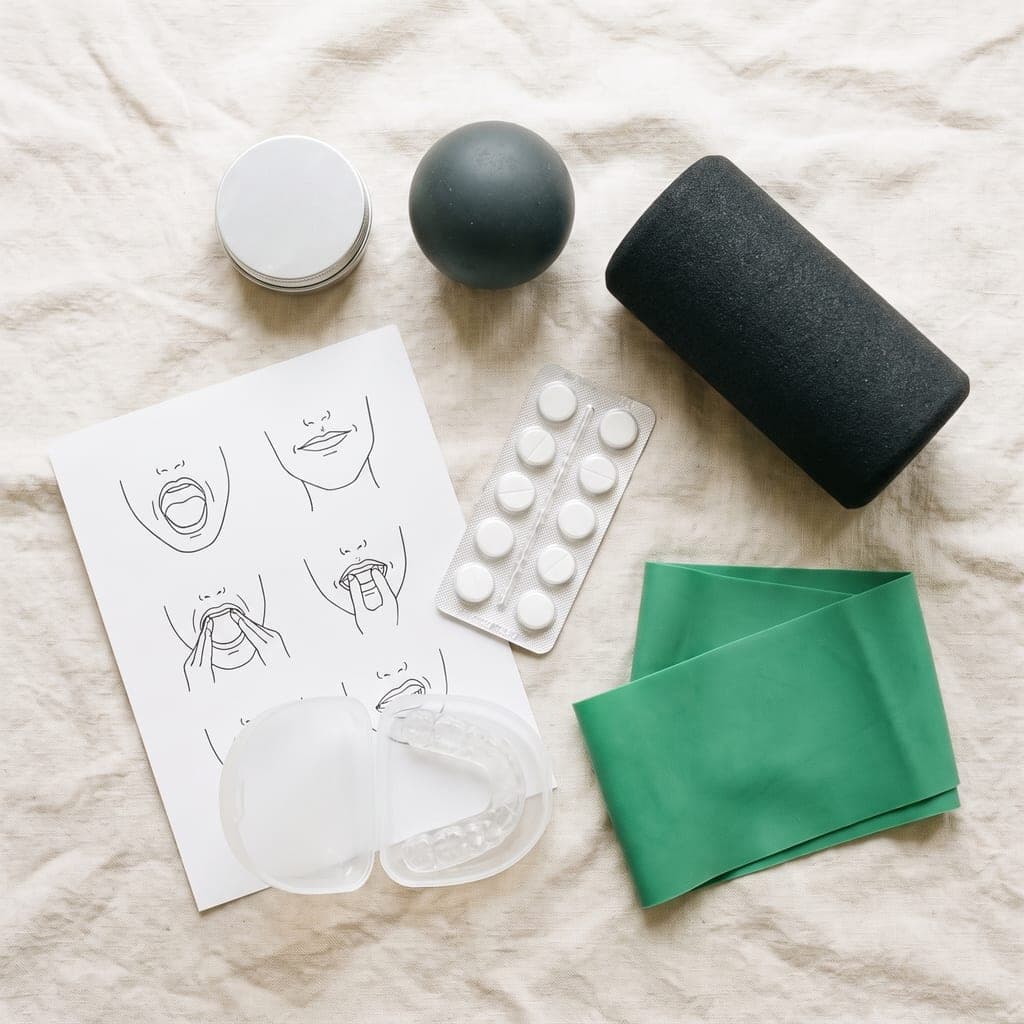
Massage for your jaw and neck that felt like relief while somebody's thumbs were in it and was gone by Friday. A foam roller for your upper back and a ball for your temples, pressed through the pain, because that was the instruction. Jaw stretches off a printed sheet, which bought you a little more opening and took it back the week you stopped. Anti-inflammatories, and once a course of muscle relaxants, for the bad weeks. Posture and strengthening work from a physio that made you stronger without making anything easier. You could add up what all of it has cost you by now. You have chosen not to.
Every one of them worked for a little while and then handed the tightness straight back.
And here is the part you do not say out loud. You are not really frightened of the stiffness. You are frightened that it is permanent. That this is your body now. That in five years it is worse, and the answer, when it finally comes, is one nobody can do anything about. You have already started leaving things out, quietly, one at a time, and nobody had to tell you to.
They scanned you. They checked you. Everything came back normal. That was supposed to be good news. What it actually left you with was no reason and no end date.
So read that list again, because it is not a list of your failures. It is a result.
Every one of them was aimed at the tissue, and every one wore off. They were all telling you the same thing.
The tissue is not the problem.
Nothing in you is torn. Your body is braced.
Bracing is not damage. It is a decision. Your nervous system's first job is to keep you safe, and when nothing has told it the danger has passed, it holds you tight as a precaution. Stiffer joints. Shallower breath. Movement it can pull back from quickly.
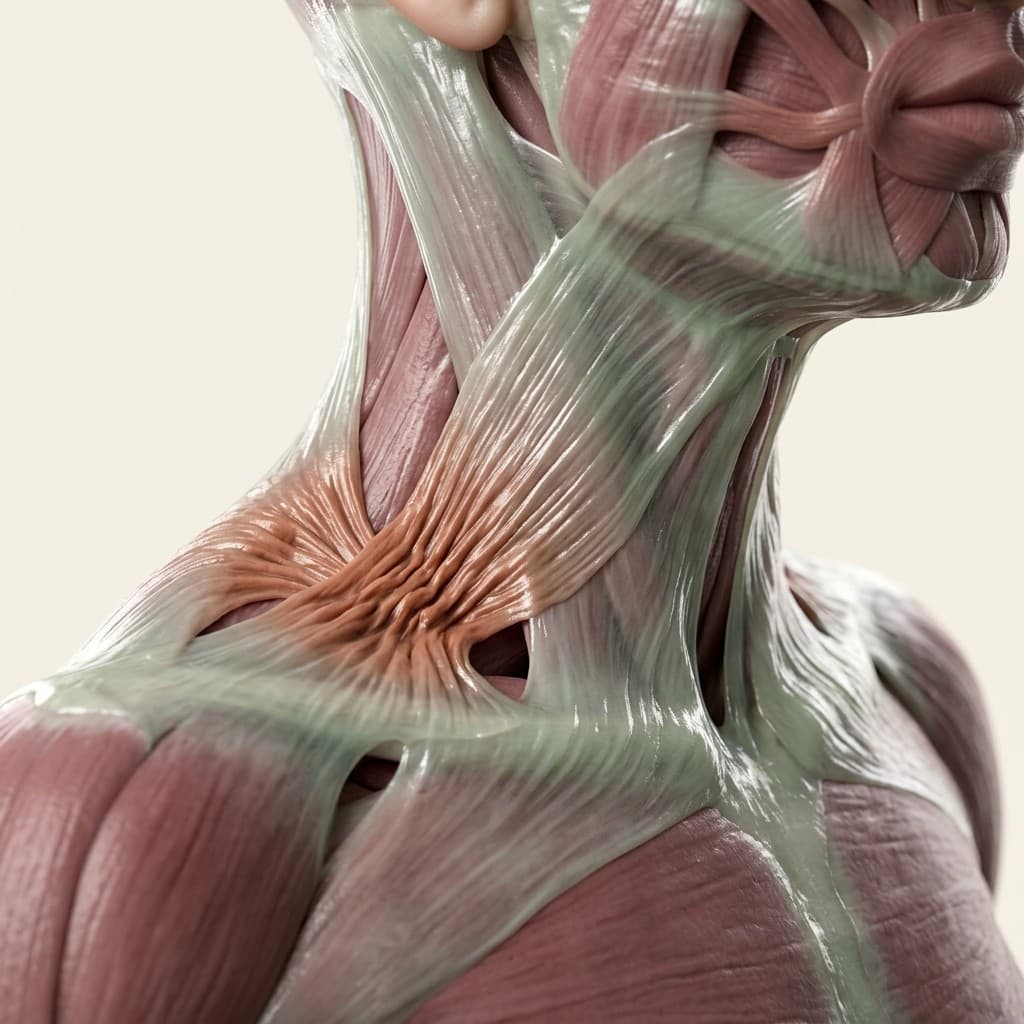
The fascia, the connective tissue web that runs from your scalp to the soles of your feet, then sets around the bracing. The way a hand held in a fist all day is not injured. It has just stopped remembering that it opens.
That is why nothing showed on the scan. A scan shows damage. It cannot show how hard your body is holding. There was nothing there to find.
And it is the only explanation that fits all of it. It explains the massage that wore off by Friday. It explains the roller that gripped harder the longer you rolled. It explains the stretch that held only while you were holding it. It explains getting stronger without getting easier.
It also means the thing you are most afraid of is not true. A brace is not degeneration. It is not the beginning of something. It is a decision your body is making today, and a decision can be changed.
You just cannot change it by force. That is the one thing everything you tried had in common.
What follows is how you change it instead. Why people under stress have about twice the odds of clenching. Why the fastest way to a soft jaw starts at the soles of your feet. And the jaw work the woman who teaches this does before she sleeps, because she clenches too.
The Research Caught Up
For most of the last century, fascia was thrown away
then anatomists went looking at what they had been discarding

In dissection rooms, the white fibrous sheeting that wraps every muscle was cut off and set aside to get a clean view of the muscle underneath. It was called packing material. Nothing in the textbooks suggested it did anything worth measuring.
That changed slowly, and then formally. In October 2007 the first International Fascia Research Congress was held at the Harvard Medical School Conference Center, bringing anatomists, cell biologists and manual therapists into the same room to look at the same tissue. Two questions dominated the field from that point on: what is fascia actually made of, and what governs how stiff it becomes.
Seven randomised trials of myofascial release for jaw pain from the chewing muscles, pulled together by a team in Italy in 2026: the release seemed to ease the pain and help the mouth open and work better. Early evidence, and promising. It is the method this program teaches, done for you in a clinic, on jaws like yours.
Ferrillo M, Calafiore D, De Rosa A, et al., 'Efficacy of Myofascial Release Therapy and Related Soft-Tissue Techniques for Pain in Temporomandibular Disorders: A Systematic Review of Randomized Controlled Trials', Journal of Oral Rehabilitation, 2026 (PMID 42458694)
Not enough evidence that a night guard treats grinding. What it may do is protect the teeth from wear.
Macedo CR, Silva AB, Machado MA, et al., 'Occlusal splints for treating sleep bruxism (tooth grinding)', Cochrane Database of Systematic Reviews, 2007 (PMID 17943862)
Pooling the studies of stress and teeth clenching and grinding, this review found that people under stress had about twice the odds of doing it. The grip is not a habit you failed to break. Stress and the clench go together.
Chemelo VDS, Né YGS, Frazão DR, et al., 'Is There Association Between Stress and Bruxism? A Systematic Review and Meta-Analysis', Frontiers in Neurology, 2020 (PMID 33424744)
Stecco spent years dissecting unembalmed bodies to document fascia layer by layer, and published it as a full atlas. The tissue turned out to be densely supplied with nerve endings, the receptors that report pressure, stretch and position. Fascia, on this evidence, is not the wrapping around the sensing organs. It is one of them.
Stecco, Functional Atlas of the Human Fascial System, Churchill Livingstone / Elsevier, 2015
The clench is a brace your nervous system holds, the fascia keeps it, and a slow, gentle signal of safety is what lets it go.
None of this has reached the woman lying awake with her teeth together. It sits in journals and anatomy atlases, not in anything you can do in a chair with a rolled hand towel at ten o'clock at night.
You have already tried the obvious things.
Every one of them was aimed at the wrong thing.
Find the tight spot. Push harder. Stretch further. Break up the knot.
That is the instruction almost everybody gets. You followed it. It teaches you to ask your body one question: how much can I take.
Every honest answer you gave made the bracing worse.
The instruction was wrong. You were not.
Something never gets called off
Stress, a strain, an old injury, years of sitting still. Nothing tells your body the danger has passed.
So the tone goes up
Your nervous system holds you tighter as a precaution. Stiffer joints, shallower breath, movement it can pull back from.
And the fascia sets around it
The connective web keeps the record of that tone. Not torn, not scarred. Shorter, thicker, and with less give in it.
Which is what you actually feel
Teeth already together in the morning. Shoulders up by eleven. Temples by three. A jaw that aches by evening.
And a guarded body is read as one more reason to guard. So it runs again.
Where the four weeks cut in
Slow, gentle pressure, away from where it hurts, timed with the breath going out. The tone comes down, and the web lets go.
Jaw massage and deep tissue. It works on tissue, by force. It genuinely changes how your jaw and neck feel for a day, and there is real relief in somebody's thumbs finding the exact spot. But think about what you did in that chair. You held your breath, and your teeth probably met while they worked. A held breath is your nervous system saying this is happening to me. Not: I am safe. So the muscle got pushed, nothing told the brace it could stand down, and by Friday you were waking up clenched again.
The ball on your temples and the foam roller. Same level, and this time you were the one pressing. Pressure is genuinely useful for finding where you hold. But you were told to press through the pain. Press hard into a jaw that is already guarding and the body reads it as one more thing to guard against. It grips. You were not doing it wrong. You were doing it to a place that had already decided it needed protecting.
Jaw stretches. Opening wide, holding, counting. Stretching works on length, and it is good for keeping range you already have. The opening went again the week you stopped because length was never what was missing. A braced jaw meets a hard pull by bracing harder. You were negotiating with the muscle. The muscle does not decide.
Painkillers and muscle relaxants. They work on chemistry and on how loud the signal is. They took the edge off a bad week, and there is nothing wrong with wanting a bad week to be shorter. They never touched why your teeth are together before you are awake. They quiet the alarm. They do not tell the body it is safe.
Chasing the sore spot. Reasonable, and it assumes the pain is where the problem is. So everything went to the jaw: the guard, the massage, the stretches. Fascia is one connected web, and it shares load. A jaw rarely clenches alone. It clenches with shoulders that never came down, a neck holding both of them and a breath that stops high in the chest. Work only the hinge and the rest of the brace hands the grip straight back to it. The pain stayed in your jaw because the reason for it was everywhere else.
Posture work and the physio's strengthening. They work on capacity, and strength is real and worth having. You got stronger. But strength does not lower resting tone. You added load to a body that was already holding itself together by force. Stronger, no easier, and the clenching carried on underneath.
Every one of them was aimed at tissue, at chemistry, or at capacity.
The brace is set a level above all three. It is set by a nervous system that still thinks it needs to protect you. So the question was never whether you were consistent enough or pressed hard enough. It was which level of you any of it was reaching.
Why the jaw lets go last
You cannot force a brace open.
You take away the reason for it, and it opens on its own.
Fascia is full of nerve endings. They report pressure, stretch, movement, and where your joints are.
They report to your brain all day, without stopping. Your brain uses those reports to answer one question.
Am I safe.
Muscle tone is the answer. Tone goes up when your brain thinks you need protecting. It comes down when your brain stops thinking that. As Theresa puts it, the nervous system sets muscle tone, and fascia keeps the record of it.
So the massage, the roller and the stretches were all pressing on nerve endings, and your brain read that pressure before any tissue was allowed to change. In 2003 the fascia researcher Robert Schleip made the case that slow, sustained pressure changes muscle tone through those nerves, not by force.
When the pressure is hard enough that you hold your breath, your brain gets one piece of information: it still hurts there, keep protecting it. Tone goes up. That is the correct response to what it was told. It is also the opposite of what you wanted.
Which is why this work runs the other way round. Three rules, and they are in every session.
One. Slow and gentle enough that you keep breathing. That is the test. Not how much you can tolerate. How much you can stay relaxed through.
Two. Work away from the sore place. A jaw that already hurts is sending a loud signal all day, and a little more pressure there does not change it. The soles of your feet are quiet. A small signal there is one your brain will actually notice. That is why the first week is your feet when it is your jaw that hurts.
Three. Time it with the breath going out. A slow exhale is itself a signal to settle. So you are not only choosing where to press. You are choosing when.
And this is why your jaw lets go last, not first. Your jaw is one stop on one web that runs from your scalp to the soles of your feet. Quiet the web from the bottom up, and the brace at the top has nothing left to hold on to. That is the order this program works in.
Here is the objection, and it is a fair one. Gentle sounds like nothing. Everything that ever helped you, even for two days, was intense. A rolled hand towel on the sole of your foot sounds like a waste of an afternoon.
That is the point. Intense is what your body has been reading as a threat for years. The question this program asks is not how much pressure you can take. It is how little you can use and still notice something change.
You are not forcing anything open. You are taking away the reason it is holding.
And you do not have to wait to feel it. Week 1 opens the minute you pay. In that first session you can feel your breath drop lower and your shoulders come down, before you have gone near your jaw.
See everything that comes with it
The Practitioner
Taught by an acupuncturist who clenches her own jaw:
Theresa Moodie
Theresa is an acupuncturist, a wellness coach and a qualified yoga teacher, with more than twenty years in health and wellness. She started as a personal trainer, worked in sports massage and Shiatsu, trains other yoga teachers, and studied acupuncture and Chinese medicine in Europe.
The acupuncture is where working away from the pain comes from. A practitioner trained in Chinese medicine does not spend her days pressing on the spot that hurts. So when the program starts at your feet, that is not a trick she read somewhere. It is how she was taught to look at a body.
The yoga is where the breath comes from. Five seconds in, five seconds out. The squeeze timed to the breath going out. It is why the pacing is unhurried, and why she keeps saying notice instead of push.
At the moment your instinct says lean in harder, the line she comes back to is the whole method in one line: slower is often more effective than deeper.
And the jaw is personal. "Many of us hold stress here without even realizing it," she says in Week 4, and she is one of them. With her fingers in front of her ears she tells you: "I like to do this before I go to sleep because I clench my jaw and it helps to cue the muscles to relax, gives them permission to soften, creates a little bit of space between the teeth."
Inside the program
Myofascial Release: Restoring Ease to the Body
four weeks, a hand towel, and teeth that finally come apart

Five sessions, a workbook and a 5-minute jaw card. Watch lying down, in pieces, as slowly as you like. Nothing in it asks more of you than making a cup of tea. It quiets the whole web in order, the quiet places first and the jaw last.

The session with no practice in it
Nothing is asked of your body. Theresa names the tools (a rolled hand towel, your hands, a massage ball, the back of a spoon), tells you what release actually feels like, and walks the safety guidance before you touch anything. The rule from here on: slow down rather than work harder, and never tolerate real pain to get a result.
Starting where it doesn't hurt
Why the first week never touches your jaw, and why that is the fastest way to it. The soles of your feet, your calves, your forearms, sitting in a chair. Then you stop and notice what your breath and your shoulders did on their own.
Why pulling harder made it worse
Why opening wide off a printed sheet bought you a little space and took it back: a body that feels unsafe answers a hard pull by pulling back. Then the opposite of what you were told, along the tops of the shoulders, where a clenched jaw keeps its other half.
Getting the breath to the bottom of your ribs
The breath that stops high in your chest is part of the clench. This week brings it down to the bottom of your ribs, then closes with five seconds in and five seconds out, counted for you.
The sequence you keep, soles to jaw
Everything builds to this: feet upward, stop by stop, and at the top, the jaw work Theresa does herself before she sleeps, with an ordinary kitchen spoon. This is the one you keep for the nights your teeth come together.
The practices that are not in the videos
Not a summary of the sessions: a second set of practices the videos never teach, two for every week. It opens with eight statements you score out of ten and closes by asking you to score them again, so the month has a before and an after, and it is yours.
Soothing Jaw Tension, TMJ & Clenching
A session built for the jaw alone, in your library on November 1st. Lifetime access, so it arrives with no second payment.
What four weeks give back
The mornings you get back
start with a little space between your teeth.
Here is what changes when the brace comes down, in the order it arrives. The first ones start in week one.

No appointment, nothing to swallow, nothing to book. A body that no longer needs to hold on. Below are reviews of Neurotoned programs, the 30-Day Program among them, which comes free with this one.
See everything that comes with it
Verified reviews
What people say about Neurotoned
in their own words.
Public reviews, left on Trustpilot by members who were not asked to write them, and quoted here exactly as they were written.
... By week three my neck pain was surprisingly almost gone completely. ... I feel calmer and l think I got out of the fight or flight mode. ...
When all else failed, the 30 day Neurotoned program brought me back to an even better place than before. At 67 years old, I experienced a shoulder injury. Then, over the course of a year my whole body gradually broke down. Chronic pain wore me down ... I was losing hope. There had to be a better way. Neurotoned was the way. The gentle breathing exercises, meditation, yoga, art and music therapy, along with the amazing support from Neurotoned and Community enabled me to truly heal and my life is now more meaningful and peaceful than before and I am pain free. ...
... I am really enjoying the slow and gentle nature of this course. Usually I try and do do do but this is encouraging me to slow down and lean into the calm feeling that slowness brings. ... where I previously felt overwhelmed and stressed, my body is slowing beginning to find a new pattern. ...
... The neurotoned experience helped he a lot after being stuck for over 5yrs in survival mode. My shoulders are more relaxed, my chest less tight ...
Living with chronic pain for the last 35 years this was a new amazing experience. What touched me the most was the personal interaction and letting me know in a gentle, loving and professional way that I am understood and not alone. The option to choose what resonates with you and having no pressure makes the program enjoyable.
I have done a few weeks into this course and already very helpful, feeling my body relax, also feeling much safer, wasn’t aware how bad a state I was in… Due to my health and time being limited I enjoy that it is not strict times, instead you get to go through at your own pace
The Program
Myofascial Release: Restoring Ease to the Body
Taught by Theresa Moodie, acupuncturist, wellness coach and qualified yoga teacher.
You could book a jaw massage instead. An hour in the diary, the travel both ways, somebody good working on you, and you walk out looser. By Thursday your teeth are together again. Not because they were bad at it. Because the change happened in their hands, not in your nights. Your jaw does not clench by appointment. A brace comes down when the signal arrives often enough to be believed, which means it has to be yours. That is why this is a chair, a towel and five minutes, for one payment.
Everything, today
The full four-week program.
Yours for life.
Why it is priced the way it is.
One hour of myofascial release in a clinic costs more than this whole program, and by Thursday it has worn off. This is yours for life, for one payment, and it is in your hands every night your teeth come together.
In context
- A custom night guard from a dentist: often hundreds, and it protects your teeth, not your sleep
- A jaw massage every few weeks: much the same, for as long as you keep booking
- Muscle relaxants for the bad weeks: they quiet the alarm, and the clench is back when they wear off
- Another year of waking up with your teeth together: free, and you know what it costs
What happens when you click the button.
You click. You enter your email and pay on the Neurotoned checkout. There is one short page after that, with an offer you can skip, and then you are in your members area. The whole program is yours from the first minute. Tonight you can be in a chair with a rolled towel under your foot, and print the jaw card for your bedside table.
Today: $16.99
One payment. Lifetime access to the program. 30-day guarantee.
The guarantee, in plain terms.
You have 30 days. No log of what you practised and when, and nobody checking up on you.
If it is not for you, email support@neurotoned.com and we refund what you paid. No form. No retention call. Nobody asking you to explain what did not work, or offering you a pause instead of the refund you asked for. You do not owe anyone a reason, including us.
A person replies, and the answer is yes.
We ask one thing, and it is the thing we would ask if you rang us: watch the introduction and the first week, and give the towel a few honest days on your feet and calves. Not to prove anything to us. Most of what this does happens quietly, and a few days is about how long it takes to notice whether your breath is sitting lower and your shoulders are further from your ears.
From here, the choice is yours.
You can close this tab and go back to the version of your nights you have been living in: teeth together before you are awake, the guard, the careful yawn, the arithmetic before every Saturday. Nobody here is going to argue with that.
Or you can press the button, sit down with a rolled towel tonight, and find out what your jaw does when the rest of you stops bracing. If yours is one of the bodies that does not answer, the 30-day refund is there for exactly that.
One payment. Lifetime access to the program. 30-day guarantee.
The questions you would ask if we were sitting down,
answered plainly.
I clench my jaw, and a dentist said TMJ. Is this for that?
It is built for the clench underneath it. What this program works on is the holding: the jaw, and the neck, shoulders and breath a clenching jaw never works without. Week 4 works your jaw itself, gently, with the same spoon Theresa uses before she sleeps. The 5-minute jaw card goes by your bed. And a session built for jaw tension, TMJ and clenching arrives in your library on November 1st. It does not replace your dentist or your night guard: keep the guard for your teeth. A jaw that locks, a bite that has suddenly changed, or pain after an injury is a question for your dentist or doctor first.
My body already punishes me for doing too much. Is this going to cost me the rest of the week?
The gentlest week asks less of you than drying the dishes. Week 1 is your feet, your calves and your forearms, sitting in a chair. If that is still too much today, you do the soles of your feet and you stop. Theresa's test for pressure is that you can breathe normally, stay relaxed and stay present. The second you are holding your breath, the pressure is wrong and you ease off.
I've done deep tissue and foam rolling. Why would something this gentle do what the hard stuff couldn't?
Because the hard stuff was aimed at your tissue, and your tissue is not what is holding on. Tone is set by the nervous system, and pressure hard enough to hold your breath through raises it. That is why the sequence starts at your feet when it is your jaw that hurts.
I already have physio, or yoga, or a class. Will this get in the way?
It sits underneath them rather than competing. It is not exercise. There is no loading and no stretching to end range, and it is built to be done sitting down with a towel or your own hands. Plenty of people use it as the thing they do before a session, or in the evening after one. Take extra care if you are on blood-thinning medication, bruise very easily, have clotting or circulation problems, are pregnant, have osteoporosis, have had recent surgery or an injury, or have unexplained or severe pain. The introduction lists all of it plainly and you can read it before you decide anything.
How long before I feel something different?
Often in the first session. After the soles of your feet you stop and check whether your breath is sitting lower and where your shoulders are. The jaw card's check is the space between your back teeth. Theresa is blunt that release is usually quiet. The bigger changes, waking without your teeth together, a yawn that just happens, deeper sleep, build across the four weeks.
And if it does nothing for me, do I have to argue for my money back?
No. Thirty days. Watch the first session and give the towel a few honest days. If it is not for you, for any reason, email support@neurotoned.com inside the thirty days and you are refunded what you paid. No threshold to reach. No form defending your effort.
One payment. Lifetime access to the program. 30-day guarantee.
P.S. If you scrolled straight here, this is the whole thing in one paragraph. Your jaw is not damaged. It is braced: a decision your nervous system makes when nothing has told it the danger has passed, and the fascia sets around it. People under stress have about twice the odds of doing it, and a night guard was never shown to stop it. This is Theresa Moodie's four-week program for the opposite: slow, gentle, starting at your feet, ending at the jaw work she does herself before she sleeps. A rolled hand towel, a chair, the 5-minute jaw card, one payment, lifetime access, and thirty days to change your mind.
P.P.S. Tonight your teeth will come together again. You can spend that night with a rolled towel and the jaw card, at the price on the button while the timer runs. The 30-day program Elizabeth talks about above comes free with it, and the jaw session arrives on November 1st for everyone who is in.
P.P.P.S. Any question before you decide, or after, the address is support@neurotoned.com.