For women with ADHD who get it all done at the last minute
ADHD? If panic gets you started,
it's also why you crash.
One fuel does both. We call it Panic Fuel, and it holds your body's brake off.
In four weeks you start the form, the email, the work, days before it's due. No 11pm sprint. No two days on the sofa after. Planners work on your to-do list. This works on what starts you.
Your teacher is Kristin Loeer, a UKCP-accredited psychotherapist and Somatic Experiencing practitioner with more than 15 years of hands-on body work. Neurotoned has helped more than 100,000 women.
See everything that comes with it
Nothing gets done until it's an emergency.
Then it all gets done at once, and you pay for it for days.
It's nearly 11pm. The thing you've had two weeks to do is due in the morning. All day you knew it was there. You looked at it. You tidied the desk instead. You answered three easy emails and scrolled for an hour you can't account for. You called yourself lazy at least twice.
Now your heart is going fast, there's a third coffee next to you, and you are finally moving. Fast, sharp, almost brilliant. By 2am it's done.
Then comes the bill, the crash many women with ADHD call burnout. The next day you're flat. The washing sits in the machine until it smells. Texts go unanswered. You lie on the sofa with your phone, knowing exactly what needs doing and unable to make your body do any of it. Some people call it ADHD paralysis. And the voice starts again: what is wrong with you?
If you have ADHD, you know this loop. Nothing until it's urgent. Everything at once. Then nothing again. People see a procrastinator who chose to leave it all to the last minute. They don't see that the last minute is the only time your body would let you start.
It isn't only the big deadlines. It's the form that sits on the side for a month. The dentist you still haven't rung. The day with one appointment at 3pm, gone, because you couldn't start anything before it. The pile on the chair you've stopped seeing. The work you'd do in an hour for someone else and can't start for yourself. Other people seem to just do these things. Maybe the diagnosis finally came in your forties and explained a lot. It still didn't get the form filled in.
The cost is more than one late night. The ADHD tax. Late fees. Missed renewals. The subscription you forgot to cancel. Weekends spent recovering. Plans cancelled. No patience left for the people you love. The quick, funny, generous version of you disappears for days at a time. Worst of all, you stop believing you're a capable adult.
And in your forties or fifties it gets harder. In a 2025 study of more than 5,000 women in Iceland, published in European Psychiatry, over half of those with ADHD had severe perimenopause symptoms. Without ADHD, it was three in ten. The rush doesn't come like it used to. The crashes last longer. The thing that carried you for thirty years is running out, and nobody has told you what to run on instead.
Why every fix lasted a week.
So you've tried things. Planners. Timers. Apps. Body doubling. Fake deadlines. "Don't sit down until it's finished." A new system every January. Productivity videos at 1am. An ADHD book or two. Maybe coaching. Each worked for a week, maybe two. Then it stopped, and you blamed yourself again.
Your discipline was fine. Look at that list again. The tricks that worked best were fake emergencies. Each one works by scaring you into motion. It's the same fuel you were already running on. We call it Panic Fuel. And a scare stops working once you're used to it. You know the fake deadline is fake. That's why each one wore off, and why you crashed after.
What the research found
At 11pm you feel brilliant.
Then your body sends the bill.
You were told you were lazy. Two research papers on adults with ADHD, one pooling more than half a million of them, found something else: far more anxiety, and far more exhaustion.
Adults with ADHD are far more likely to also live with an anxiety disorder. Across more than half a million adults with ADHD, the odds were about five times higher than for adults without it.
Hartman CA et al. Neurosci Biobehav Rev 2023;151:105209. PMID 37149075.
In an outpatient sample of 243 adults with ADHD, 62% met the bar for significant fatigue, more than the healthy adults they were compared with.
Rogers DC et al. Br J Clin Psychol 2017;56(1):33-52. PMID 27918087.
Anxious and exhausted. That isn't what lazy looks like.
So why the crash, and why was it never your fault?
Why you crash after the sprint.
Panic takes your brake off.
Key idea
The panic that gets you started is what crashes you. That's Panic Fuel. Change the fuel and the crash goes with it.
Years ago you found the one thing that reliably got you moving: alarm. A deadline tonight. A fake one. A voice in your head calling you useless. The third coffee. Dr William Dodson, an adult ADHD psychiatrist, calls the ADHD brain an "interest-based nervous system". It gets going on interest, novelty, challenge or urgency, and "this matters" isn't on the list. On a boring form, urgency is the only key left.
Your body also has a brake. It's the vagus nerve, the nerve that slows your heart and tells your body the emergency is over. Urgency takes the brake off. Heart racing, jaw tight, wired, and no way to slow down until you hit the wall.
Your brake isn't broken. Alarm keeps taking it off. And if alarm is how you start most days, it's off most days.
While the brake is off, you can't recover. You burn hot, and when the alarm runs out, nothing is left. That's the crash. The frozen hours on the sofa, the flat Saturday. Dr Russell Barkley, author of the book Taking Charge of Adult ADHD, puts it this way. ADHD is a problem of doing what you know, not of knowing what to do. That's the sofa. You know exactly what to do, and you can't move.
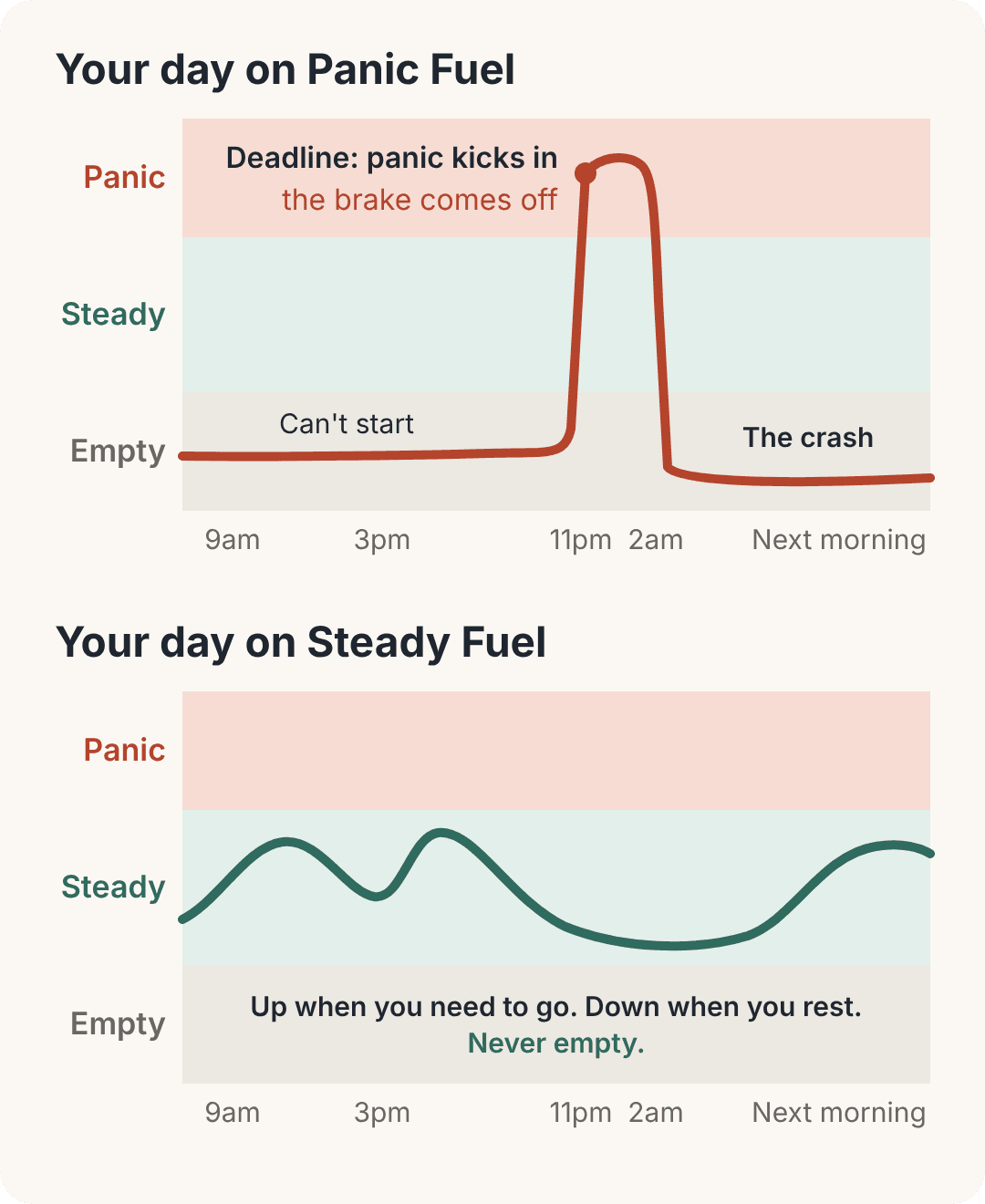
Then the crash brings the shame, and the shame is the next alarm. Panic, push, crash, shame, panic.
Now the things you blamed yourself for make sense. Nothing starts until it's urgent, because urgency is the only fuel you've had. You're tired all day and wired at night, because panic keeps taking the brake off. Your inner critic is so loud because it's fuel. Every "what is wrong with you?" is one more alarm, its way of trying to get you moving. And you feel guilty the second you sit down, because to the part of you that runs on panic, rest feels like stopping for good.
None of it is your fault. You needed something to get you going, and panic was the one fuel that always worked. It's the fuel, not you. And fuel can be changed.
Nothing you tried changed the fuel.
The part of you that pushes can learn to start you without panic.
Every ADHD tool you've tried works on the task. Plan it, time it, chunk it, set a deadline for it. None of them works on what starts you. If you take medication, keep taking it. If you still only start when it's urgent, the loop is still running, and this works on the loop.
The way in is Somatic Parts Work, the method Kristin teaches ("somatic" just means through the body). It treats the loop as two parts of you, the two voices you already argue with every day. One is the Pusher, in Kristin's words "the part that doesn't let me rest, the part that is keeping me buzzing and active, but also gets me out of bed". The other is the part that crashes, the Exhausted One. The hours you can't start are the Exhausted One, still flat from the last push. The 11pm sprint is the Pusher, finally scared enough to drag you up. In Week 1 Kristin says it outright. "There are no bad parts."

This is the part no planner reaches. The Pusher runs on fear. In Kristin's words, "I'm worried that if we stop or we slow down, we will be left behind. We will never get up again." It never lets you truly rest, in case you never get up. It keeps you buzzing all day, but it won't trust a calm start, so it holds off until a deadline scares it. That scare is the panic. "So it's not about you being weak or lazy or anything like that," Kristin says.
The secret Kristin tells you in Week 3. Both parts want the same thing. In her words, "Both your parts want you to be safe." The Pusher keeps you moving to keep you safe. The Exhausted One hides away to keep you safe. Once you see that, they stop fighting, and you stop fighting yourself.
Don't fire the Pusher. Make a deal with it. It got you through school, work and every crisis. In Week 3 the Pusher names its terms: "I need to be sure that if we do rest, we will get up again, because we need to do things." So Kristin offers it a deal it can say yes to. One minute of true rest, with a promise to get up when the minute is over. Keep the promise, and the Pusher learns that rest doesn't mean stopping for good.
Why a rest deal fixes starting. You can't start in the morning because the Exhausted One is still flat from the last sprint, and the Pusher won't move until it's scared. The deal fixes both. The Exhausted One gets real rest, so there's fuel in the tank. The Pusher gets proof you'll get up, so it doesn't need a scare.
That's Steady Fuel. You keep the drive. You lose the panic. And the crash goes, because there's nothing left to crash from.
Try the 60-second check-in now. It's from the workbook, and you can do it before you finish this page. Put a hand on your heart and ask who's here right now, the Pusher or the Exhausted One. If it's the Pusher, soften your jaw, breathe out for 6 counts and press your feet gently into the ground. If it's the Exhausted One, widen your chest, roll your shoulders back, lift your gaze a little and breathe into your belly. Then say: "We're on the same team." The long out-breath puts the brake back on. Across 223 studies, slow breathing raised vagus nerve activity (Laborde and colleagues, Neuroscience & Biobehavioral Reviews, 2022).
Then pick today's one thing. Write down three things that matter to you and one small step for each. Ask the Pusher: "Which action feels satisfying today?" Ask the Exhausted One: "Which feels gentle enough to do?" Do the one that answers both. A to-do list only asks the part that pushes, which is why the Exhausted One stopped you before you began.
One Neurotoned member wrote on Trustpilot: "... I see now when I'm holding or bracing or rushing or have underlying anxiety and I now have a variety of tools to use to calm and shift back ..."
Why it suits a brain that can't sit still. No silent meditation, no hour to find. Each session is short, and you move. You rock, you shift, you notice what your shoulders and hands are doing. Kristin tells you to get up and take a break whenever you need one.
In four weeks you get your days back. Here's one.
It's 10am. The form that has sat on the side for a month is on the table, and nothing about it is due today. You feel the old tightness start in your chest, the one that usually means you'll leave it till tonight. This time you rock in your chair for a few slow out-breaths until it eases. You ask the two questions and pick the step both parts will say yes to: just the first page. You do the first page. Then the second. By lunch it's in the post, and nobody had to scare you. You stop at 4pm because you said you would, and you have something left for the evening. You sit down without the guilt. You get back up without the panic. Same brain. No crash.
See everything that comes with it
Your teacher
Kristin Loeer,
who helps train Somatic Experiencing therapists.

Kristin Loeer is a UKCP-accredited psychotherapist, on the UK Council for Psychotherapy's register. Psychotherapists on it train for four years at postgraduate level, and the register is accredited by the UK's Professional Standards Authority. For more than 15 years she has also worked hands-on with bodies under stress and in pain, as a Somatic Experiencing practitioner, a movement specialist and a manual therapist. Today she works with people who are burnt out, exhausted or anxious, the people on this page. A private 50-minute session with her costs £90.
Somatic Experiencing is the body-based trauma method Dr Peter Levine developed. Therapists train in it worldwide, and Kristin assists on those trainings in the UK and Europe. She blends it with Parts Work, the same family of therapy as Internal Family Systems, the approach in the book No Bad Parts.
Kristin made this programme for the push and the collapse: the sprint, the crash, and the stuck place in between. In her words, "a part of us is still like, we've got to fight all these tigers." She works through the body as well as words. Week by week she has you notice how each part shows up in your posture and your sensations, the "prickly, buzzy thing" of the Pusher and the heaviness of the Exhausted One, and work with what you find.
She doesn't teach by forcing, or by pushing through. "If you feel like you're getting anxious or really stressed out, it's not about pushing yourself through this. Tell that to your pushing part." If it gets too much, she tells you to stop, "get up, have a walk around, leave it till tomorrow". That matters with ADHD. The courses you quit asked you to sit still and push through. This is a course you finish.
The four weeks
Four short weeks,
from the ADHD push and crash to steady days.

Kristin calls this loop burnout, so that's the word on the session titles. A short welcome, then one session a week, each about 15 to 20 minutes in a chair. Pause any time. Yours to keep.
Introduction To Somatic Parts Work For Burnout Recovery
Under two minutes. What the four weeks are for, and why Kristin wants you to honour what you have in you that day, "even if it's tiny".
Week 1: Meeting The Push & The Collapse Of Burnout
Why you can feel exhausted and wired at once, and stuck between the two. Meet the Pusher, the part that won't let you rest, and the Exhausted One, in your body, not just in your head. You learn to feel which one is driving, and how to give the wired one an anchor so it doesn't take off.
Week 2: Dialoguing With The Parts
The one question Kristin asks each part, and why the Pusher thinks rest is too risky. If a voice has called you lazy since your school reports said "could try harder", you ask the Pusher what it needs and hear what it has been trying to say.
Week 3: Negotiating With Your Parts
Why both parts want the same thing, to keep you safe. A small rocking move you can do in your chair any time, to settle a racing body. And the one-minute deal your Pusher will agree to, the first real rest you've had without guilt. Keep it, and the Pusher learns a start doesn't need an emergency.
Week 4: Integrating Your Conflicting Parts For True Rest
For the days you're wired and tired at once. Rest while you're awake and sitting up, a short movement both parts share, and a day shaped so the Pusher feels safe enough to let you stop.
The companion workbook
Eight short practices for between sessions, among them the 60-second check-in, the two questions that pick today's one step, and the menu of tiny rests your Pusher will allow.
Where you are, and where you're going
Four weeks from now,
the same drive, without the crash.
The work still gets done. You just stop paying for it.
See everything that comes with it
Verified reviews
What people say about Neurotoned
in their own words.
Public reviews, left on Trustpilot by members who were not asked to write them, and quoted here exactly as they were written.
... Naturally, I couldn't get myself in gear, and didn't start. ... It's super simple, smaaaall baby steps, I can manage to motivate myself daily even if it's just for a few minutes. I am still at the very beginning, but am so happy to have found Neurotoned where they don't powersell, I feel seen and taken care of and don't feel pressure to rush into things. ...
I learnt so much about our nervous system . ... Not easy to navigate site , as an adhd lady, but that’s just my wiring. ... A very healing & worthwhile course.
... I didn’t start right away. ... I could barely focus on starting anything new and then received the loveliest email from one of the Neurotoned guides. No pressure at all; she assured me that starting when I could would be good enough, no reason to feel guilty for not having started. A couple of days later I started with the first session and followed through each day thereafter. ... Neurotoned is making a difference for me. If you’ve read this far, get off the fence and give this a go!
... I am really enjoying the slow and gentle nature of this course. Usually I try and do do do but this is encouraging me to slow down and lean into the calm feeling that slowness brings. ... I have had much more success going back to work since starting these practises - where I previously felt overwhelmed and stressed, my body is slowing beginning to find a new pattern. ...
I think this is a really great program. After just 14 days, I already felt calmer, less overstimulated, and slept better. ... It feels achievable. ...
If you feel tired, stressed, anxious, burned out and demotivated to step out from this exhausted circle, these beautiful people from Neurotoned help you with simple but meaningful small steps. ... Nobody is pushing you, you can do it in your own pace. ...
The programme
Steady Fuel,
yours for life.
Everything you need to start early and stop the ADHD crash.
Steady Fuel
Somatic Parts Work for the push and the crash
taught by UKCP-accredited psychotherapist Kristin Loeer
Why it costs
so little.
Its list price is $70. We sell it for $16.99 on purpose. We'd rather thousands of women stuck in this loop had it than a handful who can pay for weekly sessions.
Another month of 11pm sprints costs nothing up front, and you know what it costs after.
One Neurotoned member wrote on Trustpilot: "I don't normally buy things I see in Facebook ads; but this talked about a lot of things I was experiencing, ... It wasn't too expensive and once purchased you get the content for life. ..."
Finding out costs $16.99, once, with 30 days to change your mind.
What it costs to stay stuck, and what this costs:
- One private 50-minute session with Kristin: £90, about $120
- Weekly ADHD coaching: often $200 to $700 a month
- The ADHD tax. One late fee, one missed renewal, one forgotten subscription. Any one of them can cost more than this programme
- Steady Fuel and its workbook: $16.99, once, yours for life
What happens when you press the button
You go to a secure checkout and pay once. All four weeks and the workbook open the moment you pay. You can do your first check-in within ten minutes. Do them all tonight or one a week. An email follows with how to sign in on any device. In your library it is called Somatic Parts Work For Burnout: Healing The Push And The Collapse. Steady Fuel is one payment, nothing recurring, nothing to cancel.
Regular price: $70 → Today: $16.99
One payment. Lifetime access to the program. 30-day guarantee.
Still running on panic after 30 days? Every cent back.
Start Week 1 today. By the end of that week you can tell in 60 seconds which part is driving, and catch the crash coming while you can still stop it. By Week 3 you have the one-minute deal that lets you rest without guilt and get back up with no deadline behind you.
Try it for 30 days. If it isn't for you, email support@neurotoned.com and we refund every cent. No conditions, no questions.
We would rather you tried it and decided it wasn't for you than spent another year of 11pm sprints.
You've spent years getting things done the hard way, with ADHD and a deadline at your back.
Running on Panic Fuel. Sprinting at midnight. Paying for it for days. Calling yourself lazy for the crash and brilliant for the sprint, when they were always the same thing. None of that was your fault. You used the only fuel that worked.
Now there is another fuel. You start without the scare, with the part of you that pushes on your side. Four short weeks to learn it. The next time the deadline is days away, you start anyway. The work gets done. The evening is yours. The weekend is yours. And the voice in your head stops calling you lazy. You were a capable adult all along. You were running on the wrong fuel.
One payment. Lifetime access to the program. 30-day guarantee.
If it's late and the list is still waiting,
Press the button below and start Week 1 tomorrow morning, before anything is due. It's one short session in a chair. And if it isn't for you, you get your money back.
One payment. Lifetime access to the program. 30-day guarantee.
Honest answers,
before you decide.
Is this an ADHD programme?
Yes. It's for women with ADHD who live the push and the crash. Kristin made it for that loop. She calls it burnout and doesn't say ADHD in the sessions. The loop is what she works on, whatever you call it.
I have ADHD and can't sit still for meditation. Will I manage this?
This isn't sitting still in silence. You move, you rock, you shift between postures and you talk to parts of yourself. Each session is about 15 to 20 minutes. Kristin tells you to stop, get up and make a cup of tea whenever you need to.
Talking to parts of myself sounds a bit much. Is it?
You already do it. One voice says get up and get it done; the other says you can't. Kristin has you notice which one is talking and what it needs, in a chair.
Will I lose my drive?
No. Kristin never asks you to get rid of the Pusher. It's the part that gets you out of bed. You learn to make a deal with it, so you keep the drive and lose the panic.
I have ADHD and never finish courses. Why would this be different?
The welcome is under two minutes and each week is one short session. Between sessions you don't need an hour. The workbook's 60-second check-in is for the moment you feel the loop start. You don't have to do it perfectly. Kristin tells you to go at your own pace and honour what you have in you that day, "even if it's tiny". It's yours for life, so if life gets in the way you pick up where you left off, with no subscription running in the background.
I take ADHD medication. Can I still do this?
Yes. This is a self-help programme, not a medical treatment, and it doesn't replace anything you've been prescribed. Keep taking what you take, and talk to your prescriber before changing anything.
I'm not diagnosed. Is this still for me?
If you know the push and the crash, yes. You don't need a diagnosis to learn to start on something other than panic. Many women find their old ways of coping stop working in their forties, whatever the reason.
I was diagnosed late. Is it too late to change how I work?
No. Whenever the diagnosis came, the loop is what you live with now, and the loop is what these four weeks work on. You don't have to go back over your childhood to make a deal with the part of you that pushes today.
Can't I just do some breathing from YouTube?
Slow breathing helps the brake, and the workbook builds it in. But a video won't help you talk to your Pusher, or make a deal it will keep. That's what stops the loop, and that's what these four weeks teach.
Is it safe for me?
It's gentle, and you are in charge of the pace. If anything feels like too much, Kristin's advice is to stop, get up and come back another day.
Who is this not for?
It isn't for you if you want a medical treatment or a replacement for your doctor, or if you are in crisis. If you feel unable to cope, contact your doctor or a crisis line now. If you want to work through painful memories, do that with a trained therapist. It is for you if you're tired of the 11pm sprint and the two days after.
How fast will I notice a difference?
In the first week. Week 1's workbook pages give you the 60-second check-in, and the change starts there. You catch the loop while you can still turn it. By Week 3 you have the deal that lets you rest without guilt and get back up without a deadline. By Week 4 you're steady through the day.
Is there a subscription?
No. Steady Fuel is one payment and yours for life, with nothing to cancel. At checkout you may see one optional set of three more programmes to tick or leave, also one payment. Straight after you pay, you may be offered a 7-day free trial of the full Neurotoned membership, which becomes a monthly plan unless you cancel. One tap says no thanks and changes nothing about what you bought.
One payment. Lifetime access to the program. 30-day guarantee.
P.S. If you have ADHD, the next deadline is already coming. Let panic start you and pay for it after, or pay $16.99 once and spend four short weeks learning to start without it. Lifetime access. 30-day refund.
P.P.S. Not sure? Press the button, watch Kristin's welcome and do Week 1 tomorrow morning. If it isn't for you, email us within 30 days and get your money back.