Your scans are fine. Your body still hurts.
Back, neck or jaw pain that never fully leaves.
Headaches most weeks. Fibromyalgia. Pain that moves from place to place.
Pain that stayed long after the injury healed.
It isn't new damage. It's one hidden loop keeping all of it switched on, and your body can switch it off.
Why your tests keep coming back normal, why stretching, massage and pills only help for a while, and the gentle 4-week course from Somatic Experiencing® Practitioner and Chronic Pain Specialist Asa Dean that switches the loop off. At home, lying down if you need to.
There is a kind of pain
no scan can find.
The doctor turned the screen toward you. "Good news," she said. "Nothing serious." You were supposed to feel relieved. Instead you sat there with your back aching, nodded, and wondered if you had just been told, in the kindest possible way, that you were making it up.
Maybe it started with something real. A fall. A surgery. A back that went out lifting a suitcase. The injury healed, or was supposed to. The pain stayed. Or maybe there was no clear start at all. Just an ache that arrived one year and never left. Neck on Monday, low back by Wednesday, hips by the weekend. Headaches that come with a tight jaw and shoulders up by your ears. Or pain everywhere at once, with a name like fibromyalgia that explains nothing.
You have done what you were told.
Physical therapy and stretching plans.
Massage, special pillows and shoes.
Pills, creams and patches.
New diets. Maybe injections, maybe surgery.
Each one helped a little, for a little while. Then the pain came back as if nothing had happened.
So you plan your days around it. You say no to the walk, the trip, the afternoon on the floor with the grandchildren. You sit at the end of the row so you can stand up. You sleep badly and wake up already braced. You have become very good at hiding how much it costs you. And under all of it sits a fear you rarely say out loud: what if this is how the rest of my life goes? The one who can't get down on the floor, can't take the trip, can't be the one who helps anymore. The one people stop asking.
Somewhere along the way you started to wonder if it was you. If you were too sensitive, or not trying hard enough. It isn't you. You are not making it up, and you are not broken. The pain is real. And there is a specific reason almost nothing you have tried has reached the part of it that keeps coming back.
Pain is not a readout of damage. It is a decision your nervous system makes, moment by moment, about how much to protect you. After months or years of pain, stress and bad sleep, that protection can get stuck on, in a loop that keeps the pain going long after the tissue has healed. Scans look at tissue. They cannot see the loop.
In this letter you will find out:
• Why a builder was in agony from a nail that never touched his foot, and what that tells you about your back.
• Why pain can move from your neck to your hip in a week, when damage stays in one place.
• Why the deep massage and the hard stretch can make a sensitive system more sensitive.
• What brain scans at Northwestern University showed, a year ahead, about whose back pain would last.
• Why the last week of the course is about feeling good on purpose, and why that is harder than it sounds after years of pain.
Here is the news that matters most: the loop can be switched off. In 2022 a trial published in JAMA Psychiatry took 151 adults who had lived with back pain for about ten years on average. One group spent four weeks with trained therapists, learning to treat their pain as a false alarm from a nervous system on guard. Afterwards, two in three of them were pain-free or nearly pain-free. A year later, their pain was still far lower.

Two things first, because this letter is long and you may be reading it on a bad day. The first is who teaches it. Asa Dean is a Somatic Experiencing® Practitioner and Chronic Pain Specialist. Much of his work is with people whose pain has outlasted every explanation they were given, online and in person. You will meet him properly further down.
The second is who this is for. It is for pain that has lasted months or years and has already been checked by a doctor, often with tests that came back normal. It is not for new pain, pain after a fresh injury, or anything you have not had looked at. It is not a hard exercise plan, and it asks you to push through nothing. It is for the woman who is tired of fighting her own body and is ready to get it back on her side.
Key idea
Chronic pain is often not new damage. It is protection stuck on, and protection can learn to switch off.
What the research says
Pain science changed its mind
about pain like yours.
For most of the last century, medicine treated pain as a signal coming straight up from damaged tissue. That works for a broken wrist. It fails for pain that outlasts its injury, or pain no one can find a cause for. The team behind the trial below notes that in about 85% of chronic back pain, no cause in the tissue can be found at all. Three pieces of work explain where that pain comes from, and why it can be turned down.
The people in this trial had lived with back pain for about ten years on average. One group spent four weeks learning to see their pain as a false alarm from a nervous system on guard, using practices for the mind, the body and the movements they had come to fear. Afterwards 66% of that group were pain-free or nearly pain-free, against 20% given a placebo injection and 10% who kept their usual care. A year later the difference was still there. The method was Pain Reprocessing Therapy, with trained therapists, in a University of Colorado trial published in one of the world's leading psychiatry journals. It showed, in a controlled trial, the idea this course is built on: a nervous system that learned pain can learn to turn it down.
Ashar YK, Gordon A, Schubiner H, et al. Effect of Pain Reprocessing Therapy vs Placebo and Usual Care for Patients With Chronic Back Pain: A Randomized Clinical Trial. JAMA Psychiatry. 2022;79(1):13-23.
Researchers scanned the brains of people with recent back pain and followed them for a year. Some recovered. Some went on to chronic pain. What predicted which group a person would end up in was how two areas of the brain were talking to each other at the start. In plain words: whether pain lasts is shaped in the nervous system, and that is the part this course works on.
Baliki MN, Petre B, Torbey S, et al. Corticostriatal functional connectivity predicts transition to chronic back pain. Nature Neuroscience. 2012;15(8):1117-1119.
Woolf brought together decades of work on what he called central sensitization: nerve pathways in the spinal cord and brain becoming more excitable, so the same signal produces more pain. His review links it to fibromyalgia, headache, jaw joint problems, joint and muscle pain, and pain after surgery. In plain words: the volume can be turned up inside the nervous system itself, in a way no scan of the sore spot will show. And he calls it reversible.
Woolf CJ. Central sensitization: implications for the diagnosis and treatment of pain. Pain. 2011;152(3 Suppl):S2-S15.
Pain is real. It is also protection, and protection can learn.
None of this says your pain is imaginary or that your scans were wrong. It says there is a second part to the story, the part your nervous system plays. That is the part most treatments never reach, and it is the part you can change, gently, at home.
One Neurotoned member, reviewing us on Trustpilot, put the loop in her own words: "I have a very stressful event that comes every 6 weeks. In the past, it would be followed by crippling pain as my auto-immune disease flared up. This last time I tried several of the neurotoned strategies to calm my system, and it helped a lot!"
The hidden loop
Why everything you tried
only ever helped for a while.
Key idea
The protection loop. Pain makes your body brace. Bracing makes your nervous system more sensitive. A more sensitive system turns small, safe signals into more pain. And round it goes.
In 1995 the British Medical Journal reported the case of a builder who jumped down onto a long nail. It went straight through his boot. The smallest movement of the nail was agony, and doctors had to sedate him before they could pull it out. Then they took off the boot. The nail had passed cleanly between his toes. His foot did not have a scratch on it. (Fisher and colleagues, British Medical Journal, 1995.)
His pain was not fake. It was real, and it was terrible. But it was not measuring damage. Asa tells this story in Week 1 because it shows the most useful fact about pain. In his words: "Fundamentally, pain is a message of danger. Now, we tend to think that pain is a message of damage." And: "The more chronic an experience of pain is, the less likely that it's related to tissue damage."
Asa calls pain from this loop neuroplastic pain, and he does not soften what he thinks of it: "it's the most common type of chronic pain, it's the most often misdiagnosed and it's also the easiest to treat." In Week 1 he lists the signs. Count how many are yours:
☐ It began during a stressful time, or without a clear injury.
☐ It moves around your body, or comes and goes with the time of day, the weather or certain people.
☐ It gets worse under stress and eases when you are doing something you enjoy.
☐ It shows up on both sides: both knees, both wrists, both hips.
☐ No doctor or test has found a physical cause for it.
☐ You are hard on yourself, a people-pleaser or a perfectionist, or you grew up on the lookout for trouble.
"If you checked any of these boxes," Asa says, "it's very likely that you're dealing with neuroplastic pain." And the reason it lasts is a loop. Picture what happens when protection goes on for months.
Pain. Your nervous system senses possible danger and sounds the alarm. Protection. Your muscles tighten, your breath gets shallow, you guard the sore spot and avoid the movements that set it off. Sensitivity. A system on guard for long enough becomes more reactive. The threshold for pain drops, so signals that used to pass unnoticed now hurt. The loop. More pain means more guarding, and more guarding means more sensitivity. This is what pain researchers call central sensitization: the volume turned up inside the nervous system itself.
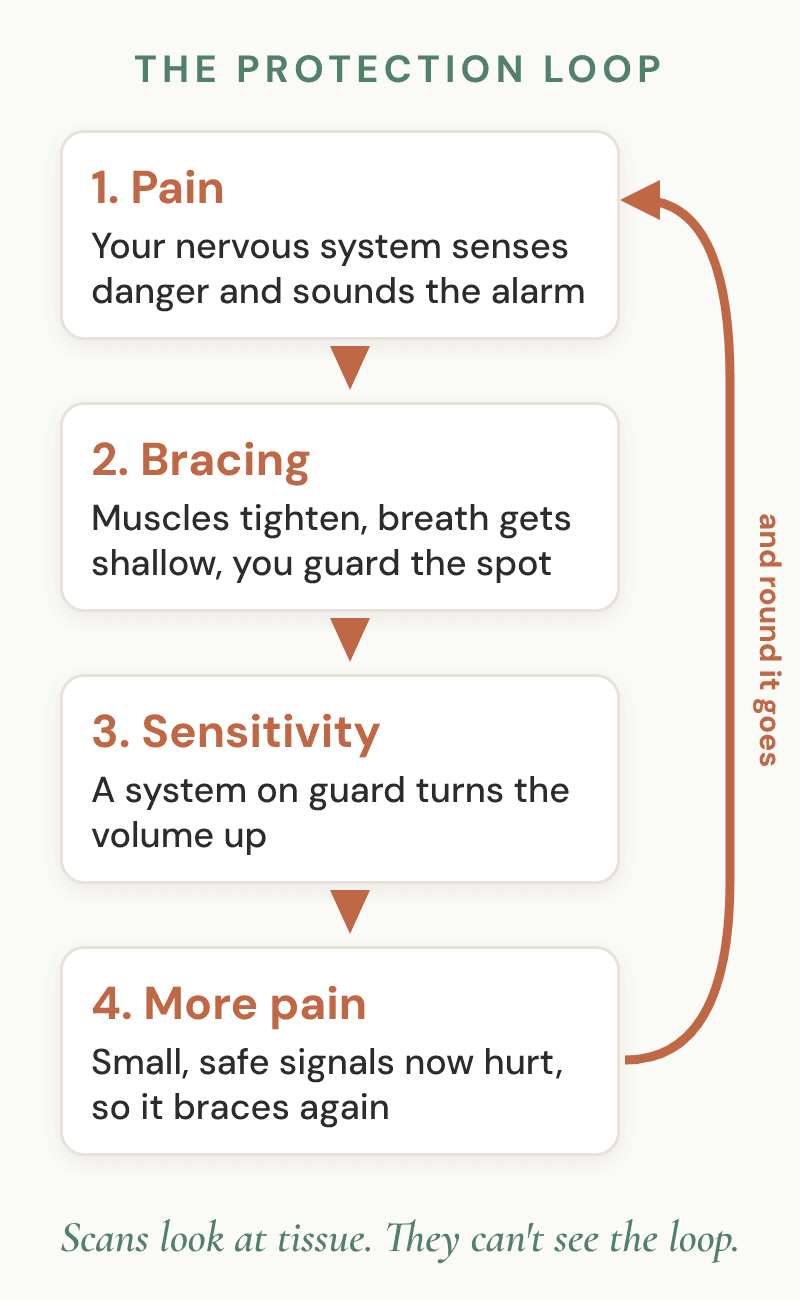
This one loop explains what nobody has explained to you. Why the pain moves: damage stays in one place, but a sensitive system can light up anywhere. Why it flares with stress, cold weather or a bad night, when you did nothing to injure yourself. Why the scans are clear: they look at tissue, and the loop is not in the tissue. Why it can feel like it is everywhere, as so many people with fibromyalgia describe. And why a tight neck, a clenched jaw and a pounding head so often show up together.
Now look at what most treatments do. They go looking for damage. They stretch the tissue, strengthen it, rub it, numb it, cut it. Sometimes that helps for a while. But if the tissue has healed and the loop is what keeps the pain going, working on the tissue is like switching off a smoke alarm that keeps going off for burnt toast. You get a few minutes of quiet. Then it starts again, because nothing told it the house is safe.
There is a second trap, and it is a cruel one. Pushing through makes a guarded system more guarded. The harder workout, the deeper massage, the stretch you hold while gritting your teeth. Each one tells an already alarmed body that the world is dangerous and it was right to brace. So you try harder, it gets worse, and you decide you are the problem.
You are not the problem. You were given tools for the wrong part of the system. Nobody told you the loop existed, so nobody could show you how to switch it off.
If you know Neurotoned, you know the idea at the heart of everything we teach: a nervous system stuck on high alert, long after the danger has passed. It is the same nervous system behind our Vagus Nerve Reset, and Neurotoned has helped more than 100,000 people calm it. Chronic pain is where that alarm hurts the most. The way out is not more force. It is showing the system, a little at a time, that it is safe to let go.
The way out
Show the loop
it is safe to switch off.
Soothing Pain comes from somatic work, the body-based side of nervous system care, and from the same pain science as the trial above. It does not ask you to ignore your pain, think positive or push through. It asks you to do something much gentler and much more specific. It breaks the loop at four points.
First, it takes the fear out. Fear turns the volume up. When every twinge might mean something is getting worse, the system stays on guard. Week 1 shows you, in plain words, why pain can outlast an injury and why that is not "all in your head". This is the week the dread lifts.
Second, you find your own triggers. Danger signals are not only physical. In Week 3 you map yours. Some are obvious, like certain movements or long periods of sitting still. Some surprise people, like speaking up for yourself. When you can see what sets your system off, flares stop coming out of nowhere.
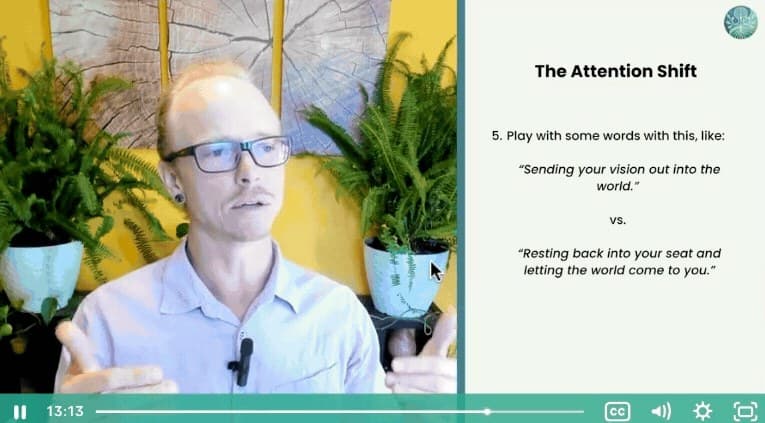
Third, from Week 2 on, you give the system new information, in small doses. This is the heart of it. Short practices that let your body feel, for a moment, that it is safe right now. One Asa calls the attention shift: moving from the narrow, braced kind of attention that hunts for pain to a softer, wider kind. Done once, it is small. Done many times, it changes how your system predicts danger, and the alarm goes quiet. As Asa puts it: "our brain becomes really skilled at what it practices." Years of pain were practice at pain. This is practice at safety.
Fourth, you practice feeling good on purpose. After years of pain, the nervous system can treat comfort as unfamiliar, and unfamiliar as a threat. Week 4 is called Getting Good at Feeling Good, and it is exactly that: training your body to spend time somewhere safe, until safe becomes normal again.
The workbook adds practices that go beyond the videos. Four of them: Tracking the First Spark, which teaches you to catch the tightening that comes hours before a flare peaks, while it is still easy to soften. The Spotlight Shift, for when pain pulls your attention in tight like a beam of light. The Capacity Scale, a way to go up to the edge of discomfort and back, so your body learns that movement is safe. And The Predictability Practice, a steady rhythm your nervous system reads as "I know what happens next". And more, with a short reflection after each week so you can see what is changing.
You are told to do less than you think you should at first. That is not a weakness of the course. It is the point. A body that has braced for years lets go when it feels safe, not when it is forced.
It does not replace your doctors or your medication. It works on the part they were never set up to reach: a protective system that needs to be shown, kindly and many times over, that it is safe to let go.
Key idea
Not more force. More safety, in small doses, repeated until your nervous system believes it.
Your teacher
Asa Dean,
Somatic Experiencing® Practitioner and Chronic Pain Specialist.
Asa Dean is a Somatic Experiencing® Practitioner and Chronic Pain Specialist. He is trained in three body-based methods for the nervous system, and he also works with trauma. In his own words, from the welcome: "I help people overcome the effects of chronic pain, trauma, and other complex conditions." Somatic Experiencing is the body-based method Peter Levine developed for helping a nervous system come out of survival mode. His other two are NARM and DARE. He works with clients online and in person from Durango, Colorado.
His interest in pain is not academic. Asa was born at home and needed emergency heart surgery at two weeks old. He grew up in a family marked by addiction and old trauma, and learned early to do what many of us learn: freeze, shut down and brace. Years of loss and grief taught him what it is to carry more than a body knows what to do with.
He studied massage and somatic healing arts in Hawaiʻi, then trained in Somatic Experiencing. Today much of his work is with people whose pain has outlasted every explanation they were given.
What you notice in Asa's lessons is that he never asks you to fight your body. His teaching is slow, warm and practical. He explains the science, starting in Week 1 with the very trial described above, then he shows you, and then he asks you to try something small and notice what happens. Private work with a practitioner like Asa is out of reach for most people in pain. Soothing Pain puts his way of working in your home, for less than the price of a single session.
What's inside
Four weeks to switch the loop off,
one step at a time.
A short welcome, then one lesson a week with Asa, each under twenty minutes. Watch it sitting up, lying down or in pieces. Then use the practices wherever you are: in bed, in a chair, in the car before you go in. Nothing to keep up with, nothing to fall behind on.
Introduction to Soothing Chronic Pain & Discomfort
Start here, on any day. What the four weeks are for, and how to pace them, with breaks whenever you need them.
Understanding the Origins of Chronic Pain
Why pain can outlast the injury that started it, and why that is not the same as "all in your head". Most people living with chronic pain have never been taught what pain actually is. This is where that changes, and where the fear comes down.
The Relationship Between Pain, Protection, and Sensitivity
How bracing and guarding feed the loop, and how to tell a loud alarm apart from real damage. In the workbook: the Capacity Scale, for moving up to the edge of discomfort and back without setting off a flare.
The BioPsychoSocial Model of Pain
The danger signals beyond the body, and how to map your own, including some that surprise people. Plus the attention shift, and in the workbook, Tracking the First Spark, for catching a flare before it builds.
Getting Good at Feeling Good
The other half of the work. Why comfort can feel strange after years of pain, and how to let your nervous system spend time somewhere safe, instead of only ever checking where it hurts.
The Soothing Pain Workbook
Sixty-five pages to keep beside you: the science of pain as protection in plain words, eight extra practices that go beyond the videos, four short bonus practices, a reflection after each week, and a simple log to see what helps on which days. Print it or keep it on your phone.
The 30-Day Neurotoned Program
More than 40 further video lessons from Neurotoned's practitioners on calming a nervous system stuck on high alert, among them vagal toning practices and a lesson on relief from chronic pain. Yours for life, free with Soothing Pain.
What the four weeks work on
From bracing against your body
to working with it.
Here is what changes as your body learns it is safe to let go.
Small shifts, repeated. That is how a nervous system learns, and how pain lets go. Neurotoned has helped more than 100,000 people calm a nervous system stuck on high alert. Here is what some of them wrote, word for word.
Verified reviews
What people say about Neurotoned
in their own words.
Public reviews, left on Trustpilot by members who were not asked to write them, and quoted here exactly as they were written.
When all else failed, the 30 day Neurotoned program brought me back to an even better place than before. At 67 years old, I experienced a shoulder injury. Then, over the course of a year my whole body gradually broke down. Chronic pain wore me down and I began to have panic attacks. I tried the medication route for both pain and anxiety but couldn't deal with the side effects. I was losing hope. There had to be a better way. Neurotoned was the way. The gentle breathing exercises, meditation, yoga, art and music therapy, along with the amazing support from Neurotoned and Community enabled me to truly heal and my life is now more meaningful and peaceful than before and I am pain free. I also have tools to help me remain resilient.
Living with chronic pain for the last 35 years this was a new amazing experience. What touched me the most was the personal interaction and letting me know in a gentle, loving and professional way that I am understood and not alone. The option to choose what resonates with you and having no pressure makes the program enjoyable.
I joined Neurotoned after a very challenging few years that left my nervous system on high alert. I am so grateful for the skills I've been learning through the video lessons, printed materials, and live sessions. Not every approach/practice is a perfect fit for me, but they are all worth exploring. The practices that have clicked have really helped bring me to a place of calm regulation. Now I'm much less likely to over-react or fall apart like I consistently did a few months ago. These days I'm better at recognizing when I'm feeling unsettled or anxious and now feel I have the resources to re-ground myself. I'm sleeping better and have less chronic pain. Neurotoned is a rich and thoughtful program and I use it nearly daily. Plugging into it has been one of the best things I've ever done for myself.
I have a very stressful event that comes every 6 weeks. In the past, it would be followed by crippling pain as my auto-immune disease flared up. This last time I tried several of the neurotoned strategies to calm my system, and it helped a lot!
This is a very comprehensive program presented in a simple non threatening way. I am very impressed. The exercises are really helping me. I have chronic pain and have experienced emotional traumas. This was exactly what I needed. If you're on the fence about wether it's worth it, just do it! You won't be sorry!
For many months, I was scared because I was experiencing symptoms that I thought were signs of a serious illness. I visited doctors, underwent testing, and everything seemed to be fine. One day, while scrolling through social media, I came across Neurotoned and decided to give it a try. When I started following the techniques and practices of the different coaches, my life changed. I especially loved the vagal toning exercises and orienting and grounding skills. I still practice them every day.
I have started Neurotone programme three weeks ago and enjoying practicing every day. From the beginning I noticed a shift in my stress level and calming my body. I will continue practicing so that to overcome a serious somatic problem with frozen muscles, that I feel it is improving day after day!
The program
Soothing Pain,
yours for life.
Everything you need to switch off the loop: four weeks with Asa on video, the workbook for the days in between, and the full 30-Day Neurotoned Program free with it, from the company that has helped more than 100,000 people calm a nervous system stuck on high alert. One payment, yours to come back to whenever your body needs it.
Soothing Pain
Somatic Support for Chronic Pain & Discomfort
four weeks to wake up without bracing and get your days back
Why it costs
so little.
Because we would rather thousands of people who are tired of hurting try this than a handful who can afford one-to-one care. A single private session with a somatic practitioner costs more than this whole course, and chronic pain usually needs more than one. Asa calls neuroplastic pain, the kind this course works on, the easiest kind of chronic pain to treat. Learning how should not cost a fortune.
And because you have probably spent a great deal already, on appointments, scans, gadgets and treatments that helped for a week. This should not be another big bet. It should be an easy yes, with every cent back if it is not for you. If one practice gives you back one walk, one trip, one afternoon on the floor with the grandchildren, it has paid for itself many times over.
What the other routes cost:
- One private session with a somatic practitioner: $100 to $200
- One physical therapy visit without insurance: $75 to $150
- A month of pain-relief patches and creams: $30 to $60
- Another year of planning your life around the pain: you already know
- Soothing Pain, all four weeks, the workbook and the 30-Day Program: $16.99, once
What happens when you press the button
You go to a secure checkout. Once you have paid, Soothing Pain opens straight away, with the workbook inside it and the 30-Day Neurotoned Program already in your library. An email follows with how to sign in, so you can come back any time, on any device. You can be watching the welcome inside ten minutes.
Today: $16.99
One payment. Lifetime access to the program. 30-day guarantee.
Feel the difference, or pay nothing.
Watch the welcome. Watch Week 1 tonight, lying down if you like. Go as slowly as you need, and do less than you think you should.
If you don't feel the difference, for any reason, email support@neurotoned.com within 30 days and we will refund every cent. No conditions, no questions, no forms, and nobody on the phone trying to talk you out of it.
You risk nothing. The risk is ours, not yours.
Thirty days. Every cent back if it isn't for you.
You have tried pushing.
You have tried the stronger stretch, the harder workout, the deeper massage, the next appointment. You did everything right, and your body still doesn't trust you. That is not because you failed. It is because nobody showed you the loop, or how gently it needs to be approached.
This is that part. Four weeks with Asa, the workbook beside you, and the 30-Day Program behind you. One small practice at a time, toward mornings you wake without bracing, days you move without fear, evenings you are present for the people you love, a body you can live in instead of guard, and the afternoon on the floor with the grandchildren, said yes to.
Every day the loop runs, it gets more practice at hurting. Every day you start teaching it the other way, it gets practice at letting go. You can close this page and keep living around the pain. Or you can start today, watch Week 1 tonight, and find out what your body does when it finally feels safe. You have 30 days to decide, with every cent back if it isn't for you.
One payment. Lifetime access to the program. 30-day guarantee.
Thank you for reading this far.
If you have been living with pain for a long time, reading a long letter about it takes energy. Thank you for giving it yours. We hope the next four weeks give you some back.
One payment. Lifetime access to the program. 30-day guarantee.
Honest answers,
before you decide.
Is this saying my pain is all in my head?
No. Your pain is real, and so is whatever started it. What the course works on is the part your nervous system plays: how much protection it decides you need. When that protection stays switched on for a long time, it can keep producing pain after tissues have healed. That is a real, physical process in a real body, not imagination.
I have fibromyalgia, or headaches and migraines. Is this for me?
Yes. Woolf's review links central sensitization to fibromyalgia, headache and jaw pain, and many long-term conditions carry a layer of nervous system sensitivity on top of whatever else is going on. That layer is what this course works on, while fully respecting the parts that need medical care. And the 30-day refund means you can find out without risking the money.
I have had pain for twenty years. Is it too late?
No. Remember the trial: those people had lived with back pain for about ten years on average, and after four weeks of therapy built on this idea, two in three were pain-free or nearly. Your nervous system keeps learning for as long as you live. One Neurotoned member wrote on Trustpilot: "Living with chronic pain for the last 35 years this was a new amazing experience." It is never too late for your body to learn it is safe.
What exactly am I buying?
Soothing Pain: a short welcome and four weekly video lessons with Asa Dean, the 65-page Soothing Pain Workbook, and the full 30-Day Neurotoned Program free with it. One payment, lifetime access to all of it on the Neurotoned app.
Do I have to stop my medication or my other treatment?
No. It does not replace your doctors or your medication, and you should never change a medication without talking to whoever prescribed it. You can use it alongside physical therapy, medical care or other support.
How much time does it take?
One lesson a week, each under twenty minutes, plus a short welcome. You can watch them lying down, in pieces, or more than once. The practices take a few minutes and can be done in a chair or in bed. The 30-Day Program is there whenever you want more, with no clock on it.
What if a practice makes me more tense, or a lesson brings things up?
Then do less, and come back another day. The whole approach is small doses, and Asa shows you how to settle your system when something stirs. You are told to do less than you think you should at first, and nothing in the course asks you to push through discomfort.
When should I see a doctor instead?
Always get medical help first for pain that is new or changing quickly, pain after a fall or injury, pain with a fever or unexplained weight loss, new numbness or weakness, or any change in bladder or bowel control. Get help urgently for those last two. This course is for long-standing pain that has already been checked, not for working out what a new pain is.
Is this a subscription?
No. It is one payment for lifetime access, with nothing recurring and nothing to cancel. One thing you should hear from us rather than find out on your own: straight after checkout we show you one optional offer, for people who want more of the Neurotoned library. It is priced separately, and saying no takes one tap and changes nothing about what you bought.
What if it isn't for me?
Email support@neurotoned.com within 30 days and we refund every cent. No conditions and no questions.
One payment. Lifetime access to the program. 30-day guarantee.
P.S. If you scrolled straight to the bottom: Soothing Pain is a gentle 4-week course from Somatic Experiencing® Practitioner Asa Dean that teaches the protection loop behind chronic pain to switch off, so you wake up without bracing and get your days back. It comes with a 65-page workbook and the full 30-Day Neurotoned Program free. You can do all of it at home, lying down if you need to. One payment of $16.99, yours for life, and a 30-day refund if it isn't for you.
P.P.S. The single sentence most worth taking from this letter is Asa's: "Fundamentally, pain is a message of danger." Not damage. Danger. And a nervous system can learn it is safe. You do not have to believe anything to start. Watch the first lesson and see how your body responds.