For women who are tired but wired
Your tests came back fine.
You're still bone-tired all day and wide awake at 3am.
One switch is behind both.
And behind the tight chest over nothing.
Acupuncturist Theresa Moodie shows you the handful of points that switch it back with your own two hands. In four weeks, the switch stops having the last word. Your energy comes back by day. You switch off at night and sleep through. At 3pm, one minute and the slump lifts. In the meeting, a hold nobody sees, and the tight chest lets go. At 3am, no phone, no maths: your hands find the points and you are back asleep. No needles. Just your hands.
"Get more sleep." "Try to relax." "It's just your age."
You've heard all three. None of them touched it.
You have heard them from friends, from articles, from everyone who means well. Maybe from a doctor too, who read your tests, looked at you and said you seem fine. Or that it's stress. Or your age. You walked out of that appointment still bone-tired, and a little less sure of yourself. So you start to wonder if it is your hormones, or you.
But you know your body, and you know what it is doing.
It is 3pm, and you are sitting in the car in the supermarket car park, engine off, keys in your hand. You can't make yourself get out. The list you came for has gone. Your shoulders are up by your ears, and you could close your eyes right here. Except you know that if you did, your mind would switch straight back on.
It is 3am. You were exhausted at ten. Now your heart is going a little too fast and your mind has started its list: the email you didn't answer, your mother, the thing you said in 2009. You are doing the maths. If I fall asleep now I'll get three and a half hours.
Bone-tired by day. Wide awake by night. On edge in between: a tight chest over nothing, shoulders that never come down. They feel like separate problems. They are one switch, firing at the wrong times.
And it costs more than sleep. You plan the week around how you slept. You say no to the evening out before anyone asks. Your fuse is short with the people you love most. You used to have energy to spare, and some days you can't remember the last time you felt like yourself. Underneath is the fear you don't say out loud: that this is how it is now, and each year it gets a little worse.
And you have tried things. Magnesium. Melatonin. A meditation app, whose calm voice your busy mind talked straight over. More coffee in the day, a glass of wine at night. Maybe HRT, which helped some things and not others. Maybe a point from a video, which did nothing much.
None of it was aimed at the switch. Ahead: why your breath reaches what a meditation app can't, the point soldiers were said to press so they could walk another three miles, and a two-point hold so discreet you could use it in a boardroom.
What the research found
Tired, sleepless, stressed: in three trials,
people taught a daily self-acupressure routine ended up less tired, sleeping better or less stressed than the people they were compared with.
First, what has been tested. Self-acupressure, steady pressure on points done daily at home, has been tested in randomised trials with people who were tired, sleepless or stressed. Cancer centres such as Dana-Farber and Memorial Sloan Kettering already teach it to their patients. Three of the trials:
270 breast cancer survivors with lasting fatigue, at least a year after treatment. After 6 weeks of a daily relaxing self-acupressure routine, 66% had reached normal fatigue levels, against 31% of women on usual care. Only the relaxing routine also improved their sleep, at 6 weeks.
Zick SM et al. JAMA Oncol 2016;2(11):1470-1476. PMID 27388752.
200 adults with insomnia came to two 2-hour classes: half learned self-acupressure, half learned sleep-hygiene advice. The self-acupressure group's insomnia severity fell further at 4 weeks and at 8 weeks, and their anxiety fell too.
Yeung WF et al. Phytomedicine 2022;99:153993. PMID 35193046.
207 stressed carers of an older family member. After 8 weeks of daily self-acupressure, their caregiver burden was lower than a wait-list group's, and it was still lower at 12 weeks. Their fatigue and insomnia scores also improved at 8 weeks.
Cheung DST et al. J Am Geriatr Soc 2020;68:1193-1201. PMID 32096884.
What these trials share with the Self-Acupressure Reset is the shape: a short routine, taught properly, then done every day for weeks. Their routines took 15 to 30 minutes a day. Theresa's points take about a minute each, so you can do several together before bed, or one at a time through the day. Theresa's advice is the same: "a little bit every day".
Why you're tired and wired at once:
the Wrong-Time Switch.
Key idea
You're not broken. Your on and off switch is firing at the wrong times.
Your nervous system has an on setting and an off setting. On gets you going: heart up, mind sharp. Off lets you rest: heart slower, breath deeper, body heavy. Theresa Moodie, the acupuncturist who teaches this programme, puts it plainly in Week 2: "We need both of these dynamics of your stress response and your relaxed response, but we need them to take place at the proper time..."
What keeps the timing is a brake: the vagal brake, the vagus nerve's steadying hold on your heart. In a rested body the brake holds when you need rest and lets go when you need to go: down at night, through the small hours without waking, up in the morning.
But after years of carrying everything, everyone's needs, every worry, every late night, the brake can wear thin. Then the switch starts firing at the wrong times. We call it the Wrong-Time Switch. For many women the midlife years add to the nights: sleep problems in the menopause transition track the hormone changes themselves, falling oestradiol, over and above the effect of age.
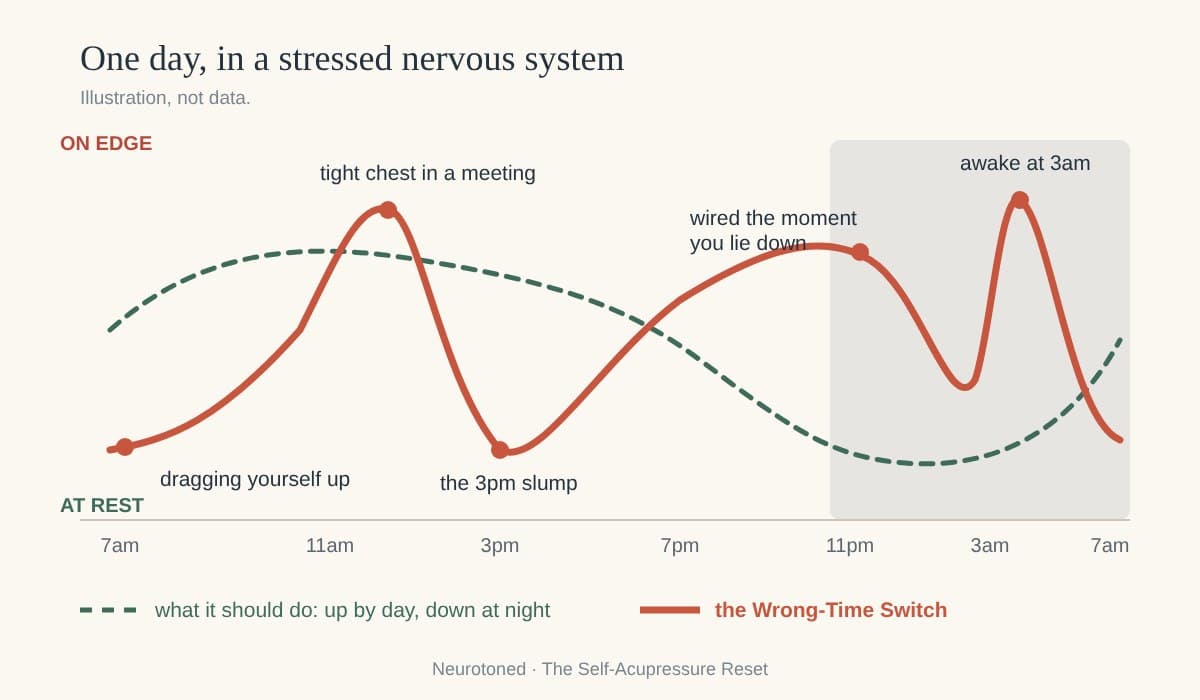
It trips on when you lie down, so you are wired at bedtime. It trips on again in the small hours, around the time the body's wake-up hormone starts its early-morning rise, so you are awake at 3am. And a body that spends its nights with the brake off pays for it by day. You wake up spent: heavy from the alarm, flat by three, however long you were in bed. In between it trips over nothing: a tight chest in a meeting. And a body that never fully comes down holds on: the shoulders up by your ears by four o'clock.
Think of it as one switch on the wrong timetable, with a brake worn thin: wired when you should rest, spent when you need to go. Seen that way, the bad nights, the heavy days and the edginess stop looking like separate problems.
It also explains why nothing you tried has helped: none of it reached the brake.
None of that is your fault. It isn't your mind, your age or your willpower. It's a brake that has worn thin, and your own two hands can set it right.
Nothing you tried reached the brake.
Two things you already have can.
And if you have pressed a point from a video, held it a few seconds once and felt nothing much, you weren't doing it wrong. You were never taught. One point, pressed once, was never the method.
The first thing you already have is your breath. A meditation app asks your thinking mind to calm down, and a busy mind talks straight over it. A long, slow out-breath doesn't ask your mind for anything. It is your body's own way of leaning on the vagal brake.
The second is touch. Not light, tickly touch, but steady pressure you can feel, never so much it hurts, on a point. That is self-acupressure: the daily routine the trials above taught people who were tired, sleepless or stressed, to do at home.
Theresa's method puts the two together: steady pressure on a point, timed to the out-breath. In her words: "when we apply the pressure, we always apply on the exhalation." If the vagus nerve is the brake, acupressure is the hand brake: the one you can reach yourself, wherever the switch trips. We call it the Hand Brake.
You don't have to believe in meridians for any of this to make sense. Theresa teaches in the language of Chinese medicine, because that is where acupressure comes from. The trials tested it the plain way: as a routine, not a belief.
Why points, and not just pressing anywhere? Because a routine of named points is what the trials taught. The relaxing routine in the Michigan trial above pressed five of them. Theresa teaches all five, two of them as tapping. And because a point gives your hands somewhere exact to go, in the dark, without thinking. Theresa is an acupuncturist. She learned "all of the points, all 362 of them". From those she teaches you the handful you can reach yourself, and how to find each one by feel: the landmark, the finger-widths, "that little empty space" you are feeling for. In Week 1 she shows you how to tell, under your finger, whether a point needs energy brought in or a knot broken down. "If you hit the bone, you've gone too far."
Why a routine? Because the switch trips at more than one time of day, so she gives you a point, or a pair, for each. For the nights your mind runs away with you, a point she ties to "the emperor" in your heart, to start a few hours before bed. For the heavy mornings and the afternoon slump, the one she uses "to bring energy into the body". The story goes that when soldiers were tired, they pressed it, "and then they would be able to walk another three miles." For an anxious moment, a two-point hold so discreet that "you could be in a boardroom... and nobody needs to see your wrists." For the tension you carry, the "four gates", worked away from the sore spot "so as not to bring pain to pain".
Why not an app, a pill or a video? An app needs your phone and your thinking mind, at the hour you have least of both. Melatonin and wine push you down without touching the brake. A video gives you one point and a promise. This is a routine, in order, from one acupuncturist, about a minute a point. In bed, at your desk, in the car park before you walk in.
In four weeks, you get your days and your nights back.
It is 3pm and the slump comes. One minute at your desk on the soldiers' point, the one Theresa uses "to bring energy into the body", and the energy is back, no third coffee. In the meeting your chest goes tight: two points on one wrist, under the table, and it lets go before anyone knows. When your shoulders creep up, the four gates, worked from your hands and feet, and they drop. At bedtime you switch off. And if you wake at 3am, you leave the phone where it is. Your hands find the points on the card by feel, you breathe out slowly, and you are asleep again before the maths can start.
Calm in your body. Energy by day. Sleep at night. You, feeling like yourself again.
Theresa's routine uses all five points the Michigan women pressed in their relaxing routine: Yin Tang, Anmian, Heart 7, Spleen 6 and Liver 3 (the first two as tapping). Those women had lasting fatigue, at least a year after breast cancer treatment, and pressed their routine daily. After six weeks, two in three had reached normal fatigue levels, against fewer than one in three on usual care. Now those points are yours, for life.
Your teacher
Theresa Moodie,
acupuncturist.
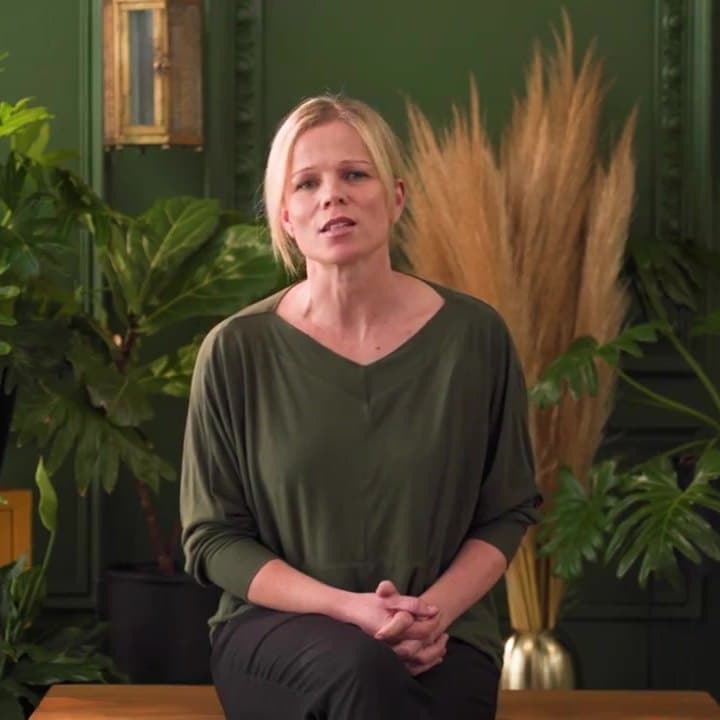
Theresa Moodie is an acupuncturist, trained in acupuncture and Chinese medicine in Europe, and she teaches Neurotoned's Myofascial Release programme. Before that came more than twenty years in health and wellness: personal trainer, then sports massage and Shiatsu, then yoga teacher, and now a trainer of other yoga teachers.
Members of her Myofascial Release programme have written about her teaching. In their own words, from their reviews of that programme:
"Theresa’s 5-to-10-minute targeted practices fit effortlessly into my routine." Sarah K., 45, on Theresa's Myofascial Release programme.
"What I love about Theresa Moodie’s guidance is how deeply trauma-informed it is. She constantly reminds you that you don't need to force a release..." Priya M., 29, on Theresa's Myofascial Release programme.
"Theresa’s background as an acupuncturist and yoga teacher really shines through." Claire B., 38, on Theresa's Myofascial Release programme.
In the Self-Acupressure Reset she teaches the way a good teacher does: one point at a time, how to find it, and how much pressure to use.
She is gentle about it. "Listen to your body. That's the most important thing." And she is honest that you are the expert in the room: "Remember, nobody knows your body quite as well as you do."
You don't need any experience. As she says in her welcome: "These practices don't require any prior experience, just your presence, your hands, and a willingness to meet your body with curiosity."
The 4-week protocol
Four weeks,
a point for every time the switch trips.
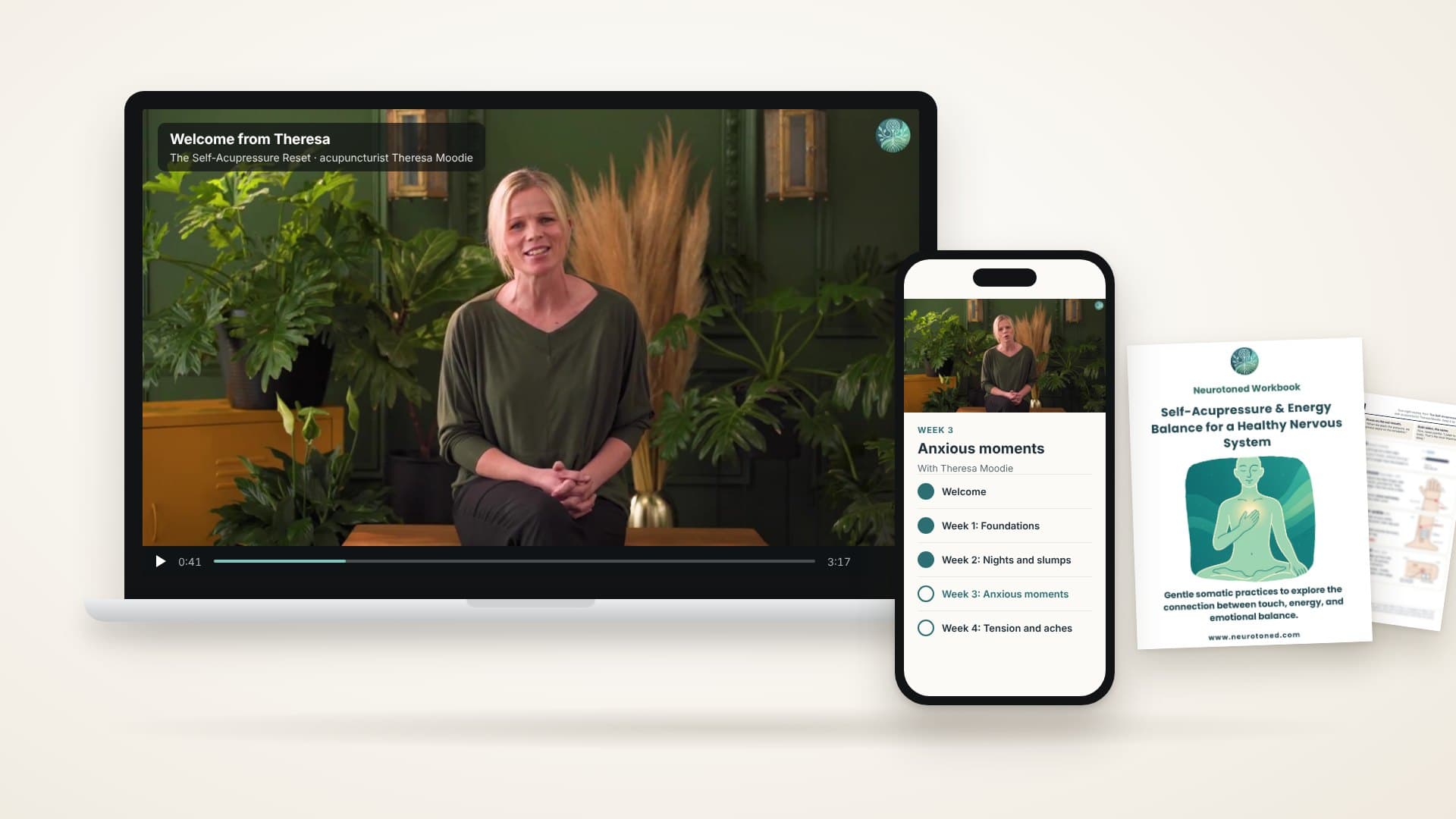
A short welcome, then one lesson a week. Watch it once with Theresa, then use the points wherever you are: in bed, at your desk, in a waiting room. You need your hands and a few slow breaths. No needles, no mat, nothing to buy.
Introduction To Self-Acupressure For A Stressed Nervous System
What the four weeks are for, and why there is no rush: small moments of ease that, in Theresa's words, "over time gently shift the way you feel and function."
Foundations of Self-Acupressure & Tapping
How to tell, under your finger, whether a point is empty or knotted, and what Theresa does differently for each; and a gentle tapping routine that brings you back into your body in a few minutes.
Acupressure for Fatigue and Insomnia
Tired all day, wide awake at night: the pairing Theresa calls "so interesting and equally frustrating". A point for the nights your mind runs away with you, one she uses "to bring energy into the body" in the day, and the one she calls "so magical" because it helps with both. You finish the week knowing which point to start a few hours before bed, and which to press as you wake.
Acupressure for Anxiety & Overwhelm
A two-point hold for the moments your chest tightens or your heart starts going, discreet enough, in Theresa's words, that "you could be in a boardroom... and nobody needs to see your wrists. You can do it lying in bed." Her advice: use it a few times a day, before the feeling takes hold.
Acupressure To Help Ease Pain
The "four gates", on your hands and feet, for a body that holds on to tension. Worked away from the sore spot, so you never press on what already hurts.
What the four weeks work on
From wired and tired
to rested, calm and yourself again.
Where you are now, and where you are in four weeks.
Your energy back, your nights back, and you, feeling like yourself again. Learned in four weeks, yours for life.
Verified reviews
What people say about Neurotoned
in their own words.
Public reviews, left on Trustpilot by members who were not asked to write them, and quoted here exactly as they were written.
Grateful This program is so authentic and the practices are so well explained and gentle. They have helped calm my nervous system and reduce my feelings of overwhelm. I’m so grateful I came across Neurotoned.
I have found the Neurotoned program to be a benefit in helping me to regulate my nervous system out of flight/ fight mode of anxiety. The practices are helpful and not so long that they are overwhelming to do when my system is activated. I appreciate the fact that the therapists are honest and relay the fact that consistently is the key to recovery, there is not a quick and easy fix. Thank you Neurotoned for this program and ongoing support.
Hi, I am so glad I found Neurotoned. The gentle exercises are very accessible due to its bite-size offerings, as it allows me to fit them into my daily busy routine flexibly. I now find myself doing the breathing exercises automatically when feeling anxious. A big thank you to the Neurotoned team, you ladies are doing awesome work. Looking forward to learning more from all of you!
Absolutely amazing, I haven’t felt so calm for ages, or more like never in my life. I am very grateful! 🙏 🩷
Great for nervous system work! I've been struggling with resting but not feeling rested, and I realized the nervous system was the disconnect. The modules here have been a really practical way to start to shift and transform my relationship with my nervous system and in my body. I've loved their 30 day program! It's been one of the best investments I've made!!
I’m really enjoying this program, it’s making a big difference to my wellbeing. I like the daily practices and I now have a good toolkit to draw on. My nervous system is gently settling down and I feel I’m able to handle life better.
The programme
The Self-Acupressure Reset,
yours for life.
Everything you need to get your energy back by day and your nights back: four weeks with Theresa on video, the workbook for the harder days, and the card that keeps the small-hours routine by your bed. One payment, yours for life.
The Self-Acupressure Reset
A 4-week protocol for a stressed nervous system,
taught by acupuncturist Theresa Moodie
Why it costs
so little.
Because it is a short programme, recorded once, and we would rather thousands of women running on empty and wound up at once had it than a handful who can afford weekly appointments.
And because you have probably spent plenty already, on supplements, apps, gadgets and hope. This shouldn't be another big bet. It should be an easy yes.
One acupuncture appointment usually costs $80 to $150, and it is over in an hour. This costs less than one, and it is yours for life.
What it costs you to find out: one small payment, and every cent back within 30 days if it isn't for you.
What happens when you press the button
You go to a secure checkout. Once you have paid, the programme is open to you straight away, with the workbook and the 3am Card ready to download, and an email follows with how to sign in, so you can come back to it any time, on any device. One payment, nothing recurring, nothing to cancel.
Regular price: $70 → Today: $16.99
One payment. Lifetime access to the program. 30-day guarantee.
Try it for 30 days.
Watch Theresa's welcome. Start Week 1 tonight. Print the 3am Card and keep it by the bed. Then use the points for a few weeks, wherever the switch trips.
If it isn't for you, for any reason, email support@neurotoned.com within 30 days and we will refund every cent. No conditions, no questions.
We would rather you tried it and decided it wasn't for you than never found out whether your hands could help. The risk is ours, not yours.
Thirty days. Every cent back if it isn't for you.
You've spent long enough running on empty and wound up at the same time.
Dragging through the day. Lying awake at night. Holding it together in between. None of that was your fault. Years of carrying everything put your switch on the wrong timetable, and nobody ever showed you where to put your hands.
Now someone will. One acupuncturist, a handful of points, a slow out-breath, and four short weeks to learn them so well that your hands go there on their own. The next time the switch trips, at 3am, at 3pm or in the middle of a meeting, your hands know where to go, your body comes down and the moment passes. Energy by day. Sleep at night. Calm in between. You, not the switch, are in charge again, and you feel like yourself.
One payment. Lifetime access to the program. 30-day guarantee.
Thank you for reading this far.
If you are reading this late at night, tired and wired at once, press the button below and open Week 1. And if it isn't for you, every cent comes back.
One payment. Lifetime access to the program. 30-day guarantee.
Honest answers,
before you decide.
Is this just for sleep?
No. Sleep is one week of four. The programme is for a stressed nervous system: the nights you can't switch off, the days you can barely get going, the anxious moments and the tension you carry. Each week gives you points for one of them.
I tried pressing a point once and nothing happened.
That is the most common story, and it is why the four weeks exist. In the trials that worked, people were taught a routine and did it every day for six to eight weeks. A single point from a video is not that. These four weeks teach you the routine, and you keep it going from there.
I can never find the point. How hard do I press?
Theresa shows each point in the lessons on camera, and how you'll know you're on it. You press enough to feel it, never so hard it hurts. "Your comfort is key." And the 3am Card keeps the small-hours routine by your bed, so you don't have to remember it.
Can't I just find these on YouTube?
You'll find single points and a 30-second promise. This is a routine, in order, from one acupuncturist, with each point in the lessons shown on camera, how to find it, how much pressure to use and for how long, and the small-hours routine on a card by your bed, so you can do it with your eyes closed.
Will I actually keep it up?
Each point takes three to six slow breaths, about a minute, with no phone, no mat and nothing to set up. That's the point: it fits moments you already have, lying in bed, sitting at your desk, waiting in the car. Theresa's advice is to do "a little bit every day", and because you have lifetime access you can come back to the lessons whenever you need a refresher.
Do I need needles, or an acupuncturist?
No, and no appointments. Theresa is an acupuncturist, and she teaches you the points you can reach yourself, so you can use them any night, without booking a single visit.
Who is this not for?
It isn't for you if you want a medical treatment or a replacement for your doctor. It is for you if you are tired but wired and want your energy and your nights back, with your own two hands.
Is it safe for me? I'm pregnant, or I have a health condition.
The pressure is gentle and you are always in charge of it: "listen to your body." Two of the points taught are not for use in pregnancy. Theresa names them in the lessons, so you can leave them out. If you have a medical condition, take blood thinners or bruise easily, check with your doctor first. One more point can be tender, so go gently there.
Will it replace my HRT, sleep medication or anything else I take?
No. This is a gentle self-care practice, not a medical treatment, and it doesn't replace anything your doctor has prescribed. Keep taking what you take, and talk to your prescriber before changing anything.
How long does it take?
A three-minute welcome and four short lessons, under 13 minutes each. They are laid out one a week, so each routine has time to settle in, but you can go at any pace you like.
How is this different from the Vagus Nerve Reset?
The Vagus Nerve Reset works with the vagus nerve through a range of gentle somatic practices. The Self-Acupressure Reset is hands-on: a few points, pressed on the out-breath, one for each time the switch trips. If you loved the Vagus Nerve Reset, think of this as a hand brake you can reach anywhere.
What if it's not for me?
Email support@neurotoned.com within 30 days and we will refund every cent. No conditions, no questions.
One payment. Lifetime access to the program. 30-day guarantee.
P.S. The next time the switch trips, you can wait it out, or you can bring your body back down with your own two hands. In four short weeks the Self-Acupressure Reset gives you your energy back by day and your nights back, from an acupuncturist, yours for life, with every cent back if it isn't for you.