Neurotoned · Your labs are fine. You are not.
Chronic fatigue. Burnout that rest doesn't fix.
Wide awake at 3am in a body too tired to move.
There is one nerve at the centre of all of it.
Why rest stopped working, why the tests keep coming back fine, and what forty years of nervous-system research found actually reaches it. Explained plainly, then a 4-week protocol you can do at home, lying down.
The original Vagus Nerve Reset, started by more than 100,000 people.
Your labs look fine. You are not. You know it most on the days you finally rest.
It's Saturday morning. Nothing is on the calendar. You slept nine hours.
By eleven you are back on the couch, more tired than you were on Thursday, when you got through a full day on almost nothing.
That is the part nobody can explain to you. The busy days, you get through. It's the quiet ones that flatten you. The more you rest, the more tired you get.
Coffee does less every month. By 3pm you are reading the same paragraph three times, and by 3am you are wide awake, wired and flat at once, which should not even be possible.
And your life has started to shrink around it. You cancel plans by Thursday. You say “maybe” when you mean “I can't.” The people you love have stopped asking you to come along, because they already know the answer. You used to be the one who held everything together. Now you budget your energy the way other people budget money.
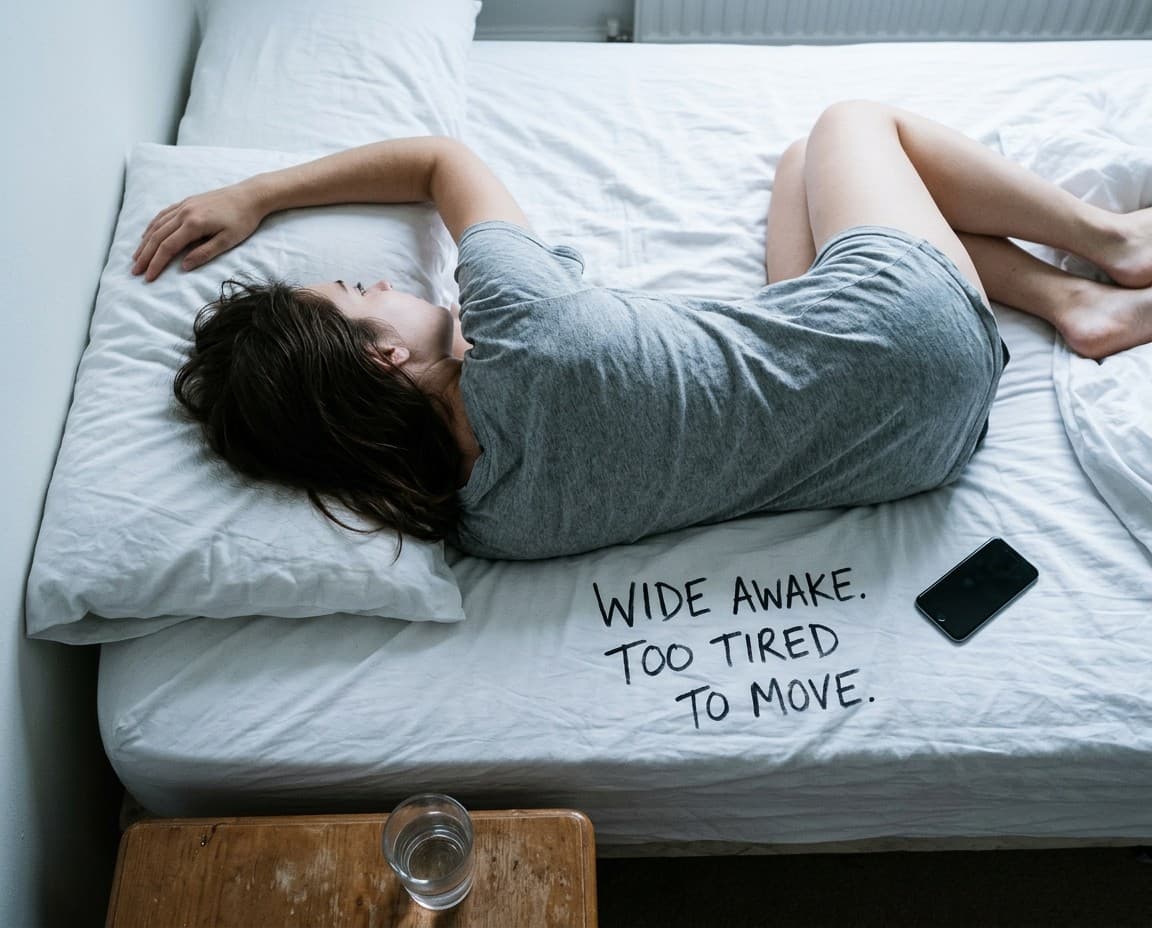
You have done every sensible thing. The bloodwork came back normal. The scans were clean. One doctor said stress. Another said you need more rest. You took the magnesium. You fixed your sleep routine. You tried the meditation app and deleted it on day six. You rested more than anyone you know.
So at 2am, scrolling in the dark, you ask the question you keep pushing away: how many more years of this? Is this just who you are now? Or the fear you don't say out loud: that it is something serious, and slowly getting worse.
There is another explanation, and almost nobody has told you about it. The quiet days are the worst for a reason, and it is not in your blood, your willpower or your head. It is one nerve, still running an emergency that ended a long time ago.
Rest can't switch off your body's emergency setting. A signal from your body can.
This letter shows you that signal, and the 4-week protocol that sends it. Do it, and here is what you get back: mornings you wake up rested. Energy that lasts past lunch. A quiet 3am. Plans you make on Monday and keep on Saturday.
The emergency ended. Your body never got the message.
The nerve is your vagus nerve. It runs from the base of your brain down through your throat, your chest and your gut. It is your body's main line for one question, asked all day long: are we safe?
When the answer is yes, your body does the things that need safety. It sleeps deeply. It digests. It recovers. It thinks clearly. It lets you rest and actually come back rested.
When the answer has been no for a long time, your body does something clever. After a long, hard season (a virus that never quite left, burnout you pushed through, grief, years of being the one who held everything together), the nervous system can drop into a protective state called freeze, or shutdown. It turns the power down to keep you going.
“This helps conserve energy, but it can leave us feeling very fatigued, having low motivation, feeling foggy or disconnected, or finding it difficult to start things.”
The hard season ends. But nobody tells your nervous system. It never gets the all-clear. So it keeps rationing your energy, keeps you on guard, and keeps treating every quiet moment as the time to shut down.
That is why the quiet days are the worst. On a busy day your system can still find emergency fuel to get you through. On a quiet day there is nothing left to borrow, and you feel what has been underneath the whole time. Rest does not send the all-clear. It just stops the borrowing.
And that is why your tests keep coming back normal. Blood tests measure chemistry. Scans show structure. A nervous system stuck in a protective state is neither. It is a setting. “Your labs look fine” was true. It just said nothing about the setting.
“This isn't a failure. It's your body trying to protect you.”
For most of the last century, science had half the map. It answered the question your doctors couldn't.

Medicine used to teach the nervous system as a simple switch. Stressed or calm. Gas pedal or brake. If you were exhausted and could not calm down, the advice was to try harder at calming down.
In the 1990s, Stephen Porges, then a professor of psychiatry at the University of Illinois at Chicago, published the Polyvagal Theory, and it gave the switch a third position. In his theory, the vagus nerve runs two different survival circuits. One keeps you calm and connected. The other, much older, does the opposite of fight or flight: it shuts you down to save energy, the way an animal goes still when it cannot escape.
That third position is the one most exhausted people are stuck in. It looks like depression. It feels like chronic fatigue. It can sit right under a layer of stress, which is how you can feel wired and flat at the very same time. It is not in your head. It is a mapped, named state.
It sits inside four decades of work on stress and the body. In the 1970s and 80s, Peter Levine had already built Somatic Experiencing, a body-based method for stress and trauma. Bessel van der Kolk, a Boston psychiatrist, spent his career on it and wrote The Body Keeps the Score (2014), read by millions. Their shared finding: long stress is held in the body and the nervous system, and it lets go through the body, not through more thinking.
One more finding changes everything about what you do next. About eighty percent of the vagus nerve's fibres carry messages up, from the body to the brain, not down. Your body is doing most of the talking.
So you cannot think your way out of shutdown. You cannot reason with it or push through it. You have to tell it, in its own language, through the body, that the emergency is over.
Why nothing you tried has stuck. Every one of them was aimed one level too low.

Look at everything you have tried with that in mind.
More sleep and more rest work on tiredness. But the tiredness is the result, not the cause. You can rest a shut-down system for years, and it will stay shut down, because rest never sends the all-clear.
Supplements each support one pathway. Magnesium for sleep, B12 for the fog. But each pathway sits under a nervous system that still decides, every morning, that it is not safe. That is why every bottle helped a little for a few weeks, and none of them changed your mornings.
Talk therapy works through words, and it can help a lot. But the pattern lives below words. You can understand exactly why you are exhausted and still be exhausted.
“I tried talk therapy for a while and felt like I made progress on some level... It made sense, logically, but it always felt like there was a missing piece. My body was still always tired, even after resting.”
Breathing apps and meditation ask you to “breathe deeply” and “relax”, but a braced body often can't, and being told to can make it tense up more. Deleting the app on day six was not a discipline problem. It was your body turning down an instruction written for someone calmer.
Pushing through spends willpower. And willpower is made by the very system that is out of fuel.
None of it was wrong, and none of it was your fault. It was all aimed at the symptoms, one level below the setting that makes them. What you spent was not proof that you are beyond help. It was the price of ruling out every other level, until only one was left.
And to be clear: nothing on this page is a reason to stop or change a medication. That decision belongs to you and the doctor who prescribed it.
What the vagus nerve actually listens to. It isn't what wellness advice tells you.
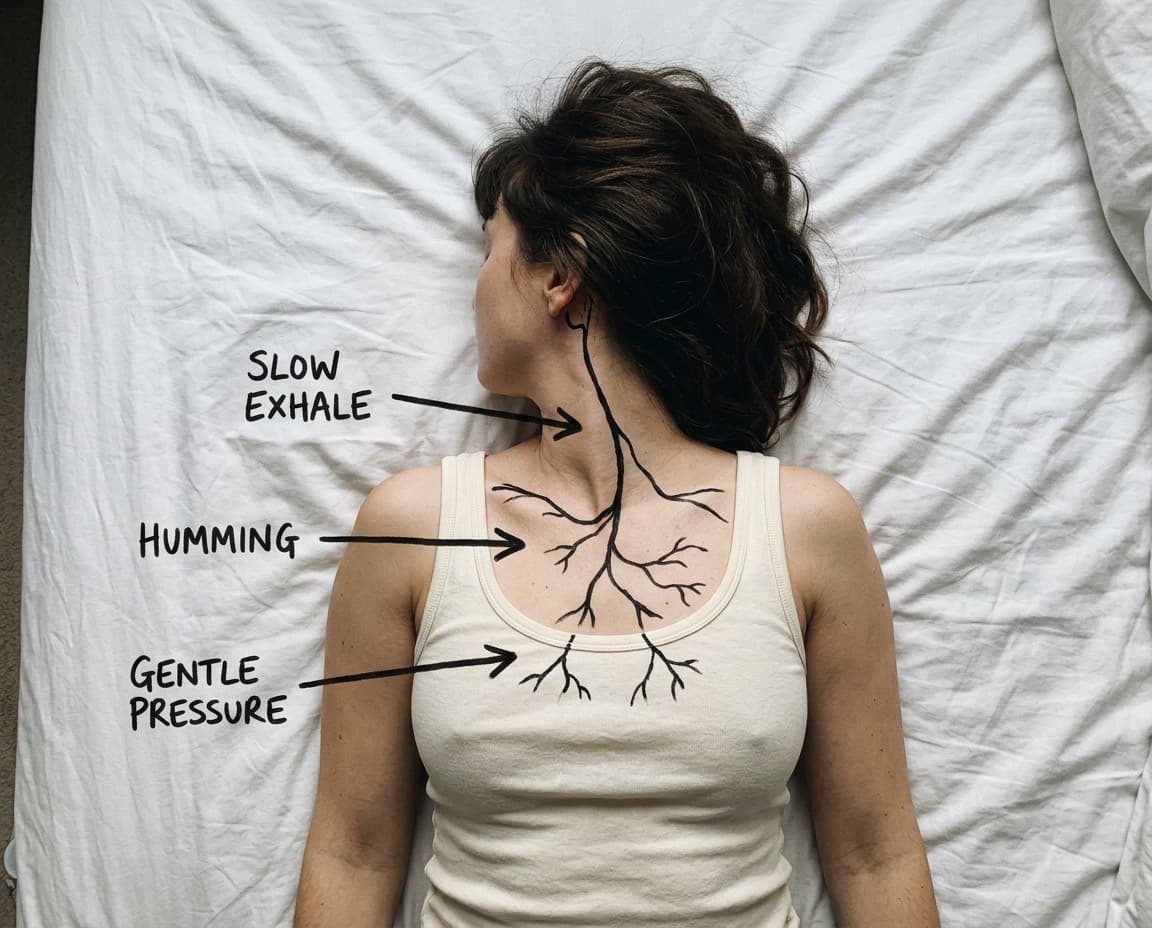
The vagus nerve responds to three plain body signals, and none of them is willpower. A long, slow breath out. A soft hum, whose vibration it can feel because it runs right past your vocal cords. And gentle rocking. Each one tells it, in its own language, that the danger has passed.
None of them takes effort. That matters, because your body has learned that effort gets punished. These are signals a tired body can actually send, lying down, on a bad day.
“Your nervous system tends to respond best to gentle repetition rather than intensity.”
What makes them work is the order. A shut-down body has to be met where it is, at the bottom, with the smallest signals first. Then, step by step, it is given a little more: from shutdown to a little energy, from a little energy to steady, from steady to trusting that it is safe to stay there. Do that on enough days and the new setting becomes the normal one.
Most programs skip straight to the end. They hand a body in shutdown the kind of practice meant for a body that is already calm. That is the step everyone misses, and it is the one this protocol was built around.
Who built the protocol. And why we asked her.
We wanted somebody who knew the body and the mind, who had spent years doing this work with real people, and who could teach it to someone she would never meet, lying on a couch on the other side of the world. We found that in Taryn Elise Herselman.

Taryn Elise Herselman is a Johannesburg-based somatic practitioner and nervous-system specialist with fifteen years in somatic practice. She holds an MA in Psychology, and between 2008 and 2020 spent twelve years in full-time, residency-style training in body-based practice for the nervous system. She directs her own practice and training centre in Johannesburg, where she certifies other practitioners in the same body-based therapeutic work. Her work focuses on nervous-system recovery, stress-related conditions, and the somatic dimension of emotional health.
The Vagus Nerve Reset is the sequence she has used in years of one-on-one practice, paced for a body with nothing to spare. She teaches every film herself, in a calm voice, sitting with you. She will never ask you to push. It is the original Vagus Nerve Reset, and more than 100,000 people have started it.
“The goal now is not to push, but to gently encourage your system to shift.”
The Vagus Nerve Reset. Four weeks to wake up with energy again.
.png)
Four weeks of short, gentle practices, in the right order, taught on film by Taryn. Each week takes your body one step up from shutdown. You do it at home, sitting up, lying down or in bed. Here is what you get back, week by week.
Before Week 1
You can start on your worst day.“If You Feel Too Exhausted to Start” is a six-minute film for the days when even choosing a practice is too much. Four tiny practices you can do in bed, with Taryn doing them alongside you. It is where she tells you to begin if you feel very tired.
Week 1
The alarm turns down.Rebuilding presence through the body. Gentle work with the neck, shoulders, throat and breath that tells your system the emergency is over, so it stops bracing and you rest for real.
Week 2
Your energy comes back.Restoring energy and supporting the vagus nerve. Practices small enough for a day you have nothing to spare: some so small nobody watching would see them, one that uses touch and sound together to pull you out of your head. Your body leaves rationing mode without being asked for energy it doesn't have.
Week 3
Your body feels safe to feel again.Reconnecting safely with your body. Years of survival mode turn your body's signals down to protect you. This week turns them back up, gently, through simple movement and breath awareness, until your body feels settled and safe.
Week 4
It holds on a normal Tuesday.Deepening trust and integration. Small practices you carry into real life, so the calm you find doesn't vanish the moment you walk into the grocery store.
A few things inside that surprise people.
The vagus nerve runs right past your vocal cords, so the vibration of a soft hum reaches it directly. Taryn hums with you in the film for your worst days, and the workbook shows how changing the pitch lands in different parts of your body. No breathing technique to get right.
Gentle rhythm is one of the oldest safety signals the body knows. One of the first practices is a slow, small sway with one hand resting over your heart. One to two minutes.
When breathing exercises make you feel worse, you need another way in. The workbook gives you a quiet anchor you do with your hands, no breath involved, that brings you back into the room when your mind won't stop.
Each practice has a card that reminds you of it in a few seconds. On a foggy day you can just pick one and do it.
A simple daily check-in (energy, one word for how you feel, one thing you notice in your body), so on a bad day you can look back and see how far you have come.
Included free
The full 30-Day Neurotoned ProgramFor when the four weeks leave you wanting more, or a bad patch comes back. It answers the questions the Reset raises, in lessons like:
- · “Vagal Toning For Sleep Problems/Insomnia”, for the nights you can't switch off
- · “Overcoming Exhaustion”
- · “Why Do I Feel Worse?”, for the days it feels like a step back
- · “Nervous System Care When You're Exhausted, Overwhelmed or Over-Extended”
Everything lives in the Neurotoned app, and it is yours for life.
How much time it takes. Each weekly film runs about eight to twelve minutes, and you can watch it lying down. In between, you do one short practice a day, ten to twenty minutes at most, often less. Taryn's own advice is to repeat the ones that feel best. There is no clock and nothing to fall behind on.
“My experience with the Vegus nerve healing program has been life changing. Regular small practices of humming has allowed me to feel my body and unlock nervous energy and muscles. My appetite has returned and my sleep is more regular.”
What people with your kind of tired say. In their own words.
Real Trustpilot reviews of Neurotoned, copied word for word. Of the 319 reviews Neurotoned had there in September 2026, 252 gave four or five stars.
Personal stories from members. Everyone's body is different.
“I've been struggling with resting but not feeling rested, and I realized the nervous system was the disconnect. The modules here have been a really practical way to start to shift and transform my relationship with my nervous system and in my body. I've loved their 30 day program! It's been one of the best investments I've made!!”
“I am a slow learner with serious fatigue: after a month, I am still busy integrating the techniques of Day 1 to Day 7 of the first 30 day course into my daily life. Daily practice is definitely helping me to re-regulate my nervous system. I can feel the difference. Energy levels are improving .”
“After just 14 days, I already felt calmer, less overstimulated, and slept better.”
“Neurotoned has been the first thing that has really helped me, after suffering with anxiety and depression for most of my life. I am 54 now. I noticed a change after the first couple of sessions, I was calmer, had more clarity and felt much less anxious than usual.”
“As someone with Chronic Fatigue Syndrome (CFS), I found these exercises perfect because they are short, manageable and didn't leave me feeling overwhelmed... My sleep has also improved, which is so important right now.”
“One of the things I appreciate most is that the practices are short and manageable, which makes it much easier to fit them into daily life and complete them at my own pace, especially when energy is low... The practices themselves really do make a noticeable difference when done regularly.”
“I came across Neurotoned quite by chance and having been inundated with supposed healing programmes in the past, I was cynical. What won me over and drew me in, was the gentle, calm and totally sensible approach that was Neurotoned's hallmark... I was impressed enough to immediately pass on Neurotoned's website to two friends also suffering with fatigue.”
Who this is not for. Please read this part.
If you want a pill, a device or a quick fix that works while you scroll, this is not it. The Reset asks you to do a few minutes of gentle practice on most days. That is all it asks, but it does ask it.
If you are in active medical care for something serious, or a symptom is new or changing, talk to your doctor first. The Reset works alongside medical care, never instead of it.
But if you are tired of being told you are fine, tired of resting and waking up tired, and ready to try the one level nobody has worked on yet, it was made for you.
What it costs to start tonight.
One session with a somatic therapist often costs $150 to $250, if you can find one with a space this year. A few months of supplements can cost a few hundred dollars. And doing nothing for another year is free. You already know what that costs.
The Vagus Nerve Reset is normally $70. Right now it is $16.99. One payment. The whole program, the 30-Day Neurotoned Program and everything in the app, yours for life. No subscription. When this campaign ends it goes back to $70, and every week you wait is another Saturday on the couch.
Everything you get today:
- · The 4-week Vagus Nerve Reset: four films with Taryn, about 8 to 12 minutes each, that take your body up from shutdown
- · “If You Feel Too Exhausted to Start”: six minutes, in bed, for your worst days
- · Reference cards: every practice in a few seconds, so you never rewatch on a foggy day
- · The Vagus Nerve Reset Workbook: see what is shifting on the days you can't feel it
- · The full 30-Day Neurotoned Program, included: sleep, exhaustion and the days that feel like a step back
- · Lifetime access in the Neurotoned app: no clock, nothing to fall behind on
- · A 30-day money-back guarantee: every cent, no conditions
“I noticed a change after the first couple of sessions...” Anna J., Trustpilot review of Neurotoned
What happens when you tap the button. You enter your email and card on the Neurotoned checkout. We show you one optional offer, one tap to pass, and you are in the app. The “Too Exhausted to Start” film is right there, and so is Week 1. You can be doing your first practice, in bed, ten minutes from now.
Why so little? Because the people who need this most have already spent a fortune on things that didn't work, and we would rather you tried it than closed the tab.
One payment. Yours for life. 30-day money-back guarantee.
The guarantee, in plain words.
Try it for 30 days. If it isn't for you, email us any time in the first 30 days and we refund every cent. No conditions. No forms. No “retention specialist” with a script. You do not have to prove anything first.
It is not a subscription. You pay $16.99 once and the Reset is yours for life. Nothing renews, and there is nothing to cancel. It's like buying a book. You just have it.
Two ways next Saturday can go.
You can close this page. Next Saturday will look like the last one: nine hours of sleep, the couch by eleven, the plans you already know you will cancel. We won't argue with that. You have closed a lot of pages like this one.
Or you can spend $16.99 tonight, lie down, and watch a six-minute film made for exactly how you feel. Then do it again tomorrow. Give your body the signal it has been waiting years for, one small practice at a time, and let it find its way back up.
And one day, without any fanfare, you will notice that you made plans on Monday and kept them on Saturday. That you woke up and wanted to get up. That you are you again.
When this campaign ends, the price goes back to $70. Today it is $16.99, with 30 days to change your mind.
One payment. Yours for life. 30-day money-back guarantee.
Honest answers to honest questions.
What exactly am I buying?
The 4-week Vagus Nerve Reset, taught on film by somatic practitioner Taryn Elise Herselman; the “If You Feel Too Exhausted to Start” film; reference cards for every practice; the Vagus Nerve Reset Workbook; the full 30-Day Neurotoned Program, included; and lifetime access in the Neurotoned app. One payment, not a subscription, with a 30-day money-back guarantee.
I'm too exhausted to do a program. Can I really do this?
That is who it was built for. The film Taryn tells you to start with, “If You Feel Too Exhausted to Start”, is about six minutes and every practice in it can be done lying in bed. Each weekly film runs about eight to twelve minutes. On a bad day you do one tiny practice, or none, and pick it up tomorrow. Lifetime access means there is no clock.
Will it work for me?
If your exhaustion comes with the signs on this page (tired after sleep, worse on quiet days, wired and flat, normal tests), it is your nervous system, and the Reset is built to reset exactly that. If you try it and it isn't for you, the 30-day guarantee gives you every cent back.
I have chronic fatigue, fibromyalgia or long COVID. Is it safe?
The practices are gentle and slow, and every one can be done lying down. There is no high-intensity work anywhere in it, and you are told to skip anything that doesn't feel right. The Reset is an educational wellness program, not medical treatment. If you are in active medical care, let your doctor know what you are doing.
I've tried breathwork and meditation. Why is this different?
Most of those ask a body in shutdown to act like a calm one. The Reset starts at the bottom, with signals a shut-down body can actually send, like a slow breath out, a soft hum and gentle rocking, and builds from there in order. And if breathing exercises have made you feel worse, many of the practices don't use the breath at all.
Is there a subscription?
No. The Vagus Nerve Reset is one payment and it is yours for life. One thing you should hear from us now: on the page straight after checkout, we offer our membership, for people who want the rest of the library once these four weeks are done. It is optional and separately priced, and saying no takes one tap and changes nothing about what you just bought.
Is it only for women?
No. It works on a nervous system, not a gender. Most of the people who find us are women in midlife, so the page speaks to them, but the practices are the same for anyone.
How do I start?
Tap any orange button on this page. Enter your email and card on the Neurotoned checkout. Pass the one optional offer with one tap, and you are inside the app with your first film ready.
One payment. Yours for life. 30-day money-back guarantee.
P.S. If you skipped to the end: your exhaustion is not laziness and it is not in your head. Your nervous system is still running an emergency that ended long ago, and rest can't switch it off. The Vagus Nerve Reset is the 4-week protocol, built and taught by somatic practitioner Taryn Elise Herselman, that sends your body the signal it has been waiting for, in short practices you can do lying down. $16.99 today, normally $70. Yours for life. 30-day money-back guarantee.
P.P.S. Questions? Email support@neurotoned.com and a real person will reply.