Neurotoned · Guilt, shame and the body
You said no on Tuesday.
It's Friday, and the pit in your stomach still hasn't left.
Why one small no can cost you a week of guilt, and the four-week body program that lets the feeling pass in minutes. So you can say no on Tuesday and sleep on Tuesday night.
It was a small no.
You told your mother you couldn't drive her on Saturday. You told your grown son you couldn't lend the money again. You didn't host Christmas this year. You said it kindly. Probably too kindly.
And then it started.
The replay. What you said. How it sounded. What they must think of you now. You defend it in your head. You rehearse what you should have said instead. You say sorry for it, silently, over and over, to someone who has probably moved on.
By Friday, nothing has happened. Nobody is angry. Nobody has even mentioned it.
And the pit in your stomach is still there.

The real cost isn't the three days. It's the next time someone asks.
Three days with a knot in your stomach is bad enough. But watch what it teaches you.
The next time someone asks, you remember Friday. The replay, the pit, the lying awake. And a part of you does the math. Saying yes costs you an afternoon. Saying no costs you a week.
So you say yes.
You drive her on Saturday after all. You lend the money again. You pick up the phone late at night with nothing left to give. Not because you want to. Because your body has learned that no is the most expensive word you know.
That is how kind women end up exhausted. A thousand small yeses they never meant, each one bought to dodge three days of guilt.
Do that for thirty years and look what it costs. The friendships where you only give. The resentment you swallow at the dinner table. The jaw you grind at night. The Sunday you have never once spent on yourself. You raised everyone, hosted everyone and kept the peace in every room, and somewhere along the way you stopped being a person with needs of her own.
And under the guilt sits something heavier. Not I did something wrong. It's something is wrong with me. A quiet fear that the guilt is telling the truth. That you really are selfish. That this is just who you are now.
It isn't. The reason it feels so true is in your body, not in your character. This letter shows you where, and how to let it pass in minutes.
Keep reading and you'll find out
- · Why the pit lands in your stomach and chest, and how to loosen its grip
- · What a Stanford lab saw inside the body when women hid what they felt
- · The four things your body does the second guilt rises, and why each one keeps it stuck for days
- · Why you can understand your patterns perfectly and still not be able to stop them
- · The kind of guilt that never settles on its own, and the one order that lets it pass
You already know where it comes from. That was never the missing piece.
Maybe you have done the work. The therapist who told you that you are allowed to have needs. The book on boundaries with half the pages underlined. The script you practised in the car, and then couldn't say. The journal. The affirmations on the mirror. You can trace it back to the house you grew up in. You might explain it better than the people you've explained it to.
And still, you say no, and your stomach drops.
"I tried talk therapy for a while and felt like I made progress on some level, after many sessions. I was able to pinpoint my problems... It made sense, logically, but it always felt like there was a missing piece... No matter what I had learned in therapy sessions, it just never seemed to work when I was in the thick of it."
That missing piece is a clue about where the guilt lives.
Talking it through works on understanding. So does journaling. Affirmations try to talk over the feeling. All of that happens in your thinking mind. But the pit in your stomach lives lower down. It is your body doing something it learned to do a long time ago.
You can't think a stomach unclenched. If you could, you would have done it years ago.
Meet the Guilt Lock. The loop that keeps a feeling from finishing.
Guilt is meant to be a passing signal. It rises, it tells you something, and it settles. Most feelings work like this when the body lets them: they rise, they peak, they pass.
But if you grew up where feelings were not safe, where one person's mood set the tone for the whole house, where needing something earned you a look, your body found a way to stay safe. It learned to brace.
Now, every time guilt rises, one of four things happens before you can think:
- You brace. Shoulders up, jaw tight, breath high and short, stomach clenched.
- You collapse. Your chest folds, your eyes drop, and you want to take up less room.
- You over-explain. You soften and hedge and apologize until the no barely sounds like one.
- You go numb. You feel nothing at all, and then it all comes back at 2am.
That is why guilt lands in your stomach and chest. Those are the places a brace grips first: the breath goes high, the belly clenches, the chest folds. The pit isn't the guilt. It's the grip around it.
Each of these was smart once. Each one stops the feeling halfway. It can't rise, peak and pass. It just gets held. The program's workbook says it plainly: feelings we push down “don't disappear, they linger in the body, sometimes showing up as numbness, tension, or sudden emotional floods.”
And a feeling that is held doesn't go quiet. Your mind keeps going back to it, trying to settle what your body won't let settle. That is the replay you run at 2am. And every replay sets off the brace again.
Key idea
Guilt that lives in the body has to finish in the body. Until it does, your mind will keep replaying it, and the replay will keep your body braced. Teach it to finish, and the loop breaks.
A Stanford lab watched women hide what they felt. The feeling didn't switch off.
In 1997, two psychologists, James Gross at Stanford and Robert Levenson, asked 180 women to watch sad, plain and funny film clips. Half of them were asked to hide what they felt and keep their faces still. The other half just watched.
The women who hid their feelings looked calmer from the outside. Inside, during the sad and funny clips, their hearts and blood vessels showed more signs of the body's stress response, not fewer.
Hiding the feeling didn't switch it off. It moved the cost into the body.
It was a lab study of hiding feelings, not of guilt. But it caught on a monitor what you already feel in your stomach after a no: a feeling you hold in is not gone. It keeps running in the body. (Gross and Levenson, Journal of Abnormal Psychology, 1997.)
Two kinds of guilt, and the one that never settles
Psychologists June Tangney and Ronda Dearing describe guilt and shame as two different feelings (Shame and Guilt, 2002). Guilt is about something you did: I did something bad. Shame is about who you are: I am bad.
Healthy guilt points at your values. It tells you that you care, and once you put something right, it settles. As the program's workbook puts it, guilt “can be useful when it shows us where we've acted outside our values.” But guilt can also get stuck on things that were never your fault.
The guilt after a fair no is different. You didn't do anything wrong. So there is nothing to put right and nothing to apologize for, and the feeling has nowhere to go. Listen closely and it often doesn't sound like I did something bad. It sounds like I am bad for wanting this. That is the guilt the Guilt Lock holds on to.
Why "just let it go" never worked. And what does.
If the lock is in the body, the key has to be in the body too.
Stephen Porges's polyvagal theory (2011) proposes that your body decides whether it is safe below the level of thought, and shifts toward rest when it picks up enough cues of safety, not because you decide to relax. That is why "just let it go" never worked for you. You can't decide your way out of a brace.
What works is the order. First your body gets a felt sense of safety: your feet on the floor, a hand on your chest, something steady to come back to. Then you go near the feeling, never into it, for a small dose while your body stays steady. Then back to safety.
This is how Somatic Experiencing works. It is the body-based method developed by Peter Levine. By its training body's own count it has been taught to more than 125,000 people in more than 40 countries. It is the one the woman who built this program spent three years training in. Small doses, at your pace, with a way back to steady every time. Nothing has to be relived.
Done that way, a feeling that has been stuck for days gets to do what it was always trying to do. It rises, it peaks, and it passes, in minutes.
You will still care about people. You will just stop paying for it all week.
"Am going very slowly and gently with it, and am feeling the benefits. For me, it reaches parts of me that nothing else quite has."
Who we asked to build it. And why her.
Neurotoned makes short, body-based programs you do at home, and has helped more than 100,000 women. For guilt and shame we wanted someone trained in exactly this: how feelings get held in the body, and how to help them move without flooding you.
Somatic Experiencing is tested, too. In its first randomized trial, 63 adults with PTSD either had fifteen weekly sessions or waited. Those who had the sessions saw large drops in trauma symptoms and in low mood, and the drops held fifteen weeks later. That trial was of sessions with a practitioner, not of this program. It is why we wanted a Somatic Experiencing Practitioner to build it. (Brom and colleagues, Journal of Traumatic Stress, 2017.)
That is Candice Winterboer.

Candice Winterboer is a Somatic Experiencing Practitioner: a three-year, trauma-informed training in how emotion gets stored in the body, and how to help it release without harm. Guilt and shame that will not leave are exactly that kind of stored feeling.
She is listed in Somatic Experiencing International's own practitioner directory, where she is an approved personal session provider for Somatic Experiencing students in their beginning year. So people training to become practitioners can have their own sessions with her. She is also a teacher of the Non-Linear Movement Method, an embodiment practice that works directly with the nervous system and gives big feelings a different way through. She works with women around the world online, from Cape Town, South Africa, and has led live sessions for Neurotoned members.
On her own website, she puts it this way: “It's even more important to have done my own work, because I can't expect a client to venture into a space I've not been willing to venture into myself.”
And in the program's welcome film she tells you that “this is your journey. And so you get to decide at what pace you go. There is no winner here. There is no competition.”
"She has such a calming, soothing presence and creates a space that feels safe, supportive, and restorative."
Unburdening the Body is her four-week program for Neurotoned, and it follows the order above. Week 1 builds safety before anything else. Guilt comes in Week 2. Shame, the heavier one, waits until Week 3. Week 4 is about living with your feelings as visitors, not threats.
Two members on this program
"I especially liked the somatic work with shame and how bodyposture effects your emotions. Candice Winterboer an somatic experienced practioner... is so gentle and encouraging. That week was "Healing shame with compassion & body wisdom." Easy to understand and very gentle but powerful."
"I have purchased two programs, the wired for love one and the unburdening the body. Both have been great..."
Introducing
Unburdening the Body
The four-week program from Candice Winterboer that lets guilt and shame finish in your body.
- Say no, and sleep that night.
- Rest on a Sunday without earning it first.
- See a certain name light up your phone, and feel your chest stay soft.
Candice, in the program's own welcome film.
Four guided sessions with Candice, one a week, each 13 to 17 minutes. A full workbook with eight practices, two for each week, some as short as three to five minutes. Lifetime access on the Neurotoned app, at home, at your own pace.
The four weeks, in the order your body needs them.
Week 1
Meeting Suppressed Emotions Safely
Safety comes first, and it is never skipped. Your body learns what safe feels like before you go near anything hard, so nothing you meet later can knock you over.
- A way to find a feeling through sensation, without being flooded by it
- A touch sequence that tells your body it is here, now, and safe
Week 2
Understanding & Releasing Guilt
Tell real guilt, the kind that points at your values, apart from the Guilt Lock that punishes you for resting and needing. Then let your body put down the guilt that was never yours.
- Guilt in the Body Mapping: find exactly where the pit sits, so a thought you can't stop turns into a feeling you can soften
- The “Not Mine to Carry” release: put down the guilt your family handed you, the guilt you never chose
Week 3
Healing Shame with Compassion & Body Wisdom
Shame says “I am wrong.” This week turns it back into a feeling that can pass, through slow posture work and kindness your body can actually feel.
- Moving In and Out of Shame Collapse: why shame folds your body into one shape, and how your body learns it can leave
- A kind of touch for the part of you that is sure it does not deserve kindness
Week 4
Befriending Your Emotions with Somatic Practices
As the workbook puts it, emotions are natural messengers that rise, peak and pass when given space. This week your body learns to give them that space. They knock, they say what they came to say, and they leave, while you stay steady.
- Emotions as Visitors: meet a hard feeling with distance and choice, instead of bracing or running
- A gentle way to listen to a feeling, so it softens instead of shouting
Eight guided practices, reflection pages through every week, an optional daily check-in, and space to build your own weekly routine from what helped most. In its own words: a gentle reflection, not a test.
One payment and it is yours. Nothing renews and there is nothing to cancel. Come back to any week, any time a hard week brings the old feeling back.
It is for you if
- · You can trace every pattern and still feel your chest go tight when a certain name lights up your phone
- · You say yes when you mean no, then feel guilty about the resentment
- · You want something gentle, because a journal prompt or a video has left you flooded before
It is not for you if
- · You are in a crisis and need a person in the room. Please call your local emergency number or a crisis line.
- · You want it done for you. It asks for one short session a week and a few quiet minutes in between, for four weeks.
What women say about Neurotoned, in their own words.
From more than 300 reviews of Neurotoned on Trustpilot, word for word.
★★★★★
"Now I'm much less likely to over-react or fall apart like I consistently did a few months ago. These days I'm better at recognizing when I'm feeling unsettled or anxious and now feel I have the resources to re-ground myself... Plugging into it has been one of the best things I've ever done for myself."
★★★★★
"I am 54 now. I noticed a change after the first couple of sessions, I was calmer, had more clarity and felt much less anxious than usual."
★★★★★
"The first time in years that I felt completely understood and had real confidence that I am not broken and that there’s a way to heal... I haven’t had this feeling of peace and love for myself for such a long time that I was positively overwhelmed when it happened..."
★★★★★
"Thank you, for guiding me back to make me number one again. to be a person with needs and dreams to fulfill. I have not done this deep and check with myself in a long long time 30 years."
★★★★★
"I'd abandoned myself long ago. Somatic practises, and Neurotoned excels at delivering somatic practises, has been my way home."
★★★★★
"Using these tools consistently brought me peace I'd never felt before."
★★★★★
"I don't normally buy things I see in Facebook ads; but this talked about a lot of things I was experiencing, and mentioned techniques that I had been meaning to research. It wasn't too expensive and once purchased you get the content for life."
Less than the price of one session. Yours for life.
We kept the price low on purpose. We would rather this reached more women than fewer, and we would rather you tried it tonight than closed the tab and wondered.
$16.99, next to what you have tried:
- · One hour with a Somatic Experiencing practitioner: often $100 or more, for a single session
- · Four weekly sessions with one: $400 or more, and then they end
- · Another book on guilt: more to understand, and your stomach still drops
- · Another year of the Friday pit: free, and you have been paying for it in sleep
The regular price of Unburdening the Body is $70. While this campaign runs it is $16.99. One payment. Lifetime access. Nothing to cancel. When the campaign ends, the price goes back to $70.
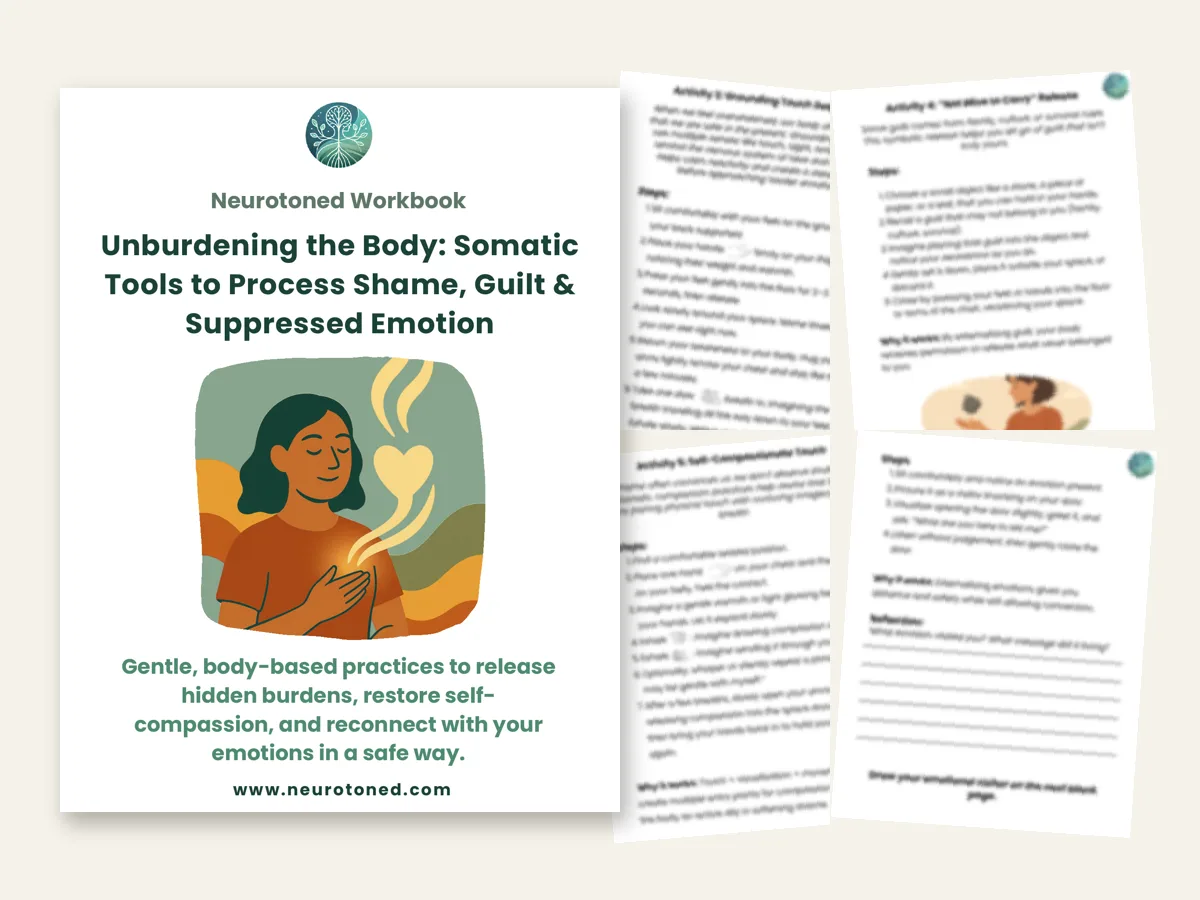
Everything you get
- ✓ Four guided sessions with Candice Winterboer, one a week, that teach your body to let guilt and shame pass, so the pit stops following you through the week. Her welcome film starts you off.
- ✓ The “Not Mine to Carry” release: put down the guilt you took on from your family and never chose
- ✓ Guilt in the Body Mapping: find where the pit sits, so a thought you can't stop becomes a feeling you can soften
- ✓ Moving In and Out of Shame Collapse: teach your body it can leave the shape shame folds it into
- ✓ Emotions as Visitors: let a hard feeling knock, say its piece and leave, while you stay steady
- ✓ Four more practices, some as short as three to five minutes, with reflection pages through every week so you can see what shifted
- ✓ The daily check-in page: one line a day for your energy, your feeling and your body, so you can watch the shifts
- ✓ Your own weekly plan, built from the practices that helped you most, to keep long after the four weeks
- ✓ Lifetime access on the Neurotoned app: yours for every boundary, every hard visit home, every week the old feeling comes back
- ✓ Feel the difference, or every cent back within 30 days
$70$16.99
76% off while the campaign runs
This price ends in 06:00:00.
If a small voice says spending $16.99 on yourself is selfish, notice whose voice it is. That is the Guilt Lock, talking about the exact thing this program is for. You are allowed to go first, for once.
One payment. Lifetime access. 30-day guarantee.
Feel the difference, or pay nothing.
Try it for 30 days. If it isn't for you, email support@neurotoned.com and we refund every cent. No conditions, no questions.
No forms. No exit survey. The refund is yours.
Unburdening the Body is yours for life, not a subscription. You pay once. One thing you should hear from us rather than find out: on the page after checkout we usually offer you a Neurotoned membership. It is optional and priced on its own. Saying no takes one tap and changes nothing about what you bought.
What happens when you click the button
The Neurotoned checkout opens. You enter your email and your card. In about a minute you are in your members area on the Neurotoned app, with Week 1 open and the workbook ready to download. The first practice takes three to five minutes. You could feel the difference tonight.
Next week, someone will ask you for something.
They always do. And you know how the week goes if nothing changes. The yes you don't mean, or the no you pay for until Friday.
Now picture it going another way. You say no. Your stomach tightens, the way it always has. But this time you know what it is. You feel your feet on the floor. You put a hand where it sits. You let the feeling be there, and you watch it pass in minutes, not days. No replay. No rehearsing. No silent apology on a loop.
That is what these four weeks give you. You still care about people. You say no anyway. You rest on a Sunday without earning it first. You let someone take care of you for once. And you sleep that night.
And the old fear goes quiet. The guilt was never proof that you are selfish. It was a feeling your body never got to finish. You were never broken. You were braced.
You can close this page, and the pit will be there next Friday. Or you can spend $16.99, take fifteen quiet minutes, and start Week 1 tonight. If it isn't for you, you have 30 days and every cent comes back.
Start Unburdening the Body · $16.99 →One payment. Lifetime access. 30-day guarantee.
Honest answers to honest questions.
Is this therapy?
No. Unburdening the Body is an educational program in body-based tools. If you have a therapist, it sits next to that work, never in place of it, and it works on the part of you that talking can't reach. If you are in crisis, please reach out to a professional or a local crisis line now.
Will I have to relive painful things?
No. Nothing has to be relived. Week 1 builds safety before anything else, and every practice works in small doses with a way back to steady. You set the pace the whole time.
Guilt and shame work has flooded me before. Is this different?
That is exactly who the small doses are for. You never go straight at the hardest feeling. You go near it, briefly, while your body stays steady, and you can stop whenever you like.
How much time does it take?
Each weekly session is 13 to 17 minutes. Some of the workbook practices take 3 to 5 minutes. Go at your own pace. There is no clock on it.
Is there a subscription?
No. One payment and it is yours for life. Nothing renews and there is nothing to cancel. You will usually be offered our membership after checkout. It is optional, priced on its own, and saying no changes nothing about this program.
What if it doesn't work for me?
30-day guarantee. Full refund. No questions. Email support@neurotoned.com within 30 days and we refund every cent.
How do I get it?
Tap any orange button on this page. The Neurotoned checkout opens. Enter your email and your card, and you will be in your members area in about a minute, with Week 1 ready.
One payment. Lifetime access. 30-day guarantee.
P.S. If you skipped to the bottom: Unburdening the Body is a gentle four-week program from Somatic Experiencing Practitioner Candice Winterboer, for guilt and shame your body won't let go of. Four guided sessions, eight practices, a full workbook and lifetime access. $16.99 today, regularly $70. One payment. 30 days to change your mind.
P.P.S. The one line worth keeping from this letter: you can't think a stomach unclenched. Guilt that lives in the body has to finish in the body. Four weeks from now, the next no costs you a few minutes, not a week. Start tonight.
P.P.P.S. A question this letter didn't answer? Email support@neurotoned.com and a real person will reply.