
I slept 11 hours and woke up exhausted. After 4 years of doctors saying “it’s probably stress,” I finally found what was actually wrong.
Not the kind of tired where you should go to bed earlier. The kind where you sleep a weekend away, wake up feeling concussed, and have to ration energy to brush your teeth.
It turned out rest was never going to fix it, and there is a specific reason why.

I am 38. For four years I was exhausted in a way that nobody could find on paper, and if that sentence landed somewhere in your chest then you already know the specific loneliness of it.
I had a job I was barely keeping. A relationship I was barely showing up for. I would lie down at 3pm because standing was too much, then lie awake at 3am because my brain would not shut off. Exhausted and wired at once, which nobody warns you is even possible.
Here is what I am going to tell you, and I have put it in order:
- The three weeks that accidentally proved rest was not the answer, and what that ruled out
- Why the supplements aimed at energy production were never going to work, no matter which brand I bought
- The difference between a body that is relaxed and a body that has collapsed, which feel identical from the inside and are not remotely the same thing
- What actually moved first, and how long it took, including the parts that are still not fixed three months in
I am not a doctor. I am somebody who spent four years and a genuinely embarrassing amount of money being treated for things I did not have.
Four years, and everything I tried
I am going to list it, because if you are reading this I would bet you have been round some version of the same loop.
The tests. Fourteen of them for me. Bloodwork, sleep study, MRI, thyroid panel. All within normal range, which everybody delivers as good news and nobody understands is the worst possible answer when you can barely stand up.
The supplements. Magnesium, ashwagandha, adaptogens, methylated B vitamins, a mushroom complex, something with a name I still cannot pronounce. They are in a basket in my bathroom and most of them are expired. That year they cost more than my rent.
Sleeping more. The advice everybody gives and the one I followed hardest. Eleven hours, weekends written off, three full weeks of medical leave doing nothing at all. I want to come back to this one, because what it proved turned out to be the entire answer.
The meditation apps. Three of them. I would open one, hear the calm voice say let's begin with a deep breath, and my chest would tighten. By day six I had forgotten my password. Then I felt ashamed about failing at relaxing, which is its own special kind of tired.
Cutting things out. Gluten, dairy, sugar, then a juice cleanse, then a thirty-day protocol that made everyone at dinner feel sorry for me. I felt slightly worse. I assumed that was the detox.
Caffeine. Coffee, then more coffee, then the matcha phase because somebody told me it was gentler. Then the crash, then needing more, then anxiety stacked on top of the exhaustion, which is a uniquely awful combination.
By year four I had read enough symptom searches to be convinced I had every chronic illness in existence. I was in three private groups full of people exactly as tired as I was. We swapped protocols nobody could finish. We all agreed something was badly wrong and not one of us could prove it on paper.
The day it broke open was an ordinary Wednesday. I was at my desk, I had already had two coffees, and I stood up to walk to a meeting and my legs felt like they belonged to somebody else. I sat back down. I put both hands flat on the desk and looked at them, and then I started crying in an open-plan office at eleven in the morning, which I had never done in my life. My manager found me like that and suggested I take a week or two.
I took six. They became three months of medical leave.
The three weeks that ruled out the obvious answer
The first week of leave I slept. The second week I slept. Somewhere in the third week I sat up in bed at two in the afternoon and had a thought that reorganised the entire four years.
If rest was the answer, three weeks of nothing would have fixed me. It hadn't. Which meant rest was not the answer.
That sounds small written down. It was not small. I had spent four years assuming I was in energy debt and that enough rest would eventually pay it off. Three weeks of doing genuinely nothing is a serious repayment. And I woke on day twenty-one exactly as heavy as day one.
So the problem was not a deficit. It was something else, still running, that rest did not reach.
The question I had been asking wrong for four years
I had spent four years asking what is wrong with me, hoping for a name I could put on a form. That was the wrong question. The right one, which I found somewhere around two in the morning reading a paper I barely understood, was this: what decides whether my body is willing to recover at all?
That is how I got to the vagus nerve, and to a phrase I had never once heard from any of my fourteen specialists. Dorsal vagal shutdown.
It is a state the nervous system drops into after it has been overwhelmed for long enough. It stops trying to fight or flee, and instead conserves. Goes offline. Energy drops, sleep stops repairing you properly, digestion slows, your face goes flat, your thinking fogs. It is not a mood and it is not weakness. It is a protective setting, and it is doing exactly what it evolved to do.
And then the sentence that actually wrecked me:
You don’t come out of shutdown by resting harder.
Where your system sits
Wired
sympathetic
Braced. Heart going, jaw set, cannot switch off.
Settled
ventral vagal
The only state where the body repairs, digests and recovers.
Shut down
dorsal vagal
Flat, heavy, far away. Still, but not resting.
You come out of it by giving the system specific physical signals that it is safe to come back online, and repeating them until the pathway is familiar again.
Suddenly the whole failed list made sense in a way it never had. The supplements were aimed at energy production, but my body was not producing energy because the system that decides whether to produce energy had decided no. The thyroid medication was aimed at hormones that were fine. The antidepressant was aimed at sadness, and I was not sad, I was shut down, which turns out to be a completely different thing.
What was wrong was not fifteen things. It was one thing, running the show.
Relaxed and collapsed feel identical. They are opposites.
This is the distinction nobody had ever made for me, and it is the one I would most want you to walk away with.
When you lie down at the end of a day that has taken everything, your body is still and heavy and doing nothing. That looks like rest. It can even feel like rest. But a collapsed system and a settled system are not the same state, they just produce a similar stillness, and only one of them is repairing anything.
Which is why you can rest for three weeks and gain nothing. You were not resting. You were lying down inside a shutdown.
What I was doing
Collapsed
- Still, heavy, doing nothing at all
- Eleven hours of sleep that repaired almost nothing
- Waking at the same floor I went down at
What I was aiming at without knowing
Settled
- Also still, and completely different underneath
- Digestion, repair and recovery back online
- The state sleep needs in order to do its job
Nobody can tell the difference by feel at the start. I certainly could not. It took me about two weeks of practice before I could, and being able to tell is most of what changed.
So before any of it, the honest question is which version of tired you are actually in.
Flat all the way down
dorsal vagal
Heavy from the moment you wake. Sleep does not touch it. Standing up is a decision you have to make.
Sounds like meTired but wired
mixed
Lying down at 3pm because standing is too much, then lying awake at 3am because your brain will not stop.
Sounds like mePush then crash
boom and bust
One good day, so you use all of it, and then you pay for three. You have learned to dread feeling well.
Sounds like meMost people are one of these most of the time, and something else on a bad week.
What I actually did, lying in bed at 11am
I almost did not try it. I had been burned by wellness before and I had developed something close to an immune response to the word transformation. What got me was that it did not promise anything overnight. It said: practices you can do in bed, built for people whose energy is on a budget.
The first one was three minutes. A specific exhale pattern with a soft hum at the end. I remember thinking this cannot possibly do anything, and doing it anyway, because I was already lying down.
I did it twice that day, and only because the instructor said something I had never heard anybody say: low-energy days are the right days to start, not the wrong ones. Every other thing I had tried in four years required me to have energy first in order to earn more of it. This was the first one that did not.
By day three I was falling asleep faster. By day five I had stopped reaching for my phone the second I woke. By the end of week two I was sleeping seven hours and waking up feeling like a person. Not a great person. A person. The bar had been on the floor for so long that this felt close to miraculous.

The thirty-minute walk
The moment I knew was about ten weeks in. I went for a walk. Outside, thirty minutes, no particular reason, and I came home and made dinner.
Then Tuesday came and I did not crash. Then Wednesday. By Thursday I sat on the kitchen floor with my back against the dishwasher and let myself understand that I had spent a whole half hour on my feet and paid nothing for it. For four years, thirty minutes outside cost me three days in bed. That arithmetic had run my entire life, and I had stopped noticing I was doing it.
My husband said I seemed more here. That one made me cry.
What is still not fixed
I am writing this three months in and I want to be straight with you, because I read enough testimonials during my four-year spiral to know exactly what overclaiming sounds like, and I promised myself I would not do it.
I am not running marathons. I still pace myself. I still get low days. The difference is that they are days now rather than weeks, and when one arrives I have something that works instead of white-knuckling through it and hoping.
I still practice ten to twenty minutes a day. I still go to the live sessions when I can. This is not a thing I did and finished. It is a thing I do.
And if you are living with ME/CFS, long COVID or fibromyalgia, I am not going to stand here and tell you this is your answer. I do not know that. What I can tell you is that nothing in it asks you to push through or build up, everything can be done lying down, and if you crash after exertion you should talk to whoever manages your care before adding anything at all, this included.
Who built the practices
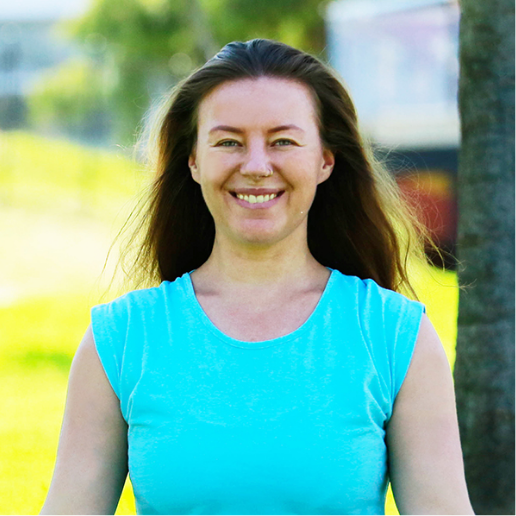
Taryn Elise Herselman
Somatic practitioner, body-based therapeutic work
MA Psychology · 15+ years clinical practice
A Johannesburg-based somatic practitioner with fifteen years in clinical practice, twelve years of residency-style study in India, and an MA in Psychology. Her work centres on nervous-system recovery: stress, exhaustion, and the body's part in emotional health. The practices here were built around what a braced or shut-down system can actually absorb, which is why most of them are done lying down and none of them ask you to hold a shape.
So before anything else, one question: which version of tired are you in?
Answer it on the next page and you’ll see the practices built for that state, and the programs you’d start with, before you decide anything at all.
Free for 7 days. Cancel any time.
I am not the only one
“I’m really enjoying this program, it’s making a big difference to my wellbeing. I like the daily practices and I now have a good toolkit to draw on. My nervous system is gently settling down and I feel I’m able to handle life better.”
“Hi, I am so glad I found Neurotoned. The gentle exercises are very accessible due to its bite-size offerings, as it allows me to fit them into my daily busy routine flexibly. I now find myself doing the breathing exercises automatically when feeling anxious. A big thank you to the Neurotoned team, you ladies are doing awesome work. Looking forward to learning more from all of you!”
“This is a very comprehensive program presented in a simple non threatening way. I am very impressed. The exercises are really helping me. I have chronic pain and have experienced emotional traumas. This was exactly what I needed. If you're on the fence about wether it's worth it, just do it! You won't be sorry!”
“I think the is easily the best resource I have ever found via the internet. Lots of gentle encouragement, but no pressure. Excellent resources that you can access in your own time. Really reasonable rates and no hidden gotchas. If anything about what they offer sounds like what you need then take the plunge. It’s not even a plunge, if you don’t want it to be ☺️”
Individual results vary. These are members’ own accounts, not a prediction of your outcome.
Two versions of next spring
In one of them you are roughly where you are now. Still rationing. Still doing the arithmetic before you agree to anything, still deciding whether a coffee with a friend is worth what it will cost you on Thursday. Still being told that everything came back normal. I lived in that version for four years and I know exactly how long a person can survive inside it. That is the problem with it.
In the other one you can tell the difference between settled and collapsed, so you stop mistaking one for the other. The bad days are days. And once in a while you spend thirty minutes on your feet and pay nothing for it, and it takes you until Thursday to even notice.
The distance between those two is one honest answer about the state you are actually in.
You don’t come out of shutdown by resting harder.
Free for 7 days. Cancel any time.
Honest answers