
Myofascial Release · Jaw · TMJ · Headaches
If your jaw clenches and your neck never lets go,
four weeks can help you release it.
The clenching a dentist calls TMJ, and the headaches that follow. From a chair, never on the part that hurts.
You wake up with your teeth already together.
Not sore. Just set. Like you have been holding something all night and nobody told you what.
You lie there and take the inventory. The hinge of your jaw, in front of your ear. Neck. Lower back. The hips, which will have their say the first time you stand up.
By eleven your shoulders are back up near your ears. By three the lower back has started. You shift. You cross your legs and uncross them. By six the tightness has climbed past your neck and settled at the base of your skull. You push away from the desk and stand up like you meant to.

In the meeting you move for the fourth time and say you are fine, because saying anything else means explaining it again. You are clenching your jaw while you say it. You did not decide to.
In the shop you ask somebody taller to reach the top shelf, and you make it sound like a favour.
Getting into the car you have a way of doing it now that avoids the thing that pulls. You have never once described it out loud.
On Saturday there was something you would have said yes to. You did the arithmetic first. You know what the next day costs. You said no.
So you tried things. Properly.
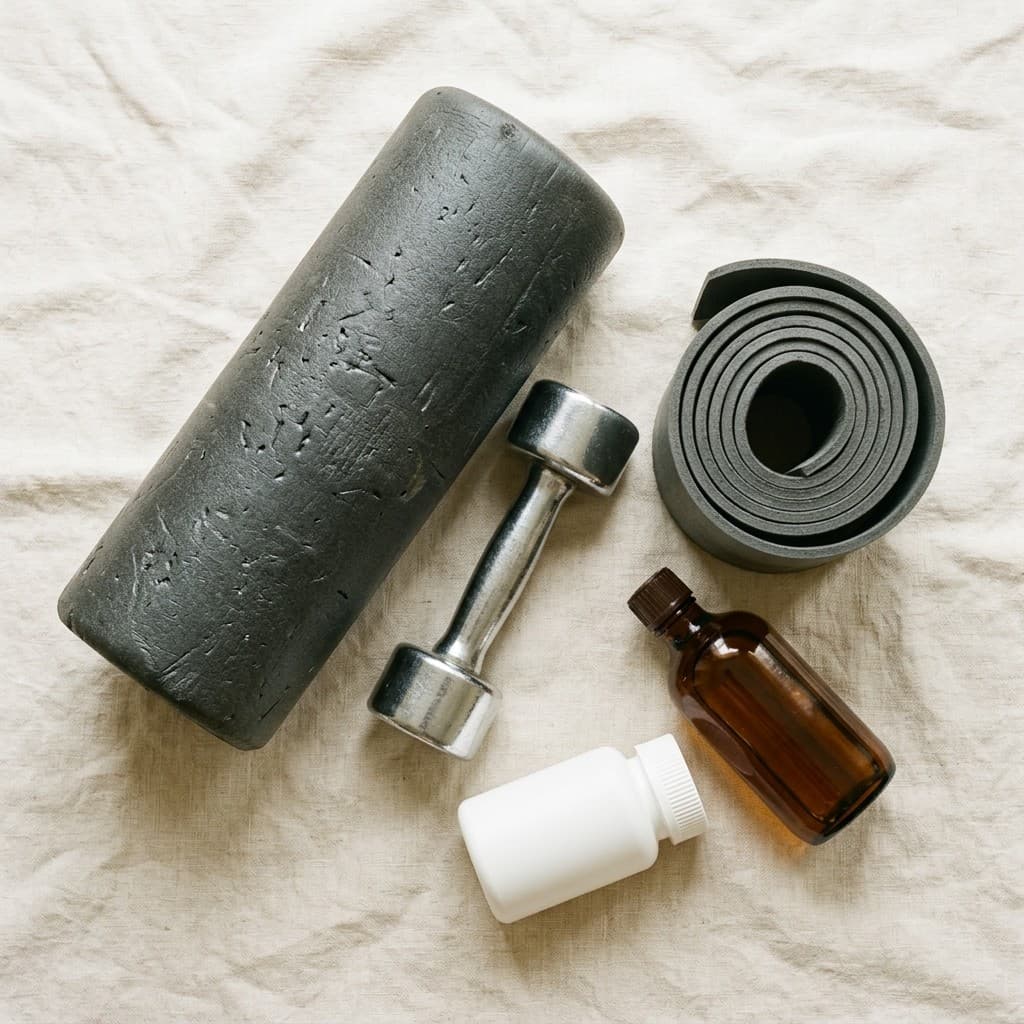
Deep tissue that left you feeling worked on for two days and sore on the third. A foam roller you rolled through the pain on, because that was the instruction. Months of stretching that gave you the range back and took it away the moment you stopped. Anti-inflammatories for the bad afternoons. Gym rehab that made you stronger without making anything easier. You could add up what all of it has cost you by now. You have chosen not to.
Every one of them worked for a little while and then handed the tightness straight back.
And here is the part you do not say out loud. You are not really frightened of the stiffness. You are frightened that it is permanent. That this is your body now. That in five years it is worse, and the answer, when it finally comes, is one nobody can do anything about. You have already started leaving things out, quietly, one at a time, and nobody had to tell you to.
They scanned you. They checked you. Everything came back normal. That was supposed to be good news. What it actually left you with was no reason and no end date.
So read that list again, because it is not a list of your failures. It is a result.
Five methods. All of them aimed at the tissue. All of them temporary. That is not five things that did not work. That is five experiments telling you the same thing.
The tissue is not the problem.
Nothing in you is torn. Your body is braced.
Bracing is not damage. It is a decision. Your nervous system's first job is to keep you safe, and when nothing has told it the danger has passed, it holds you tight as a precaution. Stiffer joints. Shallower breath. Movement it can pull back from quickly.
The fascia, the connective tissue web that runs from your scalp to the soles of your feet, then sets around the bracing. Not scarred. Set. The way a hand held in a fist all day is not injured. It has just stopped remembering that it opens.
That is why nothing showed on the scan. A scan shows damage. It cannot show how hard your body is holding. There was nothing there to find.
And it is the only explanation that fits all of it. It explains the massage that wore off by Friday. It explains the roller that gripped harder the longer you rolled. It explains the stretch that held only while you were holding it. It explains getting stronger without getting easier.
It also means the thing you are most afraid of is not true. A brace is not degeneration. It is not the beginning of something. It is a decision your body is making today, and a decision can be changed. You do not have to take that on faith either. There is a test further down this page that takes ninety seconds and settles it on your own neck.
You just cannot change it by force. That is the one thing everything you tried had in common.
What follows is how you change it instead. What the people who study this tissue have actually found. Why every method you tried was aimed a level too low. Why the field spent a century looking at the wrong tissue. The sequence itself, and why it starts at your feet when it is your neck that hurts. A test you can run on yourself in ninety seconds. Who teaches it. And what four weeks of it actually asks of you.
The Research Caught Up
For most of the last century, fascia was thrown away
then anatomists went looking at what they had been discarding

In dissection rooms, the white fibrous sheeting that wraps every muscle was cut off and set aside to get a clean view of the muscle underneath. It was called packing material. Nothing in the textbooks suggested it did anything worth measuring.
That changed slowly, and then formally. In October 2007 the first International Fascia Research Congress was held at the Harvard Medical School Conference Center, bringing anatomists, cell biologists and manual therapists into the same room to look at the same tissue. Two questions dominated the field from that point on: what is fascia actually made of, and what governs how stiff it becomes.
Rolf worked from a premise the anatomy of her day did not support: that the body is one continuous fabric, and fascia the organ that holds its shape. She argued it responds to slow sustained pressure rather than force, and that pain in one place is often organised somewhere else. She had the map decades before there were instruments to test it.
Rolf, Rolfing: Reestablishing the Natural Alignment and Structural Integration of the Human Body for Vitality and Well-Being, Healing Arts Press, 1989
Stecco spent years dissecting unembalmed bodies to document fascia layer by layer, and published it as a full atlas. The tissue turned out to be densely supplied with nerve endings, the receptors that report pressure, stretch and position. Fascia, on this evidence, is not the wrapping around the sensing organs. It is one of them.
Stecco, Functional Atlas of the Human Fascial System, Churchill Livingstone / Elsevier, 2015
No pair of hands can produce the force it would take to mechanically deform dense fascia, yet the tissue plainly changes under them. Schleip's answer, published in 2003, was that the change is neurological: slow, sustained pressure stimulates the receptors in fascia, which changes nervous system output, which changes muscle tone. The pressure is a signal being sent, not a structure being forced.
Schleip, 'Fascial plasticity: a new neurobiological explanation', Journal of Bodywork and Movement Therapies, 2003, parts 1 and 2
Porges named the process by which the body judges threat below conscious thought: neuroception. Physiology does not shift toward rest because a person decides to relax. It shifts when the system detects enough cues of safety. He also traced the link between the breath and the heart, which is why the length of an exhale is part of the signal.
Porges, The Polyvagal Theory, W. W. Norton, 2011
Craig mapped the pathway that carries the body's internal state up to the insular cortex, and argued in 2002 that it is a distinct sense: interoception. When that sense reports poorly, a body can brace for years without its owner registering it as bracing.
Craig, 'How do you feel? Interoception: the sense of the physiological condition of the body', Nature Reviews Neuroscience, 2002; and How Do You Feel?, Princeton University Press, 2015
Fascia is a sensing, densely innervated network, and how tightly it holds follows the nervous system's ongoing judgement of whether the body is safe.
None of this is contested at the level of the research, and none of it has reached the people living inside a body that will not let go. It sits in atlases, congress proceedings and journals, and not in anything a person can do sitting on a chair with a rolled hand towel on an ordinary Tuesday afternoon.
You have already tried the obvious things.
Every one of them was aimed a level too low.
Find the tight spot. Push harder. Stretch further. Break up the knot.
That is the instruction almost everybody gets. You followed it. It teaches you to ask your body one question: how much can I take.
Every honest answer you gave made the bracing worse.
The instruction was wrong. You were not.
Something never gets called off
Stress, a strain, an old injury, years of sitting still. Nothing tells your body the danger has passed.
So the tone goes up
Your nervous system holds you tighter as a precaution. Stiffer joints, shallower breath, movement it can pull back from.
And the fascia sets around it
The connective web keeps the record of that tone. Not torn, not scarred. Shorter, thicker, and with less give in it.
Which is what you actually feel
A jaw already shut in the morning. Tight shoulders by eleven. A low back by three. A head that aches by evening.
And a guarded body is read as one more reason to guard. So it runs again.
Where the four weeks cut in
Slow, gentle pressure, away from where it hurts, timed with the breath going out. The tone comes down, and the web lets go.
Deep tissue and sports massage. It works on tissue, by force, and there is real relief in being worked on by somebody good. But think about what you did on that table. You held your breath. A held breath is your nervous system saying: this is happening to me. So the tissue got pushed, nothing told the brace it could stand down, and by Thursday the tone was back.
Foam rolling and hard trigger point work. Same level, and this time you were the one pressing, told to roll through the pain. Press hard into an area that is already guarding and the body reads it as one more thing to guard against. It grips. You were not doing it wrong. You were doing it to a place that had already decided it needed protecting.
Daily stretching. Months of it, some of you. It is good for keeping range you already have. The range went again the second you stopped, because length was never what was missing. A braced body meets a hard pull by bracing harder.
Painkillers and anti-inflammatories. They work on chemistry, and they took the edge off a bad afternoon. They never touched why three o'clock is when your back starts. They quiet the alarm. They do not tell the body the danger has passed.
Chasing the sore spot. It assumes the pain is where the problem is. So you treated the neck. Then the low back. Then the hip. Fascia is one connected web, and it shares load: guard one place and something else picks up the difference. A jaw clenched for years and shoulders that never came down hand the load upward, which is how a braced body ends up with a head that hurts. The pain moved because you were following it around.
The gym and the rehab plan. Strength is real and worth having, and you got stronger. But strength does not lower resting tone. Stronger, no easier, and a week of payment for the days you pushed.
None of it was stupid. Every one of them was aimed at tissue, at chemistry, or at capacity.
The brace is set a level above all three. It is set by a nervous system that has never been told the danger has passed. So the question was never whether you were consistent enough or pressed hard enough. It was which level of you any of it was reaching.
How you talk a body down
You cannot force a brace open.
You take away the reason for it, and it opens on its own.
For most of the last century, fascia was treated as packing material. Wrapping around the parts that mattered.
That was wrong. Fascia is full of nerve endings. They report pressure, stretch, movement, and where your joints are. In some places there are as many of them as there are in your skin.
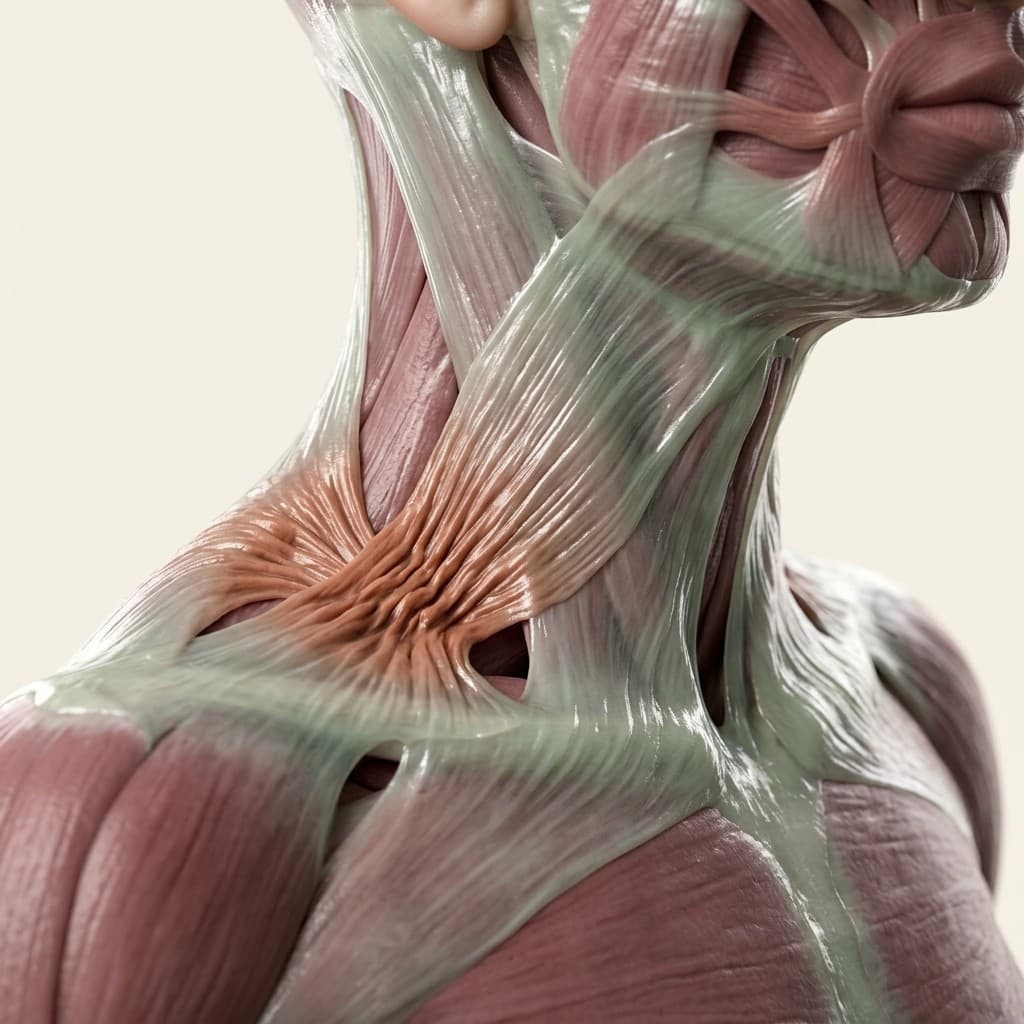
They report to your brain all day, without stopping. Your brain uses those reports to answer one question.
Am I safe.
Muscle tone is the answer. Tone goes up when your brain thinks you need protecting. It comes down when your brain stops thinking that. As Theresa puts it, the nervous system sets muscle tone, and fascia keeps the record of it.
None of them were working on dead material. They were pressing on nerve endings, and your brain read that pressure before any tissue was allowed to change.
So when the pressure is hard enough that you hold your breath, your brain gets one piece of information: it still hurts there, keep protecting it. Tone goes up. That is the correct response to what it was told. It is also the opposite of what you wanted.
Which is why this work runs the other way round. Three rules, and they are in every session.
One. Slow and gentle enough that you keep breathing. That is the test. Not how much you can tolerate. How much you can stay relaxed through.
Two. Work away from the sore place. A neck that already hurts is sending a loud signal all day, and a little more pressure there does not change it. The soles of your feet are quiet. A small signal there is one your brain will actually notice. That is why the first week is your feet when it is your neck that hurts.
Three. Time it with the breath going out. A slow exhale is itself a signal to settle. So you are not only choosing where to press. You are choosing when.
Now test it, before you decide anything about any of this.
Turn your head slowly left, then slowly right. Twice. Notice where it stops, and whether one side goes further than the other.
Now put your hands in your lap. With your right thumb, rub the fleshy web between the thumb and first finger of your left hand. Lightly. About thirty seconds. Nowhere near your neck.
Stop. One easy breath. Turn your head again.
Something may have moved. Something may not. Either way you have an answer, and it took ninety seconds. You pressed gently in one place, and looked for a change somewhere else. That is the whole method, and it is the shape of Week 1.
Here is the objection, and it is a fair one. Gentle sounds like nothing. Everything that ever helped you, even for two days, was intense. A rolled hand towel on the sole of your foot sounds like a waste of an afternoon.
That is the point. Intense is what your body has been reading as a threat for years. The question this program asks is not how much pressure you can take. It is how little you can use and still notice something change.
You are not forcing anything open. You are taking away the reason it is holding.
Key idea
Fascia is full of nerve endings, and they report to a brain that is deciding all day whether you still need protecting. Muscle tone is that decision. Hard pressure on a guarded body tells the brain the danger is real, so tone goes up. Slow, gentle pressure, away from the pain and timed with the exhale, tells it the opposite. The brace opens because the reason for it is gone, not because it was forced.
The Practitioner
The person counting the breaths and holding the towel is
Theresa Moodie

Theresa is an acupuncturist, a wellness coach and a qualified yoga teacher. Two of those sit behind almost every instruction in this program, and it is worth knowing which is which.
The acupuncture is where working away from the pain comes from. A practitioner trained in Traditional Chinese Medicine does not spend her days pressing on the spot that hurts. She is used to treating a forearm and watching a shoulder change. Treating a calf and watching a hip move differently. So when the material tells you to start at your feet, that is not a technique she read somewhere. It is how she was taught to look at a body from her first year.
The yoga is where the breath comes from. Five seconds in, five seconds out. The calf squeeze timed to the exhale. Two slow breaths to open a practice and two to close it. She teaches breathing the way somebody teaches a thing they have led rooms of strangers through, in retreats and trainings, in more than one country. It is why the pacing is unhurried, and why she keeps saying notice instead of push.
Her whole framework is the one sentence this letter has already quoted. Tone is set by the nervous system. Fascia keeps the record of it. Everything else follows from that, including the refusal to force.
And in the sessions, at the exact moment your instinct would be to lean in harder, the line she comes back to is that slower is often more effective than deeper.
Inside the program
Myofascial Release: Restoring Ease to the Body
four weeks, a hand towel, and a body that stops bracing
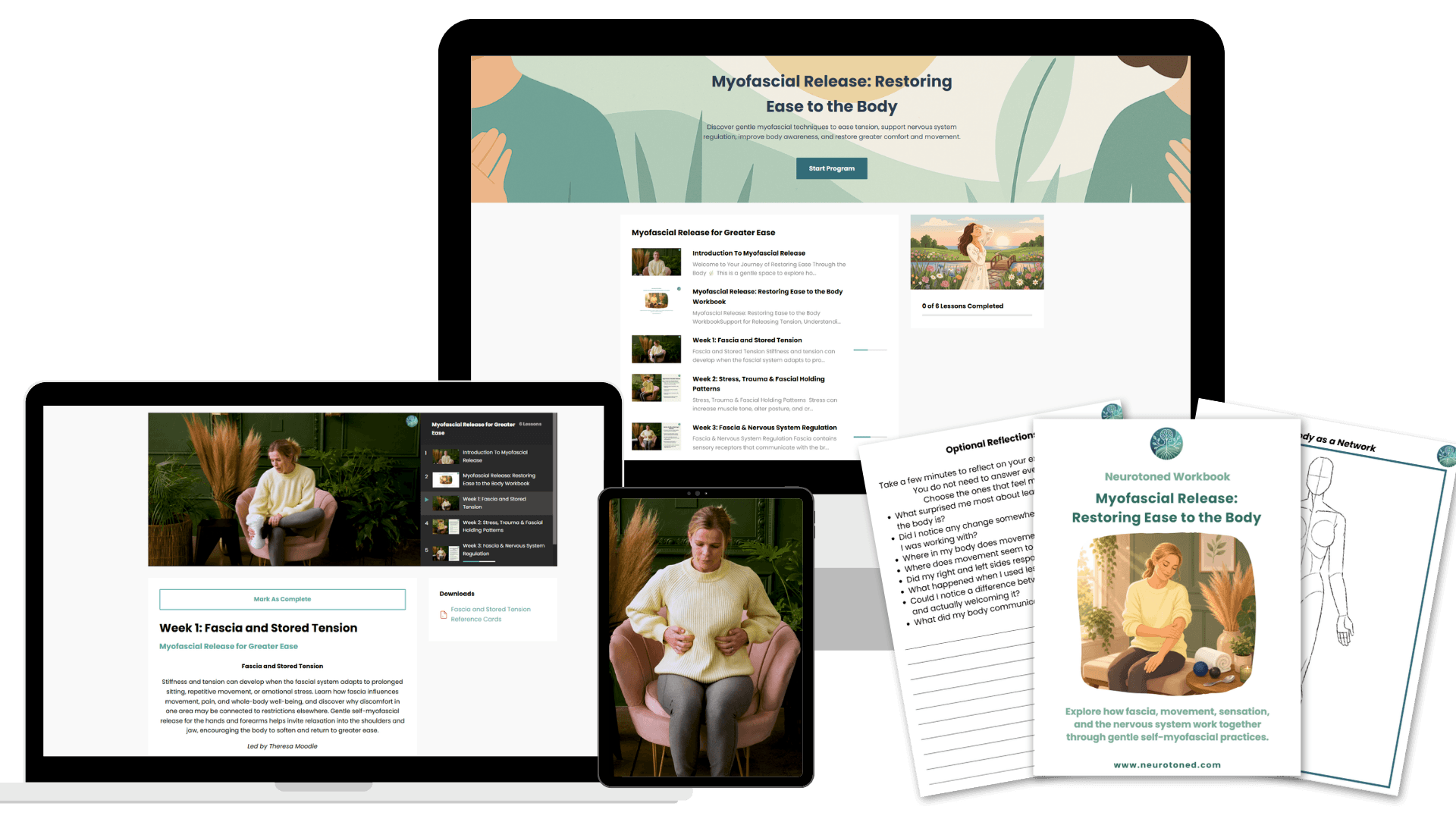
Five sessions and a workbook. Watch every session lying down, in pieces, across as many sittings as you need. Nothing in it asks more of you than making a cup of tea. It works the whole web in an order, the quiet places first and the loud ones last, which is why your jaw is the end of the sequence and not the beginning.

The session with no practice in it
Nothing is asked of your body. Theresa names the tools (a rolled hand towel, your hands, a massage ball, the back of a spoon), tells you what release actually feels like, and walks the safety guidance before you touch anything. The rule from here on: slow down rather than work harder, and never tolerate real pain to get a result.
Starting where it doesn't hurt
Two slow breaths. A rolled towel under the sole of one foot, heel to ball. Then the calves, squeezed gently as you breathe out. Then circles from wrist to elbow. You are nowhere near your neck the entire time. Then you stop, feet on the floor, and find out whether your shoulders came down.
Why pulling harder made it worse
The week that explains the months of stretching: a body that feels unsafe answers a hard pull by pulling back. Then the opposite of what you were told. Towel brushing from the collarbone to the shoulder, sweeping along the tops of the shoulders and across the shoulder blades, or a ball against a wall, kept off the spine.
Getting the breath to the bottom of your ribs
Hands on your lower ribs, and the ribs widen under your palms. The towel along the ribs, slow clockwise circles on the abdomen, then the hip flexor crease for two or three breaths. It closes with five seconds in and five seconds out, counted for you.
The sequence you keep, soles to jaw
Feet upward, in the order everything has built toward: soles, calves, hip flexors, chest, the tops of the shoulders, the rib cage, then the jaw, with your tongue resting at the palate. Hands and forearms last. Three slow breaths at every stop. This is the one you keep, and three parts of it counts.
The practices that are not in the videos
Not a summary of the sessions: a second set of practices the videos never teach, two for every week. It opens with eight statements you score out of ten and closes by asking you to score them again, so the month has a before and an after, and it is yours.
The head and neck session
It starts at your hands and forearms, then the tops of the shoulders, the sides of the neck swept and never pressed, the base of the skull, the jaw, the temples and the scalp. Fourteen minutes, with a two minute version for a day when it has already climbed. It is being filmed now, and lifetime access means it lands in your library without a second payment.
What usually shifts
The changes people tend to notice are small,
and they show up in ordinary moments first.
These are shifts commonly reported with this kind of work, listed in roughly the order they tend to appear. Not a schedule, not a promise, and not the same on any two days.

Release is rarely dramatic. It looks like a body that has slightly less need to hold on.
In their words
What changed
from people who did the work.
In their own words, from members, quoted exactly as they were written. Individual results vary.
“The best tool in my evening unwinding routine.” I used to go to bed with a racing heart and clenched jaw, waking up every few hours. Doing one of the gentle myofascial release modules right before bed signals to my body that the day is over. It relaxes the physical grip of stress in my neck, jaw, and back, allowing me to fall into deep, uninterrupted sleep.
“I finally stopped fighting my own body.” For years, I treated my tight neck and shoulders like an enemy to be beaten into submission. I did aggressive deep tissue massage, intense foam rolling, and deep stretching—only to end up tighter two days later. Theresa’s approach completely inverted my mindset. She showed me how fascial restrictions are often just protective holding patterns from my nervous system. Learning to apply slow, comfortable pressure and subtle movement gave my body permission to let go rather than guard itself. My shoulders are lower than they’ve been in five years.
“It bridged the gap between my nervous system and my physical pain.” I’ve done talk therapy and vagus nerve breathwork, but my body still felt like it was wearing a suit of armor—especially through my hips and chest. This course was the missing piece. Combining gentle myofascial techniques with nervous system awareness helped me understand that my fascia was holding onto chronic fight-or-flight energy. The practices are so gentle that my system never felt threatened or overloaded. I felt an overwhelming sense of physical safety I haven’t felt in a long time.
“In just 10 minutes a day, the physical tension stopped compounding.” I don't have an hour every day to do elaborate somatic routines, so I was skeptical if a short program could make a difference. Theresa’s 5-to-10-minute targeted practices fit effortlessly into my routine. Doing a session right after work acts like a reset button, melting away the desk posture and stress before I start my evening with my family. It’s practical, grounded, and immensely effective.
“No forcing, no pain, no pressure to 'push through.'” As someone with a history of trauma, intense bodywork or aggressive stretching often triggers my freeze response. What I love about Theresa Moodie’s guidance is how deeply trauma-informed it is. She constantly reminds you that you don't need to force a release—you’re just inviting the body to soften. That gentle cueing allowed me to stay present in my body without feeling overwhelmed or disassociated.
“My morning stiffness dropped by 80% without triggering a flare-up.” Living with chronic joint and muscle stiffness made me fearful of movement. Most exercise or stretch programs left me sore for days. The slow-pressure and gentle movement practices in this program respected my body’s boundaries. Within three weeks, I noticed I could turn my neck comfortably while driving and bend over to tie my shoes without that familiar sharp bracing sensation.
“My body finally feels like a safe place to rest.” Burnout had left me running on adrenaline while my body felt completely guarded and exhausted. I couldn't relax even when lying in bed. Working through this program helped unravel that deep physical tension that quiet rest couldn't reach. The combination of gentle fascial pressure and mindful somatic awareness retrained my body to down-regulate into true rest.
“It completely changed how I understand body awareness.” I’ve practiced yoga for over a decade, but I was still carrying stubborn tightness in my lower back and ribcage that yoga alone wasn't resolving. Theresa’s background as an acupuncturist and yoga teacher really shines through. Her explanation of how the fascial network connects to breath and nervous system regulation gave me a far deeper level of body literacy. My movement feels fluid and effortless now, rather than forced.
The Program
Myofascial Release: Restoring Ease to the Body
Taught by Theresa Moodie, acupuncturist, wellness coach and qualified yoga teacher.
You could book this instead. An hour in the diary, the travel both ways, somebody good working on you, and you walk out looser. By Thursday it is back. Not because they were bad at it. Because the change happened in their hands, not in your week, and nothing in the days between taught your body anything new. Your jaw is not clenching by appointment. A brace comes down when the signal arrives often enough to be believed, which means it has to be yours. That is the whole reason this is a chair, a towel and a few minutes, for one payment.
Program only
The full four-week program.
Yours for life.
Why it is priced the way it is.
Compared with any other route into this work, the regular price below is already small. One hour of hands-on myofascial release in a clinic commonly costs more than that on its own, and by Thursday it has worn off.
Neurotoned would rather more people did this work, not fewer. So on this page the price is the one on the button: one payment, lifetime access, nothing recurring.
In context
- One hour of myofascial release with a therapist: commonly more than the regular price of this whole program
- A deep tissue massage every few weeks: much the same, for as long as you keep booking
- A course of physio: several sessions, each one costing more than this
- The foam roller, the ball and the straps: already bought, and you know how that went
- Doing nothing for another year: free, and you have been doing that
What happens when you click the button.
You click. You enter your email and pay on the Neurotoned checkout. There is one short page after that, with an offer you can skip, and then you are in your members area. The introduction is the first thing there, with no practice in it: watch it lying down. The whole program is yours from the first minute. You can be sitting in a chair with a rolled towel under your foot inside ten minutes of clicking.
Today: $16.99
One payment. Lifetime access to the program. 30-day guarantee.
The guarantee, in plain terms.
You have 30 days. No log of what you practised and when, and nobody checking up on you.
If it is not for you, email support@neurotoned.com and we refund what you paid. No form. No retention call. Nobody asking you to explain what did not work, or offering you a pause instead of the refund you asked for. You do not owe anyone a reason, including us.
A person replies, and the answer is yes.
We ask one thing, and it is the thing we would ask if you rang us: watch the introduction and the first week, and give the towel a few honest days on your feet and calves. Not to prove anything to us. Most of what this does happens quietly, and a few days is about how long it takes to notice whether your breath is sitting lower and your shoulders are further from your ears.
From here, the choice is yours.
You can close this tab and go back to the version of your week you have been living in: teeth together before you are awake, shoulders up by eleven, the arithmetic before every Saturday. Nobody here is going to argue with that.
Or you can press the button, sit down with a rolled towel today, and find out for yourself whether your body is damaged or braced. If yours is one of the bodies that does not answer, the 30-day refund is there for exactly that.
One payment. Lifetime access to the program. 30-day guarantee.
Thank you for reading this far.
This is a long letter and we know it. If you came from the top, that is more attention than most people in pain can spare in one sitting, and it says something about how much you want this to change. The rest of the page is questions and answers.
One payment. Lifetime access to the program. 30-day guarantee.
The questions you would ask if we were sitting down,
answered the way I would answer them in person.
My body already punishes me for doing too much. Is this going to cost me the rest of the week?
The gentlest week asks less of you than drying the dishes. Week 1 is your feet, your calves and your forearms, sitting in a chair, one to three rounds of each. If that is still too much today, you do the soles of your feet and you stop. Theresa's test for pressure is that you can breathe normally, stay relaxed and stay present. The second you are holding your breath, the pressure is wrong and you ease off. There is no version of pushing through here, because a body that reads force as threat just braces again.
I've done deep tissue and foam rolling. Why would something this gentle do what the hard stuff couldn't?
Because the hard stuff was aimed at your tissue, and your tissue is not what is holding on. Tone is set by the nervous system. Pressure hard enough to hold your breath through gets filed as one more thing to guard against, so it raises tone instead of lowering it. This runs the other way: slow, gentle, away from where it hurts, timed to a long breath out, so safety registers first and the brace opens on its own. That is why the sequence starts at your feet when it is your neck or your jaw that hurts. And if you want to know before you spend anything, the head-turn test further up takes ninety seconds.
I clench my jaw. Somebody told me it is TMJ, and I get migraines as well. Is this for that?
Two answers, and they are different. There is jaw work in this program today: Week 4's full sequence works your jaw with fingertips or the back of a spoon, your tongue resting at the palate, and Week 2 works the neck and shoulders a clenched jaw never works without. A session for the head and neck is being added now, at no extra cost. What none of this is, is a treatment for a diagnosis. Nothing here treats TMJ or migraine, nothing replaces what a dentist or doctor has told you, and headaches that are new, severe or changing are a question for them first.
I already have physio, or yoga, or a class. Will this get in the way?
It sits underneath them rather than competing. It is not exercise. There is no loading and no stretching to end range, and it is built to be done sitting down with a towel or your own hands. Plenty of people use it as the thing they do before a session, or in the evening after one. Take extra care if you are on blood-thinning medication, bruise very easily, have clotting or circulation problems, are pregnant, have osteoporosis, have had recent surgery or an injury, or have unexplained or severe pain. The introduction lists all of it plainly and you can read it before you decide anything.
How long before I feel something different?
Often in the first session, though not the way you might be expecting. After the soles of your feet you stand up and check three things: whether your breath is sitting lower, where your shoulders are, and whether one foot feels flatter on the floor than the other. Theresa is blunt that release is usually quiet, and that healing is not measured by how intense the experience felt. The bigger changes, less stiffness in the morning, moving with less effort, sleeping deeper, tend to arrive across the four weeks rather than in one afternoon.
And if it does nothing for me, do I have to argue for my money back?
No. Thirty days, and the only thing asked of you is something you can check yourself: watch the first session and give the practices a few honest days with the towel. If your breath is not sitting lower and your shoulders are not further from your ears, email support@neurotoned.com inside the thirty days and you are refunded what you paid. No threshold to reach. No form defending your effort.
One payment. Lifetime access to the program. 30-day guarantee.
P.S. If you scrolled straight here, this is the whole thing in one paragraph. Nothing in you is torn. Your body is braced: a decision your nervous system makes when nothing has told it the danger has passed, and the fascia sets around it. That is why every scan came back clear, and why massage, rolling, stretching and the gym each worked for a couple of days and then handed the tightness back. All of them pushed, and a braced body reads pushing as one more reason to brace. This is Theresa Moodie's four-week program for the opposite: slow, gentle, away from where it hurts, timed to the breath going out. A rolled hand towel, a chair, one payment, lifetime access, and thirty days to change your mind.
P.P.S. Do not decide from the argument. Decide from your own neck. Turn your head slowly left and right, twice, and notice where it stops. Then rub the web between the thumb and first finger of your left hand for thirty seconds, lightly, nowhere near your neck. Then turn your head again. Whatever you find is the method in ninety seconds: you pressed gently in one place, and looked for a change somewhere else.
P.P.P.S. Any question before you decide, or after, the address is support@neurotoned.com.