
Neurotoned · The Vagus Nerve Reset
Chronic fatigue. Burnout that rest doesn't fix.
A body that won't settle.
There is one nerve at the centre of all of it.
What the last forty years of nervous-system research actually showed, and the 4-week protocol we built so you can use it at home.
There is a kind of exhausted that sleep stops touching.
You sleep a full night and wake up just as tired as when you lay down. The coffee does less than it used to. Your brain runs slower in the afternoon and louder at night. Small decisions feel disproportionately hard. You read the same paragraph three times before you take it in. You feel wired and flat at the same time, which seems like it shouldn't be physiologically possible, and yet.
The bloodwork came back unremarkable. The MRI was clean. The second doctor said it was probably anxiety and the third said it was probably overwork and neither of them was wrong, exactly, except none of them said the actual word for what was happening. The antidepressant evened out the lows by also evening out everything else. The supplements your friend swore by are expiring in your cabinet. The therapist is useful, and you have already talked about it plenty, and your body is still exhausted. The meditation app got deleted on day six. The detox lasted eleven days. The 2am Google spiral ended with you deciding you might just be broken.
You are not broken. The exhaustion is real, the brain fog is real, the wired-but-can't-move feeling is real, and there is a specific reason almost nothing you have tried has reached the thing that is actually wrong.

Every treatment so far was aimed at a symptom. The fatigue, the sleep, the anxiety, the digestion, the focus, the mood. The thing producing all of those symptoms is one nerve, and that nerve has been stuck in survival mode for so long that your body has forgotten how to come out of it.
That nerve is your vagus nerve. It is the main communication line between your brain and your body. It runs from your brainstem down through your throat, your chest, your gut, branching into nearly every organ on the way. When it is in working order, it tells your body it is safe to rest, digest, sleep, recover, think clearly, regulate emotion, and stay socially engaged without burning out. When it has been on alert for years, every one of those functions starts to break. The problem is not in any of those functions individually. The system that runs them is stuck, and everything downstream gets harder.
What the last forty years of nervous-system research showed is that this is fixable. The vagus nerve is unusually responsive to a particular kind of input, and that input is teachable. You do not need a clinic. You do not need a $200 weekly appointment. You do not need to take anything. The work is body-based and you do it on yourself, in ten to twenty minutes a day, while sitting up, lying down, or hiding from your family in the bath.
We will get into the research, the mechanism, and exactly what shifts in the body in a moment. Two things first, because this letter is long and we know your bandwidth is finite.
The first is who built the program. We brought in a somatic practitioner with formal training in Western psychology and fifteen years of somatic, body-based practice for the nervous system. We introduce her properly further down the page, where the credentials are easier to read in one place.
The second is who this is for. If you want a quick fix, an aggressive intervention, a supplement, or a device that does the work while you watch your phone, this is the opposite of that. If you are in acute medical care for something serious, please loop in your provider before starting anything new. And if you are looking for someone to tell you the solution is fast and effortless, we will disappoint you on both counts. It is gentle and short, but it requires you to actually do the practice, on enough days, for the system to learn the new pattern. The Vagus Nerve Reset is for the person who has read enough about their own condition to know that the next thing is not going to be another supplement, and who has the small amount of patience required to do ten minutes a day on a couch.
If that sounds like you, the rest of this letter will explain the nerve, the mechanism, the research, the protocol, the practitioner, the price, and the guarantee, in that order. Take your time.
The four decades of nervous-system research that finally rewired the conversation.

For most of the twentieth century, the nervous system was taught as a simple two-state machine. Sympathetic was the gas pedal: fight, flight, alertness, mobilisation. Parasympathetic was the brake: rest, digest, calm. The advice that followed from that model was straightforward. Calm down. Breathe deeply. Stop being stressed. Anyone whose system did not respond to those instructions was, in the unspoken assumption of the day, doing something wrong.
That model was incomplete. Beginning in the 1990s, Stephen Porges, then a professor of psychiatry at the University of Illinois at Chicago, published a series of papers introducing what he called the Polyvagal Theory. The vagus nerve, he showed, was not one circuit but two. A more ancient branch (the dorsal vagal complex) handled the deep-freeze response: shutdown, dissociation, the kind of collapse a body falls into when fight and flight have both been ruled out as options. A newer branch (the ventral vagal complex), unique to mammals, handled what he called the social engagement system: the state of being calm, present, regulated, and able to connect.
What this meant clinically was significant. Most of the symptoms people were calling "anxiety" or "depression" or "chronic fatigue" were actually nervous-system states. A body stuck in sympathetic activation looked wired, anxious, and unable to settle. A body stuck in dorsal vagal shutdown looked numb, exhausted, dissociated, and depressed. Both were trying to keep the person safe. Both were also exhausting. And neither responded to "calm down" because the system was not choosing the state. The state was already chosen, by an old protective reflex.
In parallel, two other clinicians built the bridge from theory to practice. Peter Levine, in the 1970s and 80s, developed Somatic Experiencing, a body-based method for working with trauma that became one of the most widely taught modalities of the last forty years. Bessel van der Kolk, a Boston-based psychiatrist, spent four decades researching trauma and its effects on the body, publishing The Body Keeps the Score in 2014. The book has been translated into dozens of languages and has sold millions of copies worldwide. Its core argument is that chronic stress, exhaustion, and unresolved threat are not held primarily in thought. They are held in tissues and in the nervous system, and they release through the body, not through another layer of cognitive understanding.
By the 2010s, the evidence base around vagal tone, heart rate variability, and the autonomic nervous system had become its own field. Researchers were measuring vagal tone with simple HRV monitors and showing that higher vagal tone correlated with better sleep, better emotional regulation, better immune function, better cardiovascular health, and lower inflammation. Several studies showed that vagal tone could be improved with practice, in adults, in weeks rather than years.
None of this is fringe. It is widely taught across trauma medicine, somatic psychology, and integrative neurology, and the clinical evidence base for body-based interventions in chronic stress and trauma has grown steadily through the last two decades. The reason this work has been slow to reach general practice is partly that the interventions are body-based and Western medicine is faster at prescribing than at teaching practice. The reason it has been slow to reach you is probably the same.
Why every other thing you tried missed the system creating the symptoms.

Key idea
When the vagus nerve is stuck in a survival state, everything downstream of it stops working properly. Sleep, digestion, energy, mood, focus, and the body's ability to come back to baseline are all controlled by the same circuit. Treating the symptoms individually leaves the circuit untouched.
Drawn from Porges, 2011, The Polyvagal Theory, W.W. Norton.
With that map in mind, look back at what almost everything you tried was actually doing.
Antidepressants and beta-blockers work on chemistry. They blunt the volume of certain signals reaching the brain. They do not, in most cases, change the state of the underlying nervous system. The system stays in whatever survival pattern it learned, and the medication mutes the loudness of how it feels. Useful when used carefully. Not the same as restoring vagal regulation. And to be clear: nothing in this letter is a reason to stop or change a medication. If you are on one, that decision belongs with you and your prescribing doctor, and nowhere else.
Talk therapy works on cognition. It changes the way you understand and interpret your inner life, and for many people that is deeply useful. Where it tends to plateau is with chronic somatic symptoms (fatigue, gut issues, insomnia, hypervigilance) that are stored below the level of words. The body holds the pattern. Words can describe it without reaching it.
Supplements work on biochemistry, at best supporting one pathway at a time. A nervous system in chronic survival mode is producing dysregulation across many pathways simultaneously, and no individual nutrient resolves the upstream state that is creating the deficiencies.
Generic breathwork and meditation apps are well-intentioned and sometimes helpful, but a fried system often cannot follow a basic instruction to "breathe deeply" because the body is already in defensive activation. The practices have to be sequenced, paced, and chosen for the state the person is actually in. Most apps do not do this.
"Just push through" advice works on willpower. Willpower is a resource produced by a regulated nervous system. Drawing on willpower when the system is depleted is using the resource to fix the resource. It does not scale.
None of these were wrong. They were aimed at symptoms instead of the system creating them. Once you see that the upstream state is set by the vagus nerve and the autonomic branch it governs, every previous treatment failure stops being about whether you tried hard enough. It starts being about which level of the body the intervention was actually reaching.
What the vagus nerve actually responds to. And why most people are giving it the wrong input.
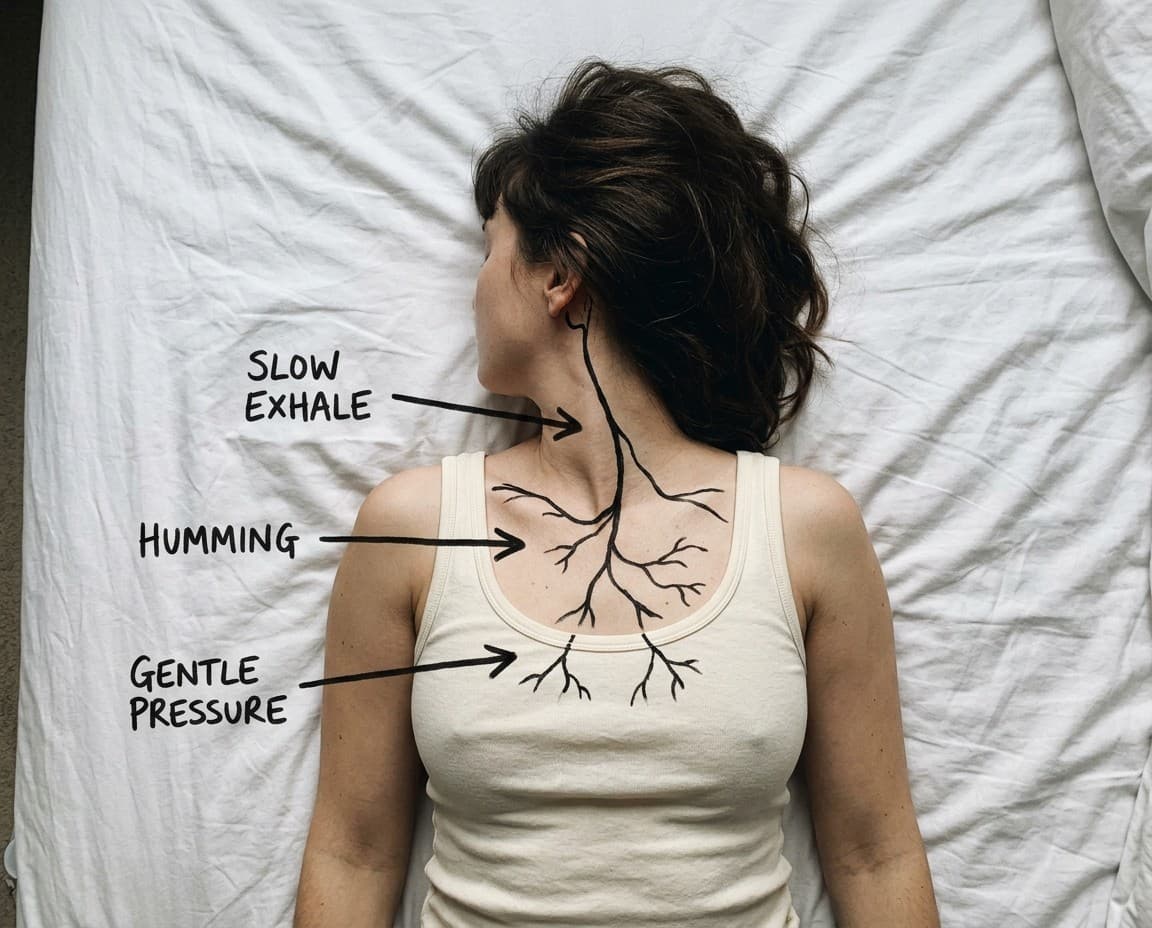
The vagus nerve is unusual among nerves in that it is roughly eighty percent afferent, meaning it carries far more information from the body to the brain than from the brain to the body. The implication is that you do not talk your nervous system into safety with thought. You signal safety to it through the body, and the brain reads those signals as evidence that the emergency is over.
The signals the vagus nerve responds to are surprisingly specific. Slow exhales that are longer than the inhale. Gentle pressure or vibration along the vagal pathway (the throat, the chest, behind the ears, along the soft sides of the neck). Humming and voiced sounds that engage the vocal folds, which are directly innervated by the vagus. Sustained gaze with a safe face. Rocking, swaying, and rhythmic movement at low intensity. Posture that opens the front of the throat rather than collapsing it. Eye movements that draw the gaze laterally without urgency. Touch on the chest or belly with attention rather than pressure.
What ties all of these together is that they are body inputs, low effort, sustained, and matched to a body that is already tired. The system does not need to be persuaded. It needs to be shown.
What the vagus nerve will not respond to, especially in a fried system, is the kind of input most wellness content recommends to a person in this state. "Just breathe deeply" is often actively counterproductive for a system in defensive activation, because forced deep breathing in an already-tense body can increase chest tightness and heart rate. "Do some yoga" is too generic and too physical for a body in shutdown. "Try meditation" requires a baseline of regulation that the depleted nervous system does not yet have. The advice was right in spirit. It was wrong in dosage and order.
What works, in the trial literature and in years of somatic practice, is a sequenced protocol. Start where the body actually is. Use very low-effort vagal inputs first. Build vagal tone gradually before asking the system to handle more. Move from shutdown into mild activation, from mild activation into regulation, from regulation into trust. Do this on enough days that the new pattern becomes the default state rather than a brief visit. Most people who follow a protocol like this notice changes in sleep and stress within the first week. The deeper changes take longer.
The protocol Neurotoned built is exactly that kind of sequence. Short daily practices, in the right order, calibrated for a body that does not have energy to spare, with an on-ramp for the days when even starting feels like too much.
Why we built this. And who we asked to build it.
Neurotoned exists because the work that actually helps a stuck nervous system lives in clinics most people cannot get to. A good somatic therapist charges between one hundred fifty and two hundred fifty dollars a session and is usually booked for months. Trauma-informed bodywork is even harder to find. For people in chronic survival mode (which, as far as we can tell, is a significant slice of the population) the work is real and the access is impossible.
Our argument is that much of this work can be taught. The polyvagal theory and the somatic field have produced a body of practices that are reproducible, low-risk, and effective when delivered in the right sequence. A home protocol, taught well, by a practitioner with the right depth of training, can do meaningful work for the right person.
For the Vagus Nerve Reset, we needed a practitioner who could hold three things at once. We needed somebody with formal training in Western psychology, because the audience is regulating both body and mind. We needed somebody with deep, long-form training in body-based practice, the kind that takes years of supervised somatic training rather than a weekend certification. We needed somebody who teaches as well as she practises, because filming a protocol that will be followed by thousands of bodies the practitioner will never meet is a different craft from one-on-one work.
We found that in Taryn Elise Herselman.

Taryn Elise Herselman is a Johannesburg-based somatic practitioner and nervous-system specialist with fifteen years in somatic practice. She holds an MA in Psychology, and between 2008 and 2020 spent twelve years in full-time, residency-style training in body-based practice for the nervous system. She directs her own practice and training centre in Johannesburg, where she certifies other practitioners in the same body-based therapeutic work. Her work focuses on nervous-system recovery, stress-related conditions, and the somatic dimension of emotional health.
What Taryn designed for Neurotoned is a 4-week protocol that takes the sequence she has used in years of one-on-one practice, paces it for a body with no energy budget, and adds an explicit on-ramp for the days when starting at all feels like too much. The work is gentle. The work is short. The work is sequenced so that each week makes the next one easier rather than harder. There are no prerequisites. You can do the practices sitting up, lying down, in bed, in the bath, or in a chair at a kitchen table.
Each week targets a specific aspect of the system: rebuilding presence through the body, restoring energy by changing the signals the body sends upward, reconnecting safely with sensation that years of survival mode may have turned down, and finally stabilising the new regulation so it persists in real life rather than evaporating at the grocery store.
That is the program in outline. The detail follows.
What you get the moment you start the Reset.
.png)
Four guided weekly sessions plus daily practice in between. Gentle, body-based, sequenced so you can't do them wrong. 10 to 20 minutes a day. Built for people whose energy is on a budget.
A gentle on-ramp added after hearing from people who almost didn't begin because everything felt like too much. Low-effort practices that meet the nervous system in shutdown. Start here if you need to.
Fifty-three additional lessons, included free, for when the 4-week protocol leaves you wanting to go deeper. There is no rush and no expiry. Use it next week or next year.
A one-page reference for recognising whether your system is activated, shut down, or overwhelmed, and which practices match each state. Print it. Stick it on the fridge.
For the nights your brain decides 3am is a great time to rethink that text you sent in 2014. Practices specifically chosen for the sleep-onset and middle-of-night patterns most members report.
Recorded with real practitioners, in real time, with real questions from real members. The longer-form version of the weekly lessons.
So you can track what is shifting on paper, like a human being, instead of squinting at a notes app at midnight.
All of it, yours forever. The program is a one-time purchase, not a subscription. No expiry, no clock. Come back to any week in any order whenever your body needs it.
How the protocol actually unfolds.
Two or three very low-effort practices that meet a body in shutdown. No prerequisites, no sequencing. Begin here if you need to. The rest of the protocol is still waiting whenever you're ready.
Gentle practices that work with the neck, shoulders, throat, and breath to start signalling the vagus nerve that the emergency is over. Sitting, lying down, or standing at the kitchen counter.
Slow rhythmic movements that change the signals the body is sending upward to the brain. The aim is to shift the system from energy hoarding into energy restoration without forcing the transition.
After prolonged stress, body awareness gets turned down to protect the person from overwhelm. Useful at the time. Less useful now. Week 3 rebuilds the body-awareness signal gently, through touch, movement, and vibration.
Small moments of movement and awareness that help the body find steadiness without effort. Grounding practices designed to survive the transition from practice to real life so regulation does not collapse at the grocery store.
Each weekly session runs about thirty to forty-five minutes. You learn the week's practices in the session, then practise daily, ten to twenty minutes at a time, until your body has the new pattern. The workbook tracks what is shifting. The Quick Guide PDF tells you, on any given day, which practice to reach for based on how your system feels.
More time doing the work than watching someone talk about it. That is the whole design.
What people are saying
when they stop being polite.
Real people. Real words. Verified members of the Neurotoned program.
Individual results vary. The testimonials below are personal accounts of program members and are not a prediction of what your own outcome will be.
"I found Neurotoned a month ago when I was trying to recover from burnout and trauma. I was very desperate, couldn't sleep, didn't have an appetite, and my body didn't feel safe to exercise. The techniques really helped me feel better and safer in my body, helped me come back to work without overstimulation, and reduced my anxiety."
"This is a life-changer for anyone who has had a lifetime of struggling with depression and anxiety as I have been. I'm 64. Thank you Neurotoned team for your support, professionalism and expertise at an affordable price."
"Bought it at 2am while catastrophising about my catastrophising. Did the first practice the next morning in my pyjamas. By day five I noticed I wasn't white-knuckling my coffee anymore. I don't know how to explain it better than that. Something loosened."
"I'm a slow learner with serious fatigue: after a month, I am still busy integrating the techniques of Day 1 to Day 7 into my daily life. Daily practice is definitely helping me re-regulate my nervous system. I can feel the difference. Energy levels are improving. I especially benefit from the humming and the step-down."
"I was sceptical because the internet is 90% snake oil in a wellness wrapper. But this was genuinely useful. No weird upsells. No emails telling me to manifest. Just the practices, the app, and a workbook. Sleep got better in week two. That alone was worth it several times over."
"I have been going to talk therapy sessions for more than a decade and made almost no progress in battling my recurring depression. Just a few weeks of Neurotoned practices helped me so much that a truly depressed state has come back only a couple of times since and lasted only one day! Usually it takes me months to recover."
"I've got long covid and brain fog so bad I forget why I walked into a room. I was worried this would be another thing I bought and didn't finish. The sessions are short enough that I can actually do them. I've done 22 in a row. That's the longest streak of anything I've managed in two years."
"My husband asked if I'd been doing something different because I 'seemed less fried.' Told him about the vagus nerve stuff. He rolled his eyes but now HE'S doing it too and keeps stealing the workbook. One payment, both of us. Great marital investment."
Why we priced it the way we priced it.
The regular price of the Vagus Nerve Reset is $70. Compared to almost any other route into this work, that is already inexpensive. A single somatic therapy session in most cities runs between one hundred fifty and two hundred fifty. Trauma-informed bodywork is similar. A year of supplements people typically reach for in this state can run a few hundred dollars on its own. An emergency room visit, even with insurance, can cost more than a thousand for one bad night.
Neurotoned's view is that the right number of people doing this work is more, not fewer. While our current acquisition campaign is running, the price is $16.99. One payment, and lifetime access to the program. When the campaign closes the price returns to $70 and stays there.
$16.99 in context.
- · One session with a somatic therapist: $150 to $250
- · One trauma-informed bodywork session: $100 to $200
- · Six months of "nervous-system supplements" people often try: $200 to $400
- · A single ER visit on a bad night, with insurance: around $1,200
- · Doing nothing for another year: free, and you've been doing that
What happens when you click the button.
You click. You enter your email and your payment on the Neurotoned checkout. You are taken straight to your members area on the Neurotoned app. The "Too Exhausted to Start" module is right there. Week 1 of the protocol unlocks immediately. The full thirty-day program sits in your library from the first minute. The workbook PDF arrives by email alongside your login. You can be doing your first practice inside ten minutes of clicking.
One payment. Lifetime access to the program. 30-day guarantee.
The guarantee, written in plain language.
Try it for 30 days. No homework. No quiz at the end. Just watch the sessions and try a practice or two.
If it genuinely isn't for you, email us any time in the first 30 days and we refund every cent. No conditions. No forms. No "retention specialist" with a script. No three-step exit survey that politely talks itself into a pause you never asked for.
We do not ask you to prove anything first. This work has been refined over years with real practitioners, and most people feel something shift in the first week if they show up for it, so we'd rather you used the program and decided than closed the tab and wondered. If it's not for you, no biggy. The refund is yours.
The Vagus Nerve Reset is lifetime access, not a subscription. You pay $16.99 once and the whole program is yours for life, with no expiry, no renewal, and nothing you have to cancel to keep it. We say this more than once on this page because apparently some of you have been burned and honestly, fair enough.
There's no "cancel" button on the program because there's nothing to cancel. It's like buying a book. You just have it.
From here, the choice is yours.
You can close this tab and go back to the version of your week you have been living in. We are not going to argue with that. Most people in real exhaustion have closed dozens of tabs like this one.
Or you can spend $16.99, take fifteen minutes today to watch the "Too Exhausted to Start" module, and find out whether the system underneath your symptoms is something a sequenced body protocol can reach. Most people in our program feel a change in sleep or stress inside the first week. If yours is one of the few bodies that does not, the 30-day guarantee is built precisely for that.
The campaign price ends when the campaign ends. We are not playing games with the timer. The price will simply return to $70 when the deadline lapses, and there will be no warning email because the warning is this paragraph.
Yes, start the Reset · $16.99 →One payment. Lifetime access to the program. 30-day guarantee.
Thank you for reading this far.
This is a long letter and we know it. If you made it from the top, that's more attention than most people in your state of tired can hold in a single sitting, and that on its own says something about how much you want this to change. The rest of the page is FAQs.
Start the Reset · $16.99 →One payment. Lifetime access to the program. 30-day guarantee.
Honest answers to honest questions.
What exactly am I buying?
A 4-week vagus nerve reset protocol built by somatic practitioner Taryn Elise Herselman, plus a "Too Exhausted to Start" on-ramp, the full 30-day Neurotoned program, a Quick Guide PDF, sleep and recovery tools, live session recordings, a printable workbook, and lifetime access on the Neurotoned app. One payment, and the program is yours for life rather than a subscription. $16.99 during the campaign. $70 after.
Is there a subscription?
No. The Vagus Nerve Reset is one payment and the program is yours for life, with no renewal on it and nothing you have to cancel to keep it. One thing you should hear from us rather than find out on your own: on the page straight after checkout we offer you our membership, for people who want the rest of the library once these four weeks are done. It is optional, separately priced, and passing on it takes one tap and changes nothing about what you just bought. Your program is paid for either way. We get it, the internet is a minefield. We are not hiding anything, which is why this paragraph is here.
Will this actually work for me?
If your symptoms have a nervous-system component (which, given the avatar this page is written for, they almost certainly do) the protocol is designed to address the upstream state rather than the downstream symptoms. Most members notice changes in sleep and stress in the first week. The deeper changes take longer. If yours does not respond, the 30-day refund is there. Individual results vary.
I have chronic fatigue, fibromyalgia, or long COVID. Is this safe?
The protocol is gentle, somatic, and self-paced. You can do every practice lying down. There is no high-intensity work anywhere in it. That said, this is an educational wellness program and not medical advice. If you are in active medical care, loop in your provider. The Reset is a support tool, not a treatment for any medical condition.
How long does each day take?
Ten to twenty minutes. You can do it in bed. You can do it in the bath. You can do it in a chair at your kitchen table. We designed it for people who do not have energy to spare.
What if I'm too exhausted to start?
We added a module specifically for this. "Too Exhausted to Start" sits before Week 1, with a few very low-effort practices that meet a nervous system in shutdown. No prerequisites, no sequencing, no pressure. Start there. Lifetime access means there is no clock.
I've tried meditation and breathwork before and they didn't help. Why would this?
Generic breathwork and meditation expect a baseline of regulation the depleted nervous system does not yet have. The protocol works in the other direction. It builds the regulation first, in low-effort body inputs, before asking the system to handle anything that resembles traditional meditation. Most members who say nothing else worked find this is the first thing that did.
Is this only for women?
No. The protocol works on a nervous system, not on a gender. The page tone reflects the avatar most often in our community, who tends to identify as a woman in mid-life with chronic stress symptoms. The work is the same regardless of who is doing it, and the testimonials on this page include both men and women.
Why is it only $16.99?
Because we'd rather you actually do it than look at your cart and close the tab. And because if it works, you might tell someone. That is most of our marketing budget. Word of mouth, and a tired team that would rather you felt better than paid more.
How do I actually buy it?
Click any orange button on this page. The Neurotoned checkout opens. Enter your email and your card. You will be in your members area within about sixty seconds, with the "Too Exhausted to Start" module ready to begin.
One payment. Lifetime access to the program. 30-day guarantee.
P.S. If you scrolled to the bottom: the Vagus Nerve Reset is a 4-week somatic protocol built by nervous-system specialist Taryn Elise Herselman, targeting the autonomic system that runs sleep, energy, digestion, focus, and emotion. Rooted in forty years of polyvagal and somatic research. Filmed so you can do it at home, ten to twenty minutes a day, on your own body. $16.99 during the campaign. Lifetime access. 30-day guarantee.
P.P.S. The single sentence most worth taking from this letter is this. The vagus nerve does not respond to thought. It responds to body signals, sustained and sequenced, that show the system the emergency is over. Almost every previous intervention was aimed at the wrong direction of communication. The protocol corrects the direction.
P.P.P.S. If you have a question this letter did not answer, email support@neurotoned.com and a real human will reply. Replies are not instant. They are real.