
"Two Women. Same Man. Same Relationship. One Feels Safe. The Other Can't Stop Checking His Location."
The difference isn't the boyfriend. It's their nervous system.

One nervous system learned love was safe.
The other learned love was something you had to monitor, manage, and earn every single day—or it would disappear.
She sees he's quiet and thinks, "He's probably tired."
You see he's quiet and your chest tightens. Your brain starts scanning. You re-read his last text looking for clues. You draft "is everything okay?" and delete it four times.
Same man. Same relationship.
Completely different experience.
The secure woman isn't smarter than you. She isn't luckier. She isn't more loved.
Her body just learned something yours didn't.
And here's what nobody tells you:
You can't think your way into feeling secure.
You can't read enough books. You can't get enough reassurance. You can't pick a "better" partner.
Because your nervous system decided love was dangerous before you had words.
And it's still running that program. In every relationship. On autopilot.
You already know what this costs you.
- ●The "K." text that ruins your whole afternoon.
- ●The sigh that sends you into a spiral.
- ●The pause before they answer that makes your stomach drop.
- ●Your partner turning away in bed—and suddenly you're wide awake, constructing worst-case scenarios.
- ●Your kid yelling "I hate you!" and your chest reacting like it's true.
And then you start doing the thing you promised you would stop doing.
You over-explain. You chase. You test. You go cold. You snap, then hate yourself for it.
And if you're a parent, there's a second pain that lands right after.
Because you can feel your child tracking your state.
They feel the tightness. The edge. The distance.
Which creates the thought that makes people hit bottom fast: "If I don't fix this, I'm going to hand this down."
Here's the good news.
Your body can still learn what hers learned.
There's a simple "pre-moment" method that turns the alarm down before you spiral, shut down, or over-explain.
Not after. Before.
This is the missing piece most people never learn, even in years of trying.
In the next few minutes, I'm going to show you:
- Why you're calm all day, then fall apart with your partner or kids.
- The three "alarm styles" that create anxious, avoidant, and disorganized loops.
- Why talk, insight, and scripts fail the moment your body clamps down.
- And the small daily step that makes change stick because it targets the root, not the regret.
Because the fastest way out is not trying harder. It's learning what to do in the 5 seconds before your body hits the panic button.
Who I Am, and Why I Know This Works

My name is Laurie James.
I'm a Certified Professional Coach, Somatic Experiencing® Practitioner, and for the past 15 years, I've specialized in one thing:
Helping people become more embodied so they feel safe in their bodies.
I've trained under Dr. Diane Poole Heller, who pioneered attachment repair for adults, and in the lineage of Dr. Peter Levine, who proved that trauma lives in the nervous system, not just the mind.
But here's what matters more than credentials.
I've sat across from hundreds of people who sound exactly like you: Smart. Self-aware. Desperate to stop the pattern.
And I've watched them try everything.
Talk therapy that gave them insight and awareness but no relief. Couples counseling where they learned scripts but still felt the anxiety. Read self-help books that gave them some tools but didn't make them feel different.
And the most heartbreaking part?
They blamed themselves for it not working.
But here's what I learned in 15 years of energy work, coaching and somatic practices:
You can't think your way out of a body alarm.
Because the part of you that reacts when your partner pulls away sends signals to your amygdala that you aren't safe.
Your survival system that formed before you could talk may have learned early that love meant danger...
Whether through abandonment, unpredictability, criticism, neglect, or chaos...
It installed a smoke alarm inside you.
This alarm turns your prefrontal cortex off, so you no longer think rationally.
And after repeated negative experiences, that alarm goes off at the slightest wisp of smoke.
Even when there's no fire.
And here's the upside…you can rewire your nervous system for safety. It begins when you listen to your body. Allowing yourself to be with the sensations and emotions in small tolerable ways, showing your nervous system (not telling it) that you are safe.
The Real Reason Everything You've Tried Hasn't Worked
You already know your attachment style.
You've read Attached. Followed therapists on Instagram.
And that knowledge helped, at first. It gave you language.
But then you hit the wall.
Because knowing why you do it doesn't stop you from doing it.
The reason insight doesn't fix it is because your attachment loop doesn't start in your thoughts.
It starts in your body. In the split-second before you consciously feel anything.
Here's what actually happens:
Your partner says something. Or their tone shifts half a degree.
And before you even register what happened… your body has already decided: "Not safe."
In that instant—literally a fraction of a second:
- ●Your amygdala fires.
- ●Your nervous system floods with cortisol and adrenaline.
- ●And suddenly you're in fight, flight, freeze, or fawn.

By the time your conscious mind catches up… the alarm has already gone off.
And now you're trying to talk yourself down from a reaction that happened before language even came online.
This is why CBT doesn't work for attachment wounds.
This is why "just communicate better" doesn't work.
Because you're trying to override a survival response with logic.
And survival doesn't speak logic. It speaks sensation.
The Three Alarm Styles
Depending on what happened to you early, your body installed one of three alarm systems.
Alarm Style #1: The Hypervigilance Alarm (Anxious Attachment)
This alarm never turns off. It's always scanning for signs that the other person is pulling away.
If this is you, you know what it's like to:
- •Wake up to a "good morning" text and feel a wave of relief. Then wake up to no text and immediately start constructing worst-case scenarios.
- •Have a perfectly fine conversation with your partner… then replay it 47 times that night, looking for the exact moment their energy shifted.
- •Check their location. Again. And again. And again. Not because you think they're cheating, but because seeing that little dot on the map means they're still there.
- •Draft a text, delete it, rewrite it, delete it again. Spend 20 minutes trying to sound "casual" when asking if everything's okay.
Because if you sound too needy, they'll see you're too much.
And if they see you're too much, they'll leave.

You know what it's like to feel your chest tighten when your child won't look at you, when your partner sighs while you're talking, or when someone says "We need to talk" and your whole nervous system goes into red alert.
You might have grown up with a parent who was:
- —Inconsistent. Loving one minute, cold the next.
- —Emotionally unpredictable. You never knew what would set them off.
- —Or just…gone. Emotionally absent. So you learned that love meant longing.
And now, as an adult, your alarm says:
"If I'm not constantly checking, they'll leave"
"If I let my guard down, I'll be blindsided."
"If I need too much, they'll see I'm too much and they'll go."
So you chase. You check. You test. You need reassurance, then feel ashamed for needing it.
And the worst part?
The more anxious you get, the more your partner pulls away.
Which proves your alarm right.
Which makes it louder.
Alarm Style #2: The Shutdown Alarm (Avoidant Attachment)
This alarm says: "Don't get too close."
If this is your alarm, you don't panic the same way.
You don't chase or check or spiral. You pull back. You go cold. You disappear into yourself.
- •Feel genuinely fine when your partner travels. You kind of prefer it. The space. The freedom.
- •Feel suffocated when they come home and want to "reconnect." Trapped.
- •Get accused of being "emotionally unavailable" and not understand what they want.
You show up. But somehow that's not enough. They want more. They always want more.
And the more they want, the less you have to give.

You might have grown up with a parent who:
- —Punished emotion. So you learned that feelings were weakness.
- —Was intrusive or controlling. So you learned that closeness meant losing yourself.
- —Or was just…too much. So you learned that love meant obligation.
And now, as an adult, your alarm says:
"If I let them all the way in, they'll trap me."
"If I need them, I'll lose my freedom."
"If I show vulnerability, they'll use it against me."
So you keep a distance. Even when you love them. Because the closer they get, the more your body wants to run.
And the worst part?
The more you pull away, the more your partner chases.
Which proves your alarm right.
Which makes you need even more space.
Alarm Style #3: The Whiplash Alarm (Disorganized/Fearful-Avoidant Attachment)
This is the alarm that fires in both directions.
You want love. Then you panic when you get it.
You chase closeness. Then you shut down the moment someone gets close.
If this is your alarm, you know what it's like to:
- •Feel desperate for connection one hour. Then suffocated by it the next.
- •Crave your partner when they're away. Then feel overwhelmed, trapped, irritated when they're home.
- •Test them to see if they'll stay. Then push them away the moment they prove they will.
- •Say "I love you" and mean it… and also wake up feeling like you need to run.
Not because they did anything wrong. But because your nervous system can't decide if they're safe or dangerous. So it just oscillates. Back and forth. Come here, go away.
You might have grown up with a parent who was:
- —Both source of comfort and source of fear. So you learned that love and pain are the same thing.
- —Traumatizing. Abusive, neglectful, terrifying.
- —Or just…impossible to read. One day warm, the next day raging.
And now, as an adult, your alarm says:
"I need you" and also "Don't come too close."
"I love you" and also "You're going to hurt me."
"Please stay" and also "I can't trust you."
So you're trapped in a loop that makes no logical sense. But it makes perfect nervous system sense. Because your body learned that love is a threat.
And the worst part?
Your nervous system is stuck in a double bind.
It can't feel safe with someone and can't feel safe without someone.
So it just…never feels safe.
Whichever alarm you have, here's what they all share:
- They were installed early. Before you had a choice.
- They formed in the moments when you needed safety and didn't get it.
- When you cried and no one came.
- When you reached out and got rejection.
- When you were scared and the person who was supposed to protect you was the one scaring you.
And your nervous system learned: "This is what love feels like."
Unpredictable. Conditional. Dangerous.
And now, 20, 30, 40 years later… that's still the program running.
Not because you're broken.
But because your body is doing exactly what it was trained to do: Protect you from the pain that closeness once caused.
And here's the part that probably keeps you up at night:
You can see it starting in your kids.
You watch your 6-year-old cling to you at drop-off, and you recognize the panic in their eyes. The same panic you feel when your partner doesn't text back.
You see your 10-year-old shut down when you try to talk about feelings, and you recognize the wall going up. The same wall you put up when someone says "Can we talk?"
You hear your teenager say "Why do you even care?" and you hear the fear underneath. The same fear you carry: that letting someone in means getting hurt.
And you think: "Oh god. I'm passing it on."
Not because you're yelling at them. Not because you don't love them. But because they're watching you.
They feel your nervous system.
They track your face when your partner texts you late at night. They notice when you go quiet after a conflict. They absorb the tension in your body when someone disappoints you. They see you checking your phone over and over. They watch you pull away when Dad tries to hug you. They feel you tighten when they say "I love you."
And they're learning the same thing you learned:
That love is something to brace for. Not something to rest in.
And the worst part?
You can already see where this is heading.
Your daughter is going to grow up and pick partners who make her feel this way.
Partners who are hot and cold. Who make her question if she's too much. Who trigger that same alarm you're trying so hard to manage.
And one day, 20 years from now, she's going to be sitting in a therapist's office saying:
- "I don't know why I keep doing this."
- "I know he's not good for me."
- "I know I deserve better."
- "But I can't stop."
And you'll realize: She learned it from watching you.
Your son is going to grow up unable to talk about his feelings. He'll shut down when his future partner tries to get close. He'll say "I'm fine" when he's falling apart inside. He'll build the same wall you built. And his relationships will suffer the same way yours have.
Not because he doesn't want love. But because his nervous system learned—from watching you—that vulnerability is dangerous.
Your teenager is going to date people who hurt them. And you're going to watch, helpless, as they spiral through the same anxious-avoidant dance you've been dancing for decades.
And you'll want to say: "Don't do this. I know where this leads."
But how can you tell them to do something different…
When they watched you do the same thing their entire childhood?
This is what makes attachment wounds so cruel.
They don't just hurt you.
They echo forward.
Into your children.
And potentially into your grandchildren.
Unless someone breaks the cycle.
The Solution: Retrain the Alarm
Now here's the part where everything changes.
Because once you understand that the problem is a body alarm… the solution becomes clear.
You don't need to fix your thoughts. You need to retrain the alarm.
Your nervous system can learn new patterns. Even if the old pattern has been running for 30 years.
Your attachment style is not your personality. It's a learned response.
And what was learned can be unlearned.
Not through willpower. But through repetition of a new experience.
The same way your body learned that closeness means danger… it can learn that closeness means safety.
But it needs to learn it the way it learned the first pattern: Through the body. Through felt experience.
Through small, repeated moments that say: "You're safe. You're safe. You're safe."
Until your nervous system finally believes it.

This is what I call Love Conditioning.
Here's how it works in 3 steps:
Interrupt the Alarm Before It Fires
If you can catch the alarm before it fully activates… you can redirect it. Not by forcing calm. But by giving your body a micro-experience of safety. A 60-second somatic circuit that speaks the language your nervous system understands: Sensation.
Train Safety Through Repetition
One moment of feeling safe doesn't rewire the pattern. But 28 days of moments does. Every time you redirect the alarm, you're weakening the old pattern. Every time you experience closeness without disaster, you're teaching your body: "Maybe love doesn't have to hurt."
Build Inner Safety As the Foundation
If your nervous system doesn't feel safe inside your own body… no amount of external reassurance will work. This is why Love Conditioning starts with inner safety. You teach your body how to feel safe alone. So that when you do connect with others… you're connecting from wholeness. Not desperation.

How This Program Was Born
About three years ago, I was working with a mother of two. Let's call her Sarah.
She was anxious-attached. She'd read every book. Been in therapy for years. She understood exactly why she did what she did. But she couldn't stop doing it.
The checking. The testing. The 3 AM panic attacks when her husband rolled over in bed.
And then one night, her 8-year-old daughter said: "Mommy, why are you always sad?"
And Sarah realized: Her daughter was watching. Learning. Absorbing the message that love means anxiety.
And something in her snapped. Not in a bad way. In a "this ends now" way.
She came to our next session and said: "I don't care how long it takes. I don't care what I have to do. I cannot pass this on to her."
So we got to work.
I pulled out everything I'd learned. Somatic Experiencing® techniques. Attachment repair protocols. Nervous system regulation practices.
We worked with her body, not her mind. We built micro-practices she could do in 90 seconds.
And within 4 weeks, something shifted.
She wasn't "cured." But she wasn't the same person either.
The panic attacks stopped. The obsessive checking dropped to almost nothing.
And most importantly: Her daughter said, "Mommy, you seem happy now."
That's when I knew this had to become something more than one-on-one sessions.
Because there are millions of Sarahs out there. Millions of parents terrified they're passing it down.
So I started refining the process. Testing it with different clients. Different attachment styles.
And across the board, the same thing happened:
When they trained their nervous system instead of just analyzing their thoughts… they changed.
Noticeably. Measurably. Undeniably.
Word spread quietly. And I realized: This isn't just for one type of person.
It's for anyone whose body learned that love means danger.
So I built it.
Introducing: Wired for Love: Healing Attachment Wounds Through Nervous System Regulation
This is 4 weeks of step-by-step nervous system retraining.
Designed for real life. For people who don't have 2 hours a day to meditate.
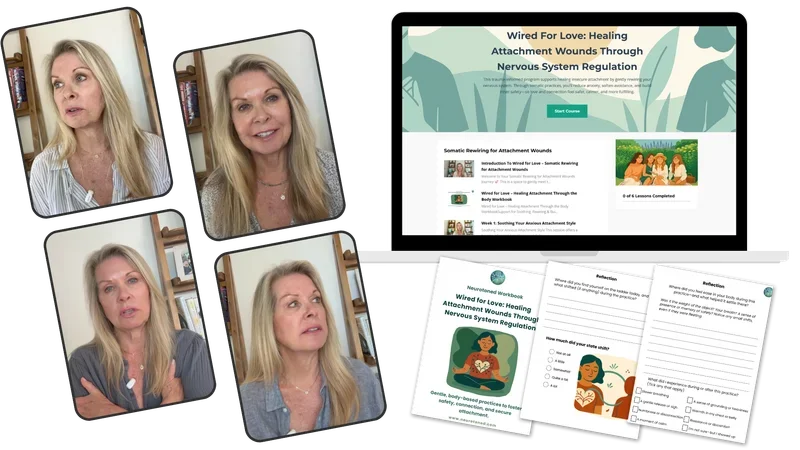
Here's what you get:
Four Weekly Modules
- Week 1: Soothing the anxious alarm
- Week 2: Softening the avoidant shutdown
- Week 3: Reducing Overwhelm and Finding More Safety Within Your Body
- Week 4: Becoming More Secure Through Connection
Each includes:
- ● A short teaching video
- ● The exact micro-practices (demonstrated)
- ● Why each practice works
Daily Practice Circuits (60-90 seconds each)
Every week includes guided teaching sessions that show you the practices. Once learned, the core practices take just 60-90 seconds daily.
Simple, body-based practices you can do anywhere.
No apps. No timers. No perfect conditions required.
You can do them:
- ●Before you check your phone in the morning
- ●In the bathroom at work
- ●Right before a hard conversation
- ●The moment you feel the alarm starting
These aren't meditation exercises. They're somatic circuits designed to interrupt the alarm before it fully activates.
Think of them like reps at the gym. Except instead of building muscle… you're building a new neural pathway.
Lifetime Access
You're not on a clock. You can go at your own pace. Repeat weeks if you need to.
Because healing isn't linear.
Why The Alternatives Keep Failing You
Talk Therapy ($150-$300/session)
Can help you understand why you panic. But can't stop the panic from happening. I've had clients who spent 5, 10, even 15 years in therapy and still panic when their partner doesn't text back.
Self-Help Books ($15-$30)
Education matters. But you can know you're being irrational and still feel the panic. Information is step one. But it's not the destination.
Couples Therapy ($200-$400/session)
Can teach communication. But if your nervous system is in alarm mode, your prefrontal cortex goes offline. You're in survival mode. You can't access "I statements."
Meditation Apps ($10-$15/month)
Help you calm down after you're already activated. Don't prevent the activation in the first place. And when you're in full panic mode… you're not going to remember to open the app.
What you need isn't a way to calm down after.
You need a way to interrupt the pattern before it fully fires.
That's what this program does.
The Real Cost of Doing Nothing
Let's talk about what it costs to not address this. Not in dollars. In life.
What does it cost you to keep checking your phone 100 times a day?
- The focus you lose.
- The work you can't concentrate on.
- The presence you can't give your kids because half your brain is tracking your partner.
- The self-respect that erodes every single time you do it.
What does it cost you to keep picking fights over nothing?
- The damage to your relationship that accumulates over time.
- The resentment that builds.
- The way your partner starts walking on eggshells around you.
- The way they stop trying because nothing they do is ever enough.
What does it cost you to keep shutting down when someone tries to get close?
- The loneliness.
- The distance.
- The way your spouse looks at you like they've given up.
- The intimacy you're losing that you can never get back.
What does it cost you to keep passing this pattern to your children?
That's the one that probably keeps you up at night.
Because you can see it already.
- Your daughter who clings too tight. Who's going to grow up thinking she's "too much."
- Your son who won't talk about his feelings. Who's going to grow up unable to connect deeply.
- Your teenager who picks partners who hurt them. Who's going to repeat your mistakes.
And you think:
- "This is my fault."
- "I did this to them."
- "I should have fixed myself before I had kids."
But here's the truth:
You can't change the past.
You can't un-live the childhood you had.
You can't go back and give your kids a different version of you.

But you can change what happens from today forward.
You can be the one who breaks the cycle.
You can be the parent who does the work.
Who shows your kids that healing is possible.
Who models what it looks like to feel safe in love.
And 20 years from now…
When your daughter is in a healthy relationship…
Or your son can talk about his feelings without shutting down…
They won't thank you for being perfect.
They'll thank you for showing them that change is possible.
My Personal Mission
I've sat across from too many people who've been told: "You're too sensitive." "You're too needy." "Just get over it."
People who've spent decades believing they're broken.
You are not broken.
Your nervous system learned a pattern early. And with the right approach, it can learn a new one.
That's not false hope. That's neuroscience.
I built this program because I believe every person deserves to feel safe in their own body.
Safe in love. Safe in closeness.
And I believe that healing is possible. Not someday. Now.
What People Say About Neurotoned
Verified reviews on Trustpilot
★★★★★
"I am completely taken by surprise! I purchased the wired for love program, and by week two I started recalling funny experiences from my childhood years, accompanied by tears and unexpected emotions . By week three my neck pain was surprisingly almost gone completely. My relationship with my husband and son improved significantly. I feel calmer and l think I got out of the fight or flight mode. Thank you."
★★★★★
"I have purchased two programs, the wired for love one and the unburdening the body. Both have been great, but the wired for love left me speechless. I literally healed my neck and found myself crying like a child and felt that it was working even after the sessions. The trauma was healing like pealing an onion, layer after layer. I even send them a message to let them know how grateful I was. Great work, better than I ever expected."
★★★★★
"I’ve really enjoyed the Neurotoned trainings. They break down nervous system regulation and attachment healing in a way that’s easy to understand and actually usable, not overwhelming or overly clinical. The content feels thoughtful, supportive, and practical. Definitely recommend if you’re interested in nervous system work that actually makes sense."
★★★★★
"The first time in years that I felt completely understood and had real confidence that I am not broken and that there’s a way to heal...."
★★★★★
"I've tried many programs with no noticeable impact, making me feel like I'm the problem. On the other hand, Neurotoned makes me feel welcomed, nurtured and supported."
How Much Does True Safety Cost?
If you went the traditional route…
- Weekly therapy for a year: $10,400
- Couples therapy: $10,000+
- Total: Over $20,000 and years of your life.
And most people who do all of that still don't feel fundamentally different.
This program? Normally $70.
But right now, through this page only, you can join for $16.99.
I'm doing this because I know the people who need this most have often already spent thousands trying to fix this.
And I refuse to let money be the reason someone doesn't heal.
$16.99. Less than a therapy co-pay. Less than dinner out.
For lifetime access to a method that can genuinely rewire your nervous system.
Here's What Happens When You Join
Click the button below
Enter your information (takes 2 minutes)
Get instant access to all 4 weeks
Start Week 1 today
Plus, You're Covered By Our 30-Day Money-Back Guarantee
Try the program. Go through all 4 weeks. Actually try this work.
And if 30 days from now you don't feel noticeably different… just email us at support@neurotoned.com.
No hoops. No hassle.
Because we know this works.
We've seen it work for too many people to have any doubt.
But I also know you've been burned before.
You've been promised results and gotten nothing.
You've invested money you couldn't afford on solutions that made things worse.
You've felt the sting of hope followed by disappointment so many times that hoping again feels dangerous.
I understand that.
I respect it.
Which is why we're shouldering all the risk. You risk nothing.
Try Neurotoned for 30 full days.
If it's not for you, you pay nothing.
If it is for you, it could change everything.
Plus You Get These Bonuses:
Bonus #1: The Trigger Interrupt Guide
A quick-reference PDF organized by situation.
- "When you're spiraling about a text" → Page 3
- "When you're shutting down" → Page 5
Bonus #2: Parenting with a Healing Nervous System
- ● How to co-regulate when you're both activated
- ● What to say when your kid triggers your wound
- ● How to repair after you react in a way you regret
The goal isn't to never get triggered. It's to model repair.
Bonus #3: Full 30-Day Neurotoned Membership Program
Complete access to the core Somatic Rewiring for Attachment Wounds program with Laurie James.
Includes 4 weeks of guided sessions, companion workbook, and audio tracks. Lifetime access.
Bonus #4: Unburdening the Body Program
Somatic Tools to Process Shame, Guilt & Suppressed Emotions with Candice Winterboer.
4-week program covering emotional lifecycle, guilt patterns, shame healing, and befriending emotions. Lifetime access.
$16.99 today. Lifetime access. 30-day guarantee.
You Have Two Choices
Choice 1:
Keep doing what you've been doing. Keep reading books. Keep understanding your attachment style. Keep watching your kid mirror your anxiety.
Hope is not a strategy. Understanding is not healing.
Choice 2:
Actually try something different.
Join this program. Train your nervous system. Give yourself 4 weeks.
And if it doesn't work, you get your money back.
But what if 30 days from now:
- You only checked your phone twice instead of 47 times.
- You stayed in the room during conflict instead of shutting down.
- Your chest didn't tighten when your kid said "I hate you."
What if this is the thing that actually works?
But You Need to Decide Now
- Reason #1: This $16.99 price is only available through this page. Close this page and it's gone.
- Reason #2: You'll never feel "ready." Your anxiety will always have a reason to wait.
- Reason #3: Every day you wait is another day in the pattern. Each time you interrupt it… you're building the new pathway.
4 weeks from now, you could be living in a different reality.
Or you could still be here, promising yourself you'll change.
Listen to What Your Nervous System Is Telling You
If you're still here, something resonated.
Maybe it was the part about your body deciding "not safe" before you even know what's happening.
Maybe it was recognizing yourself in one of the alarm styles.
Maybe it was the fear about passing this to your kids.
Whatever it was… that's your nervous system saying: "I'm ready."
Listen to that voice.
You deserve to feel safe in love.
You deserve to be the one who breaks the cycle.
I'll see you inside.
Laurie James, LPC
Somatic Experiencing® Practitioner
P.S. - Still not sure?
Q: How is this different from therapy?
Therapy helps you understand. This retrains. Many clients do both.
Q: What if I don't have time?
The guided sessions teach you the practices. Once learned, each takes 60-90 seconds. You have time.
Q: How long until I see results?
Most notice a shift in Week 1. Changes are usually undeniable by Week 4.
Q: Can I really get my money back?
Yes. 30-day money-back guarantee if you give a fair try and it's not for you.
One Last Thing:
A client sent me a photo last month. Her daughter's kindergarten worksheet.
"My mom is the best at making me feel safe."
She wrote: "Two years ago, my daughter would have said I was good at worrying. This program didn't just change me. It changed what I'm passing down."
That's what this is really about.
Becoming the person who feels safe to come home to.
For your kids. For your partner. For yourself.
And that's worth $16.99.
Let's start today.
Laurie