
Stop guessing which practice will help today. Get the one built for the state you’re actually in.
Neurotoned is a nervous-system membership. 17 programs built by practitioners, short daily practices you can do lying down, two live group calls a month, and a plan that re-matches itself as your state changes. Free for 7 days, then $5.22 a month.
Most of the practices are done lying down. That is not a concession for beginners, it is where a braced system can actually take the input.
First, is this even for you?
Six questions. Answer them honestly in your head, and count.
Do you fall asleep fine, then wake at 3am with your heart already going?
Are you tired in a way that a full night's sleep does not touch?
Have you snapped at someone you love this week over something that did not matter?
Do you go quiet and far away when it gets to be too much, rather than loud?
Have you been told to just relax, by someone who meant well?
Have you tried the apps, the breathing, the podcasts, and quietly concluded that the problem is you?
If you said yes to two or more, you are in the right place, and the rest of this page is worth seven minutes. If you said yes to none of them, close the tab with my blessing. This was not built for you.
Nearly everybody who ends up here has already tried more than enough. That is the problem. Not the effort.
So here is what I am going to show you, in order.
- Why the same breathing exercise calms you on Tuesday and tightens your chest on Thursday, and the one thing that decides which
- The reason a meditation streak is the wrong measure entirely when your system is depleted
- What actually changes first when this works, and it is not your mood
- What 7 free days looks like, hour by hour, before you spend anything
Before the price
Which of these hits closest to home right now?
Pick the one that feels most true today
Why the last thing you tried stopped working
You are not short of information. You know what the vagus nerve is. You can explain your own symptoms better than most people could. What you have not found is something that works on the days you have nothing left.
Here is the honest read on each of the usual answers.
Yoga and stretching classes. A class runs on shapes, and on a room of people moving at one pace that is not yours. Holding a posture asks a braced body to perform while it is still braced, which is why you can leave one session looser and the next one wound tighter, with no idea what changed. Nothing here is held for the sake of holding it, and most of it happens lying down.
Medication. Doing a real job, and not ours to touch. Keep taking what you were prescribed and keep your prescriber in the loop. Medication can turn the volume of the signal down; it does not teach a body the way back down by itself, which is why the 3am wake-ups and the braced jaw often outlast the dose. Plenty of members do both, and say each one started working better once the other was in place.
Meditation apps. Built for a body that has already settled. Sitting still with your eyes closed hands a revved-up system a bigger room to move around in, and gives a shut-down one nowhere to go. Most people blame their own discipline for this. It is a design mismatch.
Breathwork off the internet. One instruction for everybody. A long exhale settles an over-revved system and can flatten one that is already flat. That is why it helps on Tuesday and backfires on Thursday, and why you could never find the pattern.
Talk therapy. Worth keeping, and not the same job. Insight arrives in language. The thing running your heart rate at 3am does not read language. Plenty of members do both, and say each one started working better once the other was in place.
Rest, holidays, early nights. You have already run this test. A week away and it lifts, then it is back by the second Wednesday. Rest restores a body that can still drop out of alert on its own. It does very little for one that has forgotten how, and that forgetting is the actual problem.
Discipline. You have never been short on it. That is usually the finding rather than the fix. Pushing a depleted system harder is the input that got it stuck, so more of it reliably buys less.
Look at what those have in common. Every one is aimed either above the problem, at thoughts and meaning, or at the symptom once it has already arrived. None of them is aimed at the thing setting the level.
The thing setting the level
Underneath mood and thought sits the autonomic nervous system. It runs your heart rate, your digestion and your sleep, and it makes one decision constantly and far below thought. Is it safe enough here to rest and recover, or do I need to stay ready?
After enough years under load, and load includes a demanding job, a small child, an illness, a grief, a bad decade, it stops moving freely between those settings. It sticks on ready. Or, when ready has cost too much for too long, it drops into the other protective setting: flat, heavy, far away.
Both are protection. Neither is a personality. And neither responds to being reasoned with, which is why understanding your pattern perfectly and still living inside it is the most common place people get stuck.
You can’t talk a nervous system into safety. You can show it.
The part the free lists leave out
The inputs that reach this system are physical and unglamorous. A long exhale. A low hum in the chest. Light pressure at the base of the throat. Eyes moving slowly around the room until the body registers that nothing here is coming for you. Roughly eighty percent of the fibres in the vagus nerve carry information up from the body to the brain, so the body is where the message goes in.
You can find all of that for free in an afternoon. Plenty of people do. And then it stops working by week two, for a reason nobody tells them.
The right practice depends entirely on the state you are in when you start it. A long slow exhale settles a revved-up system and pushes a shut-down one further down. The small activating work that brings a flat system back online winds a wired one tighter. Same exercise, opposite outcome, and if you happened to pick wrong you did not conclude "wrong match." You concluded "this does not work for me either."
Two people can do the identical practice and one comes out calmer while the other comes out worse. They started in different states.
Where your system sits
Wired
sympathetic
Braced. Heart going, jaw set, cannot switch off.
Settled
ventral vagal
The only state where the body repairs, digests and recovers.
Shut down
dorsal vagal
Flat, heavy, far away. Still, but not resting.
What you have been doing
One routine, every day
- The same practice whether you are wired or flattened
- Works some days, backfires others, and you cannot see the pattern
- A missed day reads as a discipline problem
What this does instead
The practice for today's state
- One question decides what you are handed
- Wrong-state practices are simply not offered to you
- A bad day gets you a shorter one, not a lecture
Which is the whole reason this is a membership rather than a course. A course hands everybody the same sequence on day one. Your state is not the same on day one and day nine, so the thing choosing your practice has to know which day it is.
How that works, in practice, every day
One question when you open the app reads whether you are regulated, activated or depleted. What you are handed next is built for that answer. Not a fixed routine you push through on a day it does not fit.
Check in
One question, about ten seconds. Regulated, activated or depleted.
Practice
You are handed the practices built for that answer, sized for the day you are having.
Keep what works
Anything that lands goes to your toolbox, one tap away next time.
A daily check-in that decides what you practice. One question a day reads whether you are regulated, activated or depleted, and what you are given next is built for that answer. This is the part that makes everything above it work.
17 programs, in a deliberate order. Structured start to finish, not a pile of clips. Short practices you can do lying down, in a parked car, before a meeting. A new stretch unlocks each week so you are never staring at all of it at once.
Two live group calls a month. Real practitioners, the ones who built the programs. Ask a question, practice together, or keep your camera off and just listen. Every call is recorded, and the replay lands on your account with notes.
Progress you can actually see. A trend line of your check-ins, how far you have shifted since you started, and eight regulation milestones. The point is the trend, not a perfect record.
One free spot for someone else. A partner, a sibling, whoever holds you up gets their own full account on your plan, for as long as you are a member.
Your nervous system toolbox. The practices that worked for you, saved in one place, for the moment you need them and cannot think straight.
A guide in the app, and a buddy if you want one. An AI guide that knows the library and can point you at the right practice, plus optional matching with another member on a similar path. Ignore either entirely if you would rather work alone.
The community. Comment, ask, and read other people's weeks. Members only, moderated, and quiet by design.
Nothing is held back for a higher tier. One membership, all of it.
Who built the practices
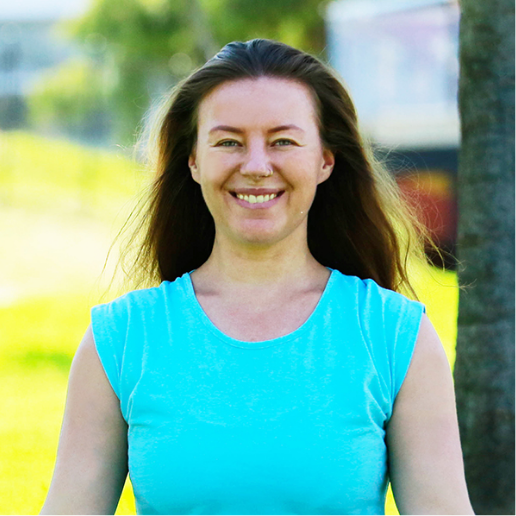
Taryn Elise Herselman
Somatic practitioner, body-based therapeutic work
MA Psychology · 15+ years clinical practice
A Johannesburg-based somatic practitioner with fifteen years in clinical practice, twelve years of residency-style study in India, and an MA in Psychology. Her work centres on nervous-system recovery: stress, exhaustion, and the body's part in emotional health. The practices here were built around what a braced or shut-down system can actually absorb, which is why most of them are done lying down and none of them ask you to hold a shape.
What is in the library
Real programs, built by practitioners. Your answer above decides which of these you start with.
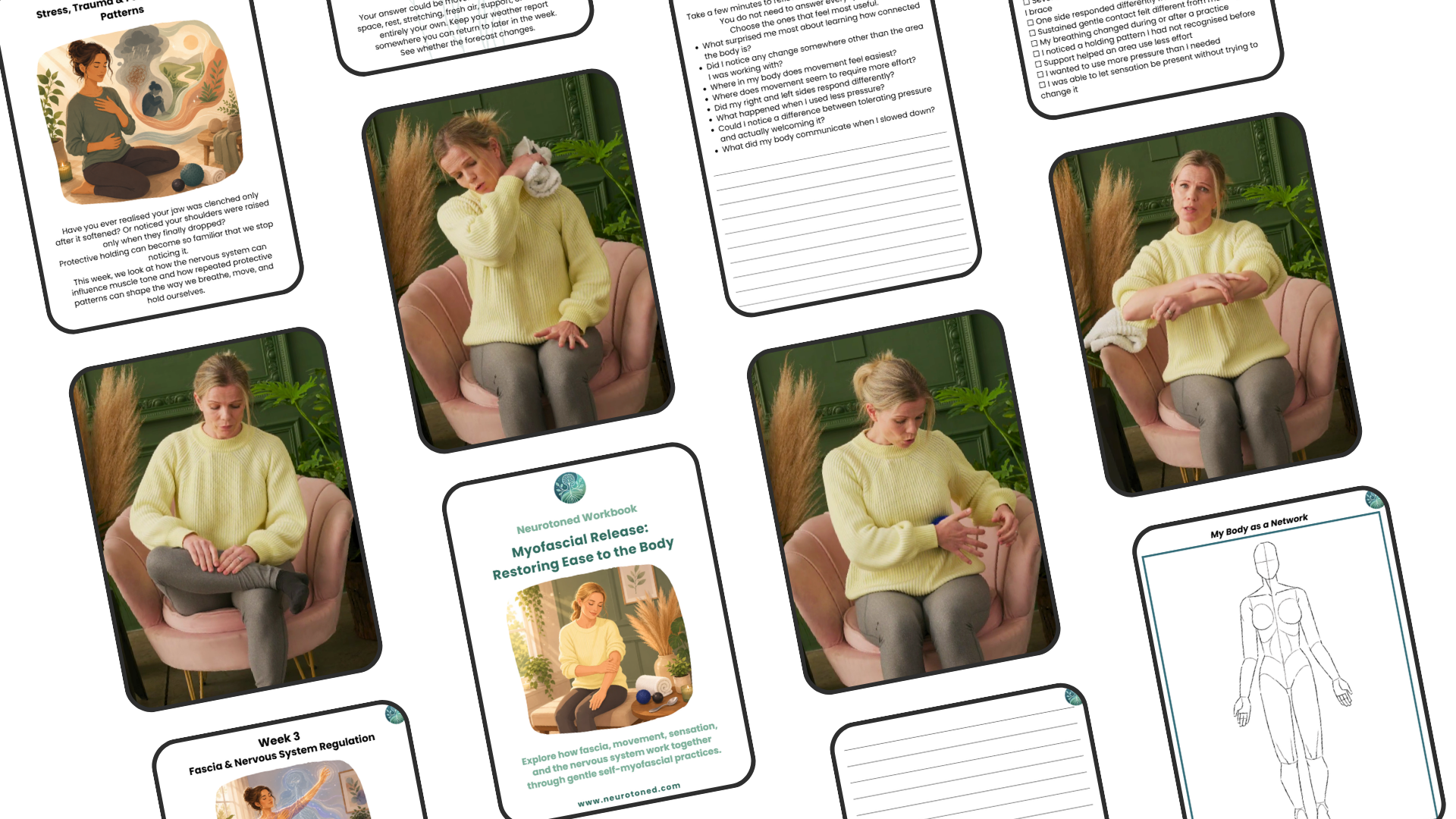
Myofascial Release: Restoring Ease to the Body

Holding & Letting Go: Integrating Grief, Loss & Life Transitions Through the Body

Wired For Love: Healing Attachment Wounds Through Nervous System Regulation

Unburdening the Body: Somatic Tools to Process Shame, Guilt & Suppressed Emotions

The Vagus Nerve Reset: 4-Week Somatic Protocol

Unwinding Anxiety Spirals: Coherence and Bilateral Rhythm for Steadiness
What changes, and roughly when
No promises about your outcome. This is the shape members describe, and it is deliberately unglamorous.
First week
You find the two or three practices that land for you, and you stop doing the ones that do not. Most people notice the exhale getting longer before they notice anything else.
Weeks two to four
Sleep is usually the first thing to move, or the 3am wake-up gets shorter. Jaw and shoulders let go before mood does.
Month two and three
The gap between a trigger and your reaction widens. Not gone, wider. This is the change people describe as feeling like themselves again.
After that
You reach for the practices without deciding to. Bad weeks still happen, and they stop costing you a month.
90 sec
Shortest practice in the library
2 a month
Live calls with practitioners
1 question
Decides your day's practice
30 days
Money-back guarantee
What members say
“I’m really enjoying this program, it’s making a big difference to my wellbeing. I like the daily practices and I now have a good toolkit to draw on. My nervous system is gently settling down and I feel I’m able to handle life better.”
“Hi, I am so glad I found Neurotoned. The gentle exercises are very accessible due to its bite-size offerings, as it allows me to fit them into my daily busy routine flexibly. I now find myself doing the breathing exercises automatically when feeling anxious. A big thank you to the Neurotoned team, you ladies are doing awesome work. Looking forward to learning more from all of you!”
“This is a very comprehensive program presented in a simple non threatening way. I am very impressed. The exercises are really helping me. I have chronic pain and have experienced emotional traumas. This was exactly what I needed. If you're on the fence about wether it's worth it, just do it! You won't be sorry!”
“I think the is easily the best resource I have ever found via the internet. Lots of gentle encouragement, but no pressure. Excellent resources that you can access in your own time. Really reasonable rates and no hidden gotchas. If anything about what they offer sounds like what you need then take the plunge. It’s not even a plunge, if you don’t want it to be ☺️”
“For many months, I was scared because I was experiencing symptoms that I thought were signs of a serious illness. I visited doctors, underwent testing, and everything seemed to be fine. One day, while scrolling through social media, I came across Neurotoned and decided to give it a try. When I started following the techniques and practices of the different coaches, my life changed. I especially loved the vagal toning exercises and orienting and grounding skills. I still practice them every day.”
“I am so pleased to have found the Neurotoned app. It has made it possible for me to access somatic practice in a way that works for me, at my own pace. Am going very slowly and gently with it, and am feeling the benefits. For me, it reaches parts of me that nothing else quite has. Thank you to all the lovely practitioners at Neurotoned!”
Individual results vary. These are members’ own accounts, not a prediction of your outcome.
What 7 free days gets you, and what it costs after
One membership, two ways to pay for it. Both open the same library, the same live calls, the same everything.
Yearly
$5.22/month$12.42
$62.58 billed once a year $149, $139 less than paying monthly
First year, then $149.00/year
Then $62.58 for your first year with your discount, then $149.00/year. Cancel any time.
Monthly
$10.08/month$24
Billed monthly. Change or stop whenever you like.
Then $10.08 a month with your discount.
For context, one session with a somatic practitioner runs $100 to $200 in most cities, and the usual recommendation is one a fortnight. That is the alternative most people reading this have already priced up and quietly decided they cannot sustain. This is $5.22 a month, for daily practice plus two live calls with practitioners, billed in US dollars.
If it is not for you
7 free days first. We take card details to start the trial, and you are not charged if you cancel before it ends.
Cancel from your account whenever you like. We ask one question on the way out and there is a skip link right next to it, so nobody gets held in a retention maze.
No silent charges. Before a trial converts we email you three times, at three days out, one day out, and on the day, each with the exact date and the exact amount. Annual renewals get two more reminders.
Try it for 30 days. Do at least the first week of your plan, and if it isn't for you, email support@neurotoned.com and we refund every cent.
Two versions of next March
In one of them you are roughly where you are now. Not in crisis. Managing. Running the same background process you have been running for years, still competent, still tired in a way sleep does not touch, still doing the arithmetic about whether you have enough left for the evening. I am not being cruel about that version. It is extremely survivable. That is exactly what is wrong with it.
In the other one, three things are different. You have found the two or three practices that work for your system, so the guessing has stopped. You reach for them without deciding to, on a bad afternoon, the way you would reach for a glass of water. And the thing that used to cost you an entire evening costs you about twenty minutes.
You are not fixed. You are not a different person. You have just stopped being someone who manages their nervous system around everything else, and that turns out to be most of it.
The distance between those two is one honest answer about the state you are in, and 7 days of finding out whether the practices match it.
You’ve been patient long enough.
Card required to start. Cancel from your account any time before day 7 and you are not charged.
Honest answers
Want to look around first? Browse the full library →